
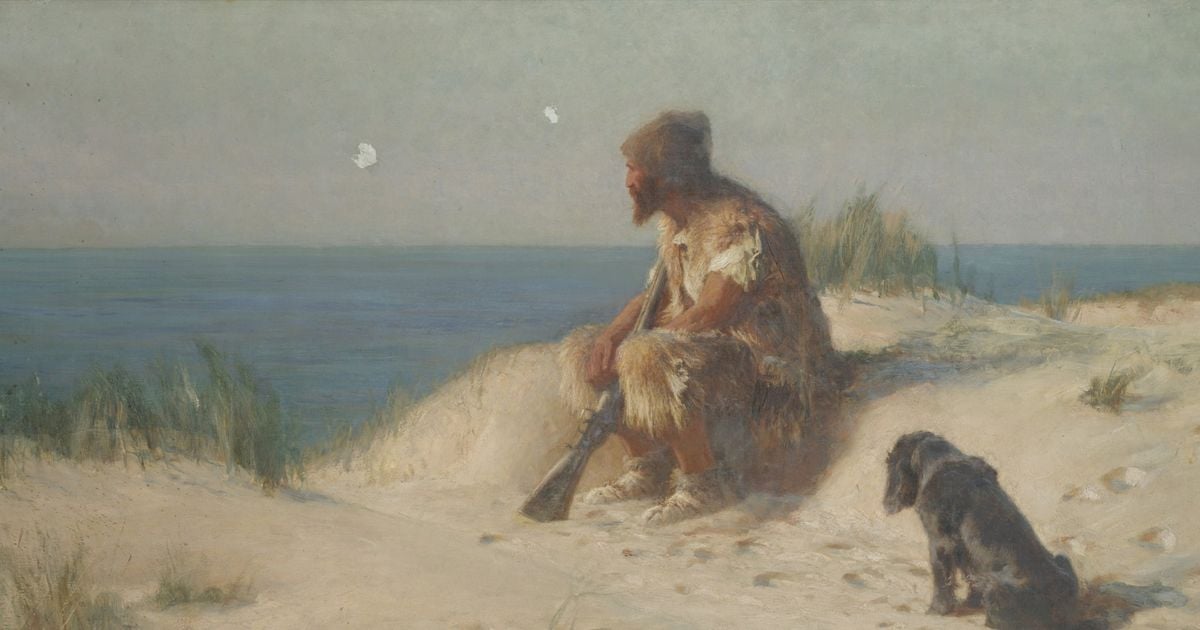
Five years pass in barley, rice, raisins, and days with the gun, while Crusoe finishes a second canoe. The first, too large to launch, stays where he felled it. This one is smaller. A ditch six feet wide and four deep, nearly half a mile and close to two years of digging, brings it into the creek. It cannot cross forty miles of sea. He steps a mast, cuts a sail from stored canvas, and on 6 November, in his sixth year, sails to circle the island with the umbrella fixed at the stern.
Rocks off the east shore run two leagues out. A current sets hard to the east. A boat's length from land, the water takes him like the sluice of a mill, and the paddles do nothing. He calls the shrinking shore a happy desert and pulls north toward an eddy until he is nearly spent. A noon breeze lets him raise the mast. The stream splits on rocks, and the return sets him on the northern end of the island, not the creek he left. By late afternoon he is ashore. He kneels, sleeps, and puts aside any escape in that boat.
Next morning he coasts west and lays the boat in a brook where she sits as if in a dock. At the old bower a voice keeps calling Robin Crusoe and asking where he has been. He starts up in fright, then sees Poll on the hedge, using the words he taught, and at last the parrot steps onto his thumb. He carries it home. The boat stays on the far side. For nearly a year he will not trust the currents on either shore. He shapes his pots on a wheel and makes a rough pipe that draws.
Powder he cannot replace is running low. In the eleventh year the snares break, so he digs pits and covers them with hurdles. One morning an old he-goat is in one and three kids in another. The goat is too fierce to keep. He lets it go and leads the kids home. A hedge begun at two miles round would have left them as wild as ever, so he stops and spends three months on a smaller field. They bleat after him for corn. In a year and a half he has about twelve. Two years more bring forty-three, besides the ones he kills, in pens with gates between them. Milk comes, then butter and cheese after many failures, and salt from the hot rocks. The wild goats stay outside the fence, and the powder keeps thinning.
Crusoe's first boat represents something we all do: we fall in love with the exciting part of our plans while ignoring the mundane logistics that make them possible. This isn't just poor planning: it's how human psychology works. Our brains are wired to focus on rewards, not processes. We can visualize success but struggle to visualize the boring steps that create success. This pattern shows up everywhere in working-class life. The nurse who enrolls in online classes but never plans study time around her shift schedule. The mechanic who dreams of opening his own shop but never researches permits and insurance. The single parent who plans elaborate birthday parties but forgets to budget for next week's groceries. We're not stupid: we're human. Our motivation system evolved to help us spot opportunities, not handle paperwork. But recognizing this pattern gives us power over it. When Crusoe builds his second boat, he succeeds because he learned to handle logistics first, excitement second. The lesson isn't to stop dreaming: it's to dream backwards. Start with the least exciting but most crucial step. Make boring your foundation, not your afterthought. This shift in approach can transform how we navigate everything from career changes to family planning to financial goals.
Explore this chapter with AI to uncover deeper meaning and practical takeaways.
AI Discussion