
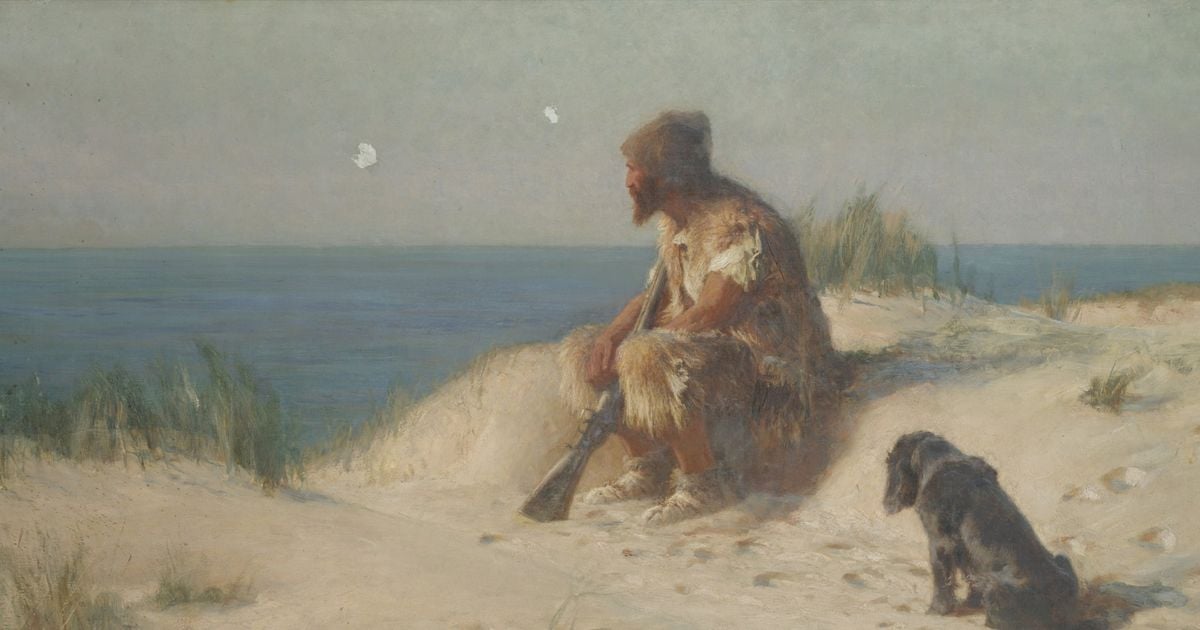
Seed for more than an acre sends Crusoe to a week on a heavy wooden spade, then to two fields near the house, hedged with stakes that will grow. Rain stretches the work across three months. Indoors he teaches the parrot to cry Poll, the first word he has heard on the island from any mouth but his own. He still needs a pot that will hold liquid and stand the fire. For two months the clay sags, cracks, or falls apart. Two ugly jars, bedded in wicker and straw, will keep dry corn. Nothing smaller will boil.
A shard left in the cooking fire comes out red as a tile and hard as stone. He piles pots in embers, feeds the flames until the clay glows, and watches all night so the heat dies slowly. Morning leaves him three pipkins and two pots, one glazed where sand in the clay has melted. He boils kid into broth at once. The rock is too soft for a stone mortar, so he burns a hollow in hard wood, as he once saw canoes begun in Brazil, and cuts an iron-wood pestle. Months pass before calico neckcloths from the ship give him sieves. Wide earthen covers and a hearth of his own tiles then let him bake barley loaves under an upturned pot, and rice cakes after them. By the end of this third year he has about twenty bushels of barley and as much rice, more than he can eat in a year. He will sow the same ground again. The ship's biscuit is already gone, so the new loaves are no longer only seed kept back.
The mainland he saw will not leave him. Three or four weeks of levers and rollers cannot right the ship's boat, lying almost bottom upward on the sand. He fells a cedar five feet ten inches through at the stump. Twenty days drop it, fourteen more clear the head, a month shapes the hull, and nearly three months of mallet and chisel hollow a boat fit for twenty-six men. It lies about a hundred yards uphill from the creek. A dug slope will not shift it. A canal to the sea would be twenty feet deep and would take ten or twelve years. He gives the canal up. Somewhere in that labour his fourth year ends, and he keeps the day as before, with the hull still sitting where he cannot launch it.
About thirty-six pounds in gold and silver sit in a drawer and grow mouldy. He would trade a handful for pipes, a hand-mill, or a little turnip and carrot seed. The last of his ink, thinned with water, barely marks the paper, and in it he sets down the dates that keep returning: the day he left his father, the capture off Sallee, the escape, and the 30th of September, both his birthday and the day he came ashore. Clothes rot in the heat that blisters bare skin. He botches waistcoats from the seamen's watch-coats, then a cap, jacket, and open-kneed breeches of goatskin with the hair turned out to throw off the rain. An umbrella fails two or three times before one will open and shut. He walks under it in the worst of the sun and carries it under his arm when he has no need of it. When the wish for a voice besides his own returns, he is still asking whether his own thoughts, and a word to God, are company enough. The great canoe remains a hundred yards from the water.
Crusoe's pottery disasters reveal something crucial about how we actually learn difficult things. He doesn't succeed because he's naturally gifted: he fails spectacularly until accident teaches him what theory couldn't. His breakthrough comes when broken pottery falls into fire, revealing the hardening process. This is how humans are wired to learn, yet our culture treats failure as shameful rather than educational. We see this everywhere today: the nurse who becomes excellent through handling hundreds of difficult patients, not textbook study. The mechanic who diagnoses weird engine sounds because they've heard every possible failure. The parent who learns to handle tantrums through trial and error, not parenting books. But we're taught to hide our learning process, to present only polished results. Social media amplifies this: we see everyone's highlight reel, not their pottery disasters. The result? People quit after the first few failures, never reaching the breakthrough that comes from persistent experimentation. Crusoe's massive canoe project teaches another lesson: the cost of not planning ahead. He builds this beautiful boat but can't get it to water. How many of us dive into projects without counting the real cost: not just money, but time, relationships, opportunity cost? The key is distinguishing between productive failure that teaches you something new and repetitive failure that just wastes resources. What would change if we celebrated the learning process instead of just the final product?
Explore this chapter with AI to uncover deeper meaning and practical takeaways.
AI Discussion