
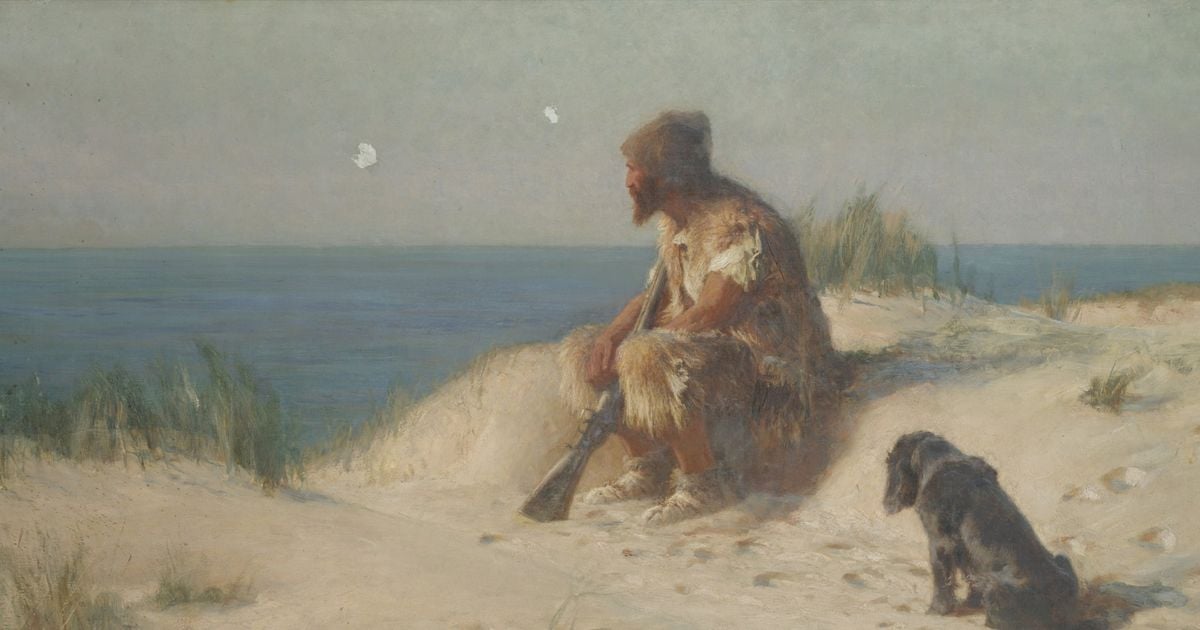
Crusoe dines with Poll as the only voice, the old dog at his right, and a tame cat to either side. The cats from the ship are dead and buried by him. The two beside him he has kept tame. The rest ran wild, raided the house, and left only after he shot a great many. He wants the far boat and fears the water. Five or six days along the shore, in goatskin cap, jacket, and breeches, he goes to watch the current again. It is smooth at first. On the ebb it runs well off the land, and he sees that tide and wind decide how close it comes. He could bring the boat round by waiting. He cannot bear to try. He will build a second canoe, one for each side.
He has two homes by now. Rooms open inside the cave, one of them full of pots and baskets of corn, and the stake wall has grown into trees that hide the house. At the country bower he keeps a hedge, a ladder, a tent of sail, and a couch of skins. The goat pens are staked so tight he has to pull wood out when it grows. He sleeps there on the way to the boat and, if he sails, stays a stone's throw from the beach.
One noon, on that path, he finds a single naked footprint, toes and heel, and no other mark. He searches, sees nobody, and goes home hardly feeling the ground, every stump a man. He does not sleep. A devil would not leave one print for the next sea to wipe away, so he settles on people from the mainland who have already gone. If they saw the boat they may come back. He, who once wanted any human face, now dreads a foot in the sand. After three days shut in, the goats unmilked, he hopes the print is his own. It is not. He was never on that sand when he laid the boat up, and his foot is much smaller than the mark. He returns shaking with cold.
That night he thinks of pulling down fences, corn, and bower so the island will look empty. He sleeps at last and wakes calmer. Fifteen years, and no one has stayed. He can hide. On the double row of trees planted twelve years before, he raises a second wall, packs it with timber and old cables, banks the inner side with earth until it is about ten feet thick, and sets seven muskets to fire in two minutes. Beyond it he plants near twenty thousand stakes. Two years make a grove. Five or six make a wood with no path through it. Two ladders, drawn up behind him, are the only way in. He waits there, still not knowing whose foot printed the sand.
Crusoe's terror at the footprint reveals something profound about human psychology: we can become so adapted to control that we lose our ability to handle the normal uncertainties of life. This wasn't just about fear of cannibals - it was about fear of anything that might disrupt his carefully constructed world. The irony cuts deep: the man who once desperately wanted rescue now dreads the possibility of it. This pattern shows up constantly in working-class life. The factory worker who's done the same job for twenty years and panics when asked to cross-train on a different line. The single parent who's built such a tight routine that any deviation - even positive ones like dating or kids' activities - feels overwhelming. The night shift nurse who's become so comfortable with the quiet hours that the thought of switching to days creates genuine anxiety. We tell ourselves we're being practical, avoiding unnecessary stress. But there's a line between smart caution and fear-based isolation. The question isn't whether to have safe spaces - we all need them. The question is whether those spaces are launching pads for engaging with life or bunkers for hiding from it. Crusoe's two years of frantic fortification show what happens when we choose the bunker: we become prisoners of our own protection.
Explore this chapter with AI to uncover deeper meaning and practical takeaways.
AI Discussion