
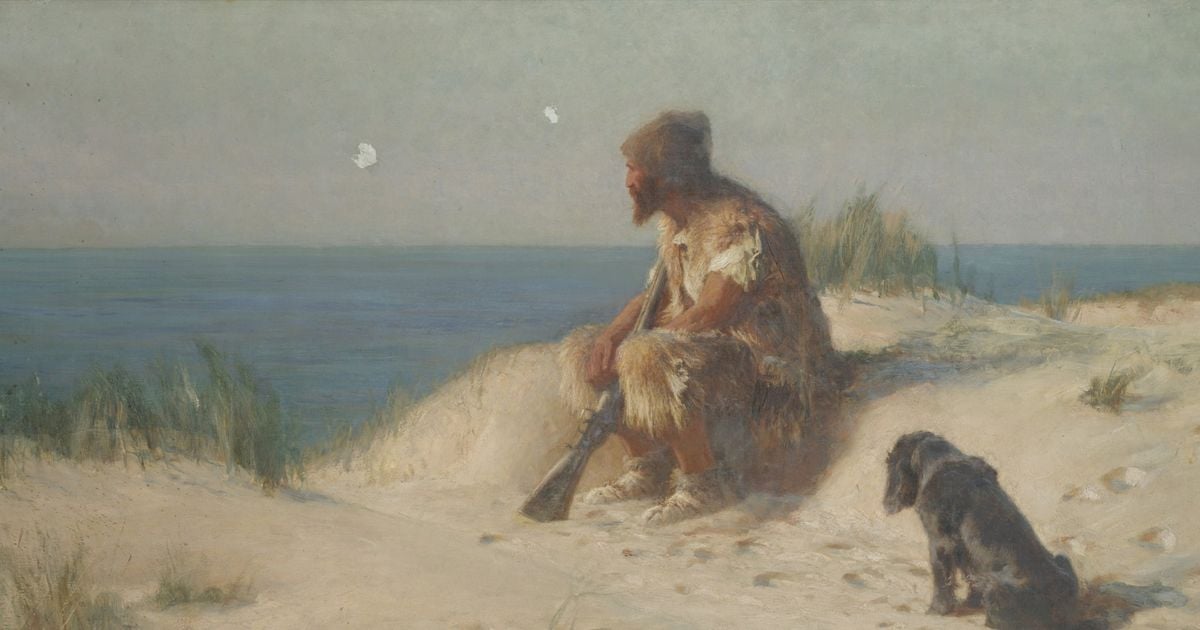
Crusoe crosses the island with gun, hatchet, dog, and raisins. From the western height he makes out land fifteen or twenty leagues off, perhaps a Spanish coast where a ship might pass, perhaps the cannibal shore between that coast and Brazil. He knocks a young parrot down with a stick and carries it home. Years will pass before it says his name. The far beach is thick with turtles, against three on his own shore in a year and a half, and with birds he will not spend powder on. Goats see him too soon on the flat. He will not move. Twelve miles east he sets a pole and turns back on a new path.
Haze traps him. Wooded hills close out the sun for three or four days, and he has to find the sea, find the pole, and come the long way home. The dog seizes a kid. Crusoe saves it, collars it with rope-yarn, and leaves it in the bower. He has been gone more than a month. The hammock feels like a settlement, and he resolves not to travel far from it again. When he returns, the kid is nearly starved. Fed, it follows him like a dog and will not leave.
On 30 September, in the autumn rains, he keeps the second anniversary of the landing. He starts to thank God that this life may be happier than his old one, then stops, unwilling to bless a condition he still wants to escape. One sad morning the Bible opens on the promise never to leave him or forsake him, and the fits of weeping that used to halt his work begin to ease. He reads three times a day. A board for one shelf takes forty-two days.
In November the barley and rice stand up, and goats and hares shear the blade to the ground. A hedge and the dog at the gate save the crop. Birds then cover the ears. He shoots three and hangs them in chains, and the rest leave that ground. Late in December he cuts the ears with a cutlass, rubs the grain by hand, and guesses near two bushels of rice and two and a half of barley. He will not eat it. Mill, sieve, yeast, salt, and oven are still missing, and he sets the next six months to inventing them.
Crusoe's discovery reveals a fundamental blind spot in human psychology: we can't see our own expertise. After two years on his island, he'd built invisible assets: knowledge of weather patterns, safe paths, reliable food sources, the rhythm of his environment. But familiarity bred contempt. The daily struggle made him focus on what was missing rather than what he'd mastered. This pattern hasn't changed in 300 years. We live in a culture that glorifies the fresh start, the career pivot, the geographic cure. Social media amplifies this by showing us everyone else's highlight reels while we live with our own behind-the-scenes struggles. We see the nurse who switched hospitals and got better pay, not the six months she spent rebuilding relationships and learning new systems. We hear about the friend who moved to a cheaper city, not the isolation and career setbacks that followed. The result is chronic undervaluation of our accumulated wisdom. Every job teaches you the unwritten rules. Every neighbourhood gives you informal networks. Every relationship builds trust accounts. These assets are invisible because they work quietly: until you lose them. Defoe understood that contentment often comes not from changing circumstances but from changing perspective. Sometimes the prison is actually the foundation.
Explore this chapter with AI to uncover deeper meaning and practical takeaways.
AI Discussion