
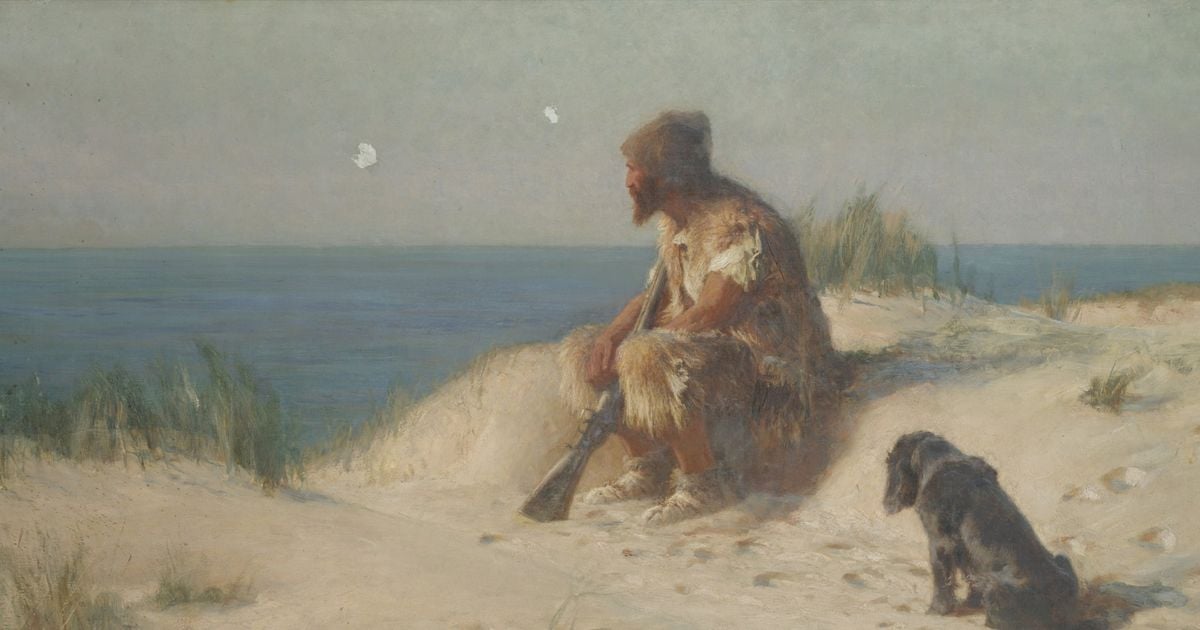
After more than ten months, Crusoe leaves the cave on 15 July and follows the creek until the tide dies in a fresh brook among savannahs of tobacco, aloes, and poor wild sugar-cane. He finds no cassava. Next day the woods give him melons and ripe grapes. He eats sparingly, remembering men in Barbary who died after gorging on grapes, and that night he sleeps in a tree, the first night away from his tent. Nearly four miles on he finds a spring and a green valley of cocoa, orange, lemon, and citron. He heaps the fruit to fetch later. What he carries home bruises into pulp under its own juice.
On 19 July the heaps are trampled and partly eaten by a creature he never sees. He hangs fresh bunches on the outer branches to dry and carries home what citrus he can. The valley tempts him off the beach. He stays, because another wrecked man might be driven to that same shore, and a house in the hills would put any meeting out of reach. Through the rest of July he still builds a bower there, a double hedge and a ladder. By early August he sleeps some nights in that country house and keeps the house by the sea.
Rain comes with the finished fence. On 3 August he gets more than two hundred bunches of raisins into the cave just before the sky breaks, and from mid-August into October he is often shut in. A cat he thought lost returns with three kittens. He kills a goat and finds a large tortoise, and eats raisins, broiled meat, and turtle eggs, with no pot to boil in. A sideways dig opens a door beyond the wall, and he lies uneasy at sleeping so exposed. On 30 September he counts a full year, fasts until sunset, and begins again to mark every seventh day. His ink fails. Two-thirds of the barley and rice, sown after the rains, die in the drought.
In February the handful he held back rises near the bower under the March and April rains, half a peck of each, so that two seed-times are plain. The bower stakes have shot like willow. He prunes them and sets a second double row around the seaside wall. Brittle twigs will not weave, but this wood will. He makes deep baskets for earth and for corn he still barely has. A pipe remains unmade, and the only kettle is the great one from the ship. He keeps staking and weaving while another task begins to take more days than he can spare.
Crusoe's valley discovery challenges our cultural obsession with fresh starts and clean slates. American mythology celebrates burning bridges: quitting dramatically, moving across country, leaving everything behind for a dream. But Defoe shows us something more sophisticated: the power of strategic layering. Crusoe doesn't abandon his coastal shelter for the inland paradise. He builds a system that gives him both security and growth. This wisdom feels especially relevant in our gig economy, where we're constantly told to 'follow our passion' and 'take the leap.' The healthcare worker considering nursing school, the retail manager eyeing a food truck, the factory worker learning coding: they all face Crusoe's choice. Do you abandon stability for possibility, or find ways to build both? The chapter reveals that most successful transitions aren't dramatic pivots but careful expansions. You keep the day job while building the side business. You maintain the apartment while testing the new city. You preserve relationships while exploring new ones. The island teaches us that real freedom comes not from having no base, but from having multiple bases. In our winner-take-all culture, this feels like compromise. But Defoe suggests it's actually intelligence: the kind that survives storms and capitalizes on opportunities simultaneously.
Explore this chapter with AI to uncover deeper meaning and practical takeaways.
AI Discussion