
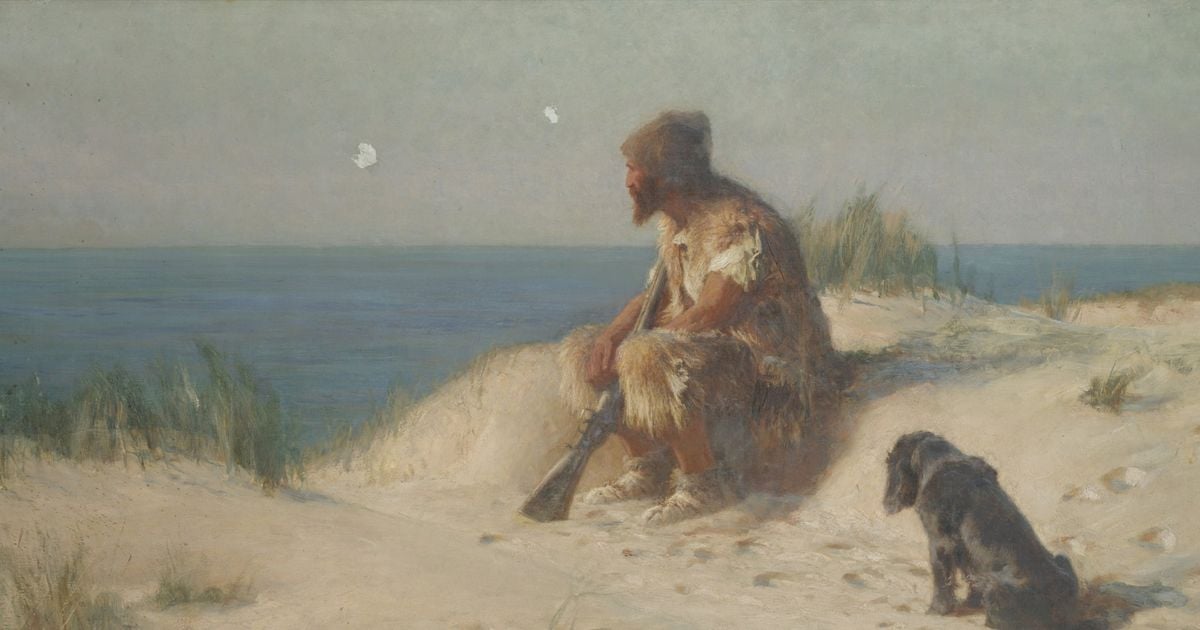
The earthquake has lifted the wreck. The forecastle stands at least six feet higher, the stern is thrown aside, and at low tide he can walk to a hold choked with sand. He gives up moving house and pulls the ship apart. Through May he saws beams, floats planks in on the flood, and levers iron free until he is ready to stop. A hookless line of rope-yarn takes a young dolphin. He dries fish in the sun, feels a roll of lead he cannot shift, and loses a tide to pigeon-hunting. What floats home is mostly timber, plus Brazil pork spoiled by salt and sand. By mid-June he has wood and iron for a boat, if he knew how to build one, and near a hundredweight of sheet lead.
Then he finds a tortoise, his first, and cooks it with threescore eggs, the best meat since he landed. The rain turns cold. Fever and a seven-hour ague follow. He can kill a goat and cannot stew it, for want of a pot. One day he cannot stand to fetch water, and he cries for pity until he sleeps. In the dream he is outside the wall again. A man comes down from a black cloud in a flame, spear ready, and the ground shakes. Crusoe is told that nothing yet has brought him to repentance, and that he is now to die.
Eight years at sea sit behind that voice, years in which he cannot remember looking towards God. Barley stirred him only while it seemed miraculous. The earthquake stirred him only while it moved. His father had said that this foolish step would cost him the blessing, and that he would have time to see it with nobody to help. He says those words have come to pass. He sets rum and water by the bed for the next fit, roasts three turtle eggs, and asks a blessing on meat for the first time he can recall. By a calm sea he asks why this was done to him, and the question turns into a list he cannot answer: Yarmouth Roads, the fight at Sallee, the beasts of Africa, the boat in which the rest drowned. He climbs the wall, lights the lamp, and opens a chest on tobacco and a Bible he has not wanted to read.
He chews the leaf, steeps more in rum, and leans into the smoke. The book falls open on a call in the day of trouble. He does not believe the island can be escaped. He kneels anyway, drinks the dose, and sleeps so deeply he may lose a day from his count. He wakes hungry. The ague fades, flickers, and by the 3rd of July is gone, though his limbs still convulse and strength is slow. He kneels to thank God for the illness ended, then reads each morning and night. The dream's demand for repentance meets words about a Prince and a Saviour who can give it, and he asks for that. Through the middle of the month he walks a little at a time with his gun, testing the strength coming back, and storm-rain begins to frighten him more than the rains of September and October.
Defoe understood something modern psychology has confirmed: we avoid hard truths about ourselves by staying busy, and crisis forces the stillness where those truths emerge. Crusoe couldn't examine his spiritual rebellion while frantically salvaging supplies, just like we can't examine our deeper issues while managing work deadlines and family logistics. The fever created space for questions he'd been outrunning for years. This pattern repeats constantly in working-class life. The factory worker who stays busy with overtime until an injury forces him to face his drinking problem. The single mom who fills every moment with kids' activities until her own illness creates space to examine her isolation. The maintenance worker who avoids his depression through constant projects until a layoff strips away that distraction. We often resist these forced pauses, seeing them as interruptions to our plans. But Defoe suggests something radical: maybe the interruption is the point. Maybe the fever, the layoff, the injury isn't punishment but opportunity: a chance to realign our lives with what actually matters instead of what we think we should be doing. The question isn't whether these moments of forced stillness will come, but whether we'll use them for genuine growth or just wait for them to pass so we can get back to avoiding ourselves.
Explore this chapter with AI to uncover deeper meaning and practical takeaways.
AI Discussion