
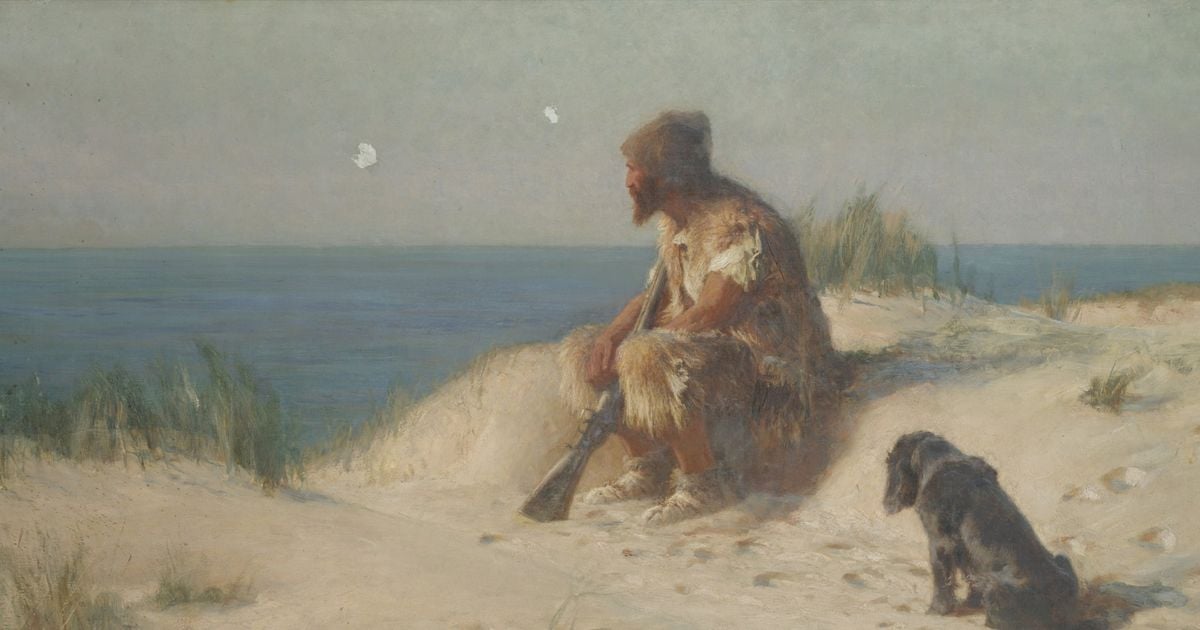
The journal opens on the landing. Crusoe names the shore the Island of Despair, sees nothing ahead but beasts, murder, or hunger, and sleeps in a tree in the rain. Next day the ship has drifted nearer. Through late October he rafts stores ashore in the rains, loses one load and recovers much of it at low water, and on the 25th watches the ship break up. He marks a semicircle under a rock for a fence of piles, cable, and turf, and moves his goods. A she-goat falls to his gun. The kid follows home, will not eat, and he kills it.
He sets hours: the gun for the morning, work until about eleven, food, sleep in the heat, work again after two. A table and a chair he keeps pulling apart come out of that order. He skins a wild cat he cannot eat, watches seals slide into the sea, and forgets Sunday once he stops marking it. Thunder makes him box the powder in small parcels. For the cave he has no shovel. A tree as hard as the iron-tree of the Brazils becomes a spade and nearly ruins his axe. He cannot make a wheel, so a hod carries the earth. The ceiling then falls in. Shores and boards prop it and become partitions. On the 27th of December he lames a young goat, splints the leg, and nurses it until it grazes tame at his door and will not go. For the first time he thinks of keeping animals against the day the powder ends.
From January into April he finishes the long wall, thick enough that people on the shore should not see a house. Pigeons he tries to tame fly off. A cask defeats him. He cannot make staves hold water. Dark comes by about seven, so goat tallow in a clay dish, with an oakum wick, serves as a lamp. He shakes rat-eaten corn husks out under the rock and forgets them. A month later ten or twelve ears of green barley are standing, and rice beside them. He hunts the island for a miracle. Then he remembers the bag. He saves every ear, sows, and loses that first crop by sowing just before the dry season.
The day after he pulls his ladder inside, the cave cracks and the ground shakes three times. A rock half a mile off falls. He sits outside, sick, and the short cry for mercy leaves him once the shaking stops. Hurricane and rain follow. He cuts a drain through the wall, drinks a little rum, and remembers he cannot get more. A hut in the open would be safer than a cave that can bury him, but a night without a fence seems as bad. He decides to stay until a second camp is built. The axes are dull. A week goes to a wheel and string that let his foot turn the grindstone. At the end of April his bread is down to one biscuit a day. On the 1st of May a cask at low tide is powder caked hard as stone. He rolls it up the beach and keeps walking towards the wreck, which looks higher out of the water than before.
Crusoe's discovery of growing barley seems minor compared to his shelter-building or tool-making, but it represents something profound: proof that his efforts can compound over time. He didn't plant those seeds intentionally: they grew from grain he'd scattered carelessly months earlier. But when he sees them sprouting, he recognizes opportunity and tends them carefully. This pattern reveals why small, consistent actions often matter more than grand strategies. In our achievement-obsessed culture, we're taught to think big, set ambitious goals, and measure success in dramatic transformations. But real resilience comes from accumulating small victories that build psychological momentum. The person who walks fifteen minutes daily is more likely to develop lasting fitness habits than someone who commits to hour-long gym sessions they can't sustain. The family that saves five dollars weekly builds both financial reserves and the mental habit of prioritization. The student who reads one page nightly develops reading skills and confidence that sporadic cramming sessions never provide. Crusoe's barley teaches us that progress doesn't always announce itself dramatically: sometimes it grows quietly while we're focused on other survival tasks. The key is recognizing these small wins when they appear and nurturing them intentionally. What matters isn't the size of the victory, but the pattern it establishes and the momentum it creates for whatever challenges emerge next.
Explore this chapter with AI to uncover deeper meaning and practical takeaways.
AI Discussion