
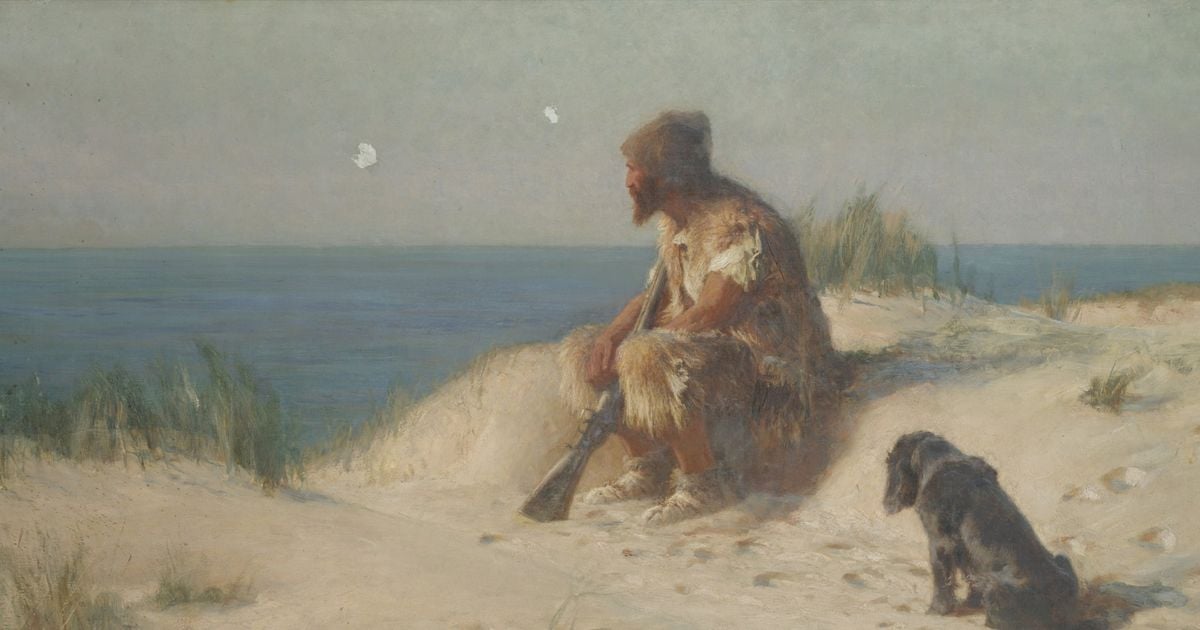
They had hauled the long-boat above the tide and broken a hole in her when the ship fired a gun and waved her ensign. Nothing answered. A second boat then rowed in with ten armed men. The captain picked out three or four honest fellows, dragged along by the boatswain and the rest. Crusoe told him every man who landed would live or die by his conduct. The prisoners already in hand were divided. Two went bound to the cave. Two stayed pinioned. Two were trusted with arms. Crusoe had seven men.
The ten found the first boat stripped and holed. They launched, ready to tell the ship their comrades were murdered, then thought again, left three men with their own boat at anchor, and sent seven up the hill. Those seven sat under a tree and would not sleep. At last they started downhill to abandon the search. Friday and the mate crossed the creek and hallooed. The party followed, had themselves ferried into the creek, and left only two men on the boat. The captain knocked one down. The other yielded, and joined them. Friday kept the shouts moving from hill to hill until the rest were lost in the woods and the day was gone. They returned to a stranded boat and two missing men, and cried that the island was enchanted.
Crusoe held off until the boatswain came ahead with two others. The captain and Friday fired. The boatswain died on the spot. The next man was shot and lived only an hour or two. The third ran. Darkness made eight men easy to call fifty. The sailor who had changed sides called on Tom Smith to throw down his arms, and the captain offered life to everyone but Will Atkins, the first man who had seized him in the mutiny. They yielded and were bound. The captain named an English governor of the island, and told Atkins to prepare for hanging in the morning. Crusoe was that governor, and he stayed unseen. The hanging was invented. Atkins knelt. The others begged not to be sent to England.
The worst were shut in the cave, the rest in the country bower. Five were then promised pardon if they boarded the ship, and five were kept as hostages. Near midnight the boats came alongside. A hail held the watch in talk until the captain and the mate were aboard. They knocked down the second mate and the carpenter, fastened the hatches, and broke into the round-house. The rebel captain's fire broke the mate's arm. The mate shot him through the head, and the ship was taken. Seven guns reached Crusoe, who had watched the shore until nearly two. He slept. A later gun and a cry of "Governor!" woke him. The ship lay within half a mile, and the captain, holding him up, called her his. Crusoe could not speak until he had swallowed a dram and sat on the ground. Wine, food, and a suit of clothes came ashore. As governor, he offered the men he dared not take to sea a choice between the island and the gallows. They chose the island. He freed them, showed them how he had lived, left a letter for the seventeen Spaniards still expected, and gave them arms and a bag of peas to sow. The boat would come for him next day. He was still on shore.
Crusoe's victory reveals something uncomfortable about human nature: we're terrible at assessing actual versus perceived power. The mutineers surrender to a 'governor' with 'fifty men' who doesn't exist, proving that fear fills information gaps more effectively than facts. This wasn't unique to 1719—it's how power works everywhere, from medieval kingdoms to modern corporations. The person who acts like they have options usually gets them. The employee who seems connected to upper management gets better treatment. The patient who appears to have other doctors gets more attention. The customer who hints at taking their business elsewhere gets better service. We evolved in small groups where reputation and alliances mattered more than raw numbers, so we still instinctively defer to perceived authority even when we could easily verify the facts. Social media amplifies this perfectly—accounts with engagement attract more engagement, creating real influence from artificial metrics. The scary part isn't that bluffs work, but how rarely we call them. We assume others have information we don't, so we defer to confidence even when it's completely unfounded. Understanding this pattern protects you from manipulation while revealing opportunities for ethical influence.
Explore this chapter with AI to uncover deeper meaning and practical takeaways.
AI Discussion