
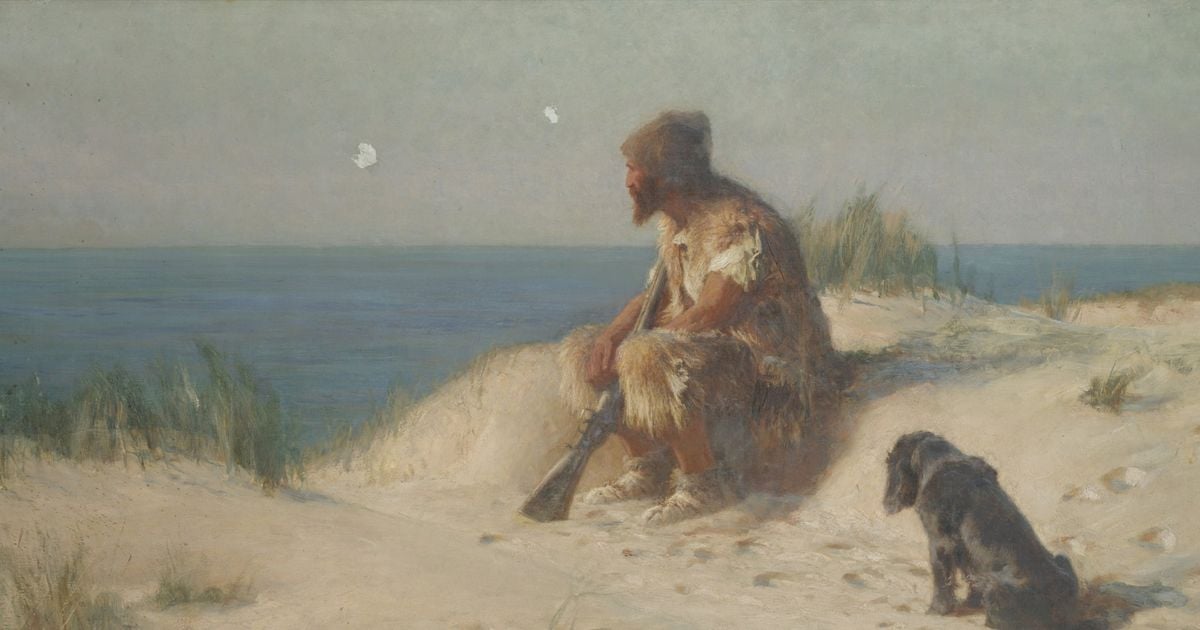
Crusoe had begun to think of the mainland again, the fear of more canoes having worn off, when the Spaniard told him of sixteen men still living on the cannibal coast. They were his countrymen, with Portuguese taken from another wreck. Their ship had been lost on the way from the Rio de la Plata to the Havanna, carrying hides and silver. Five of the crew had drowned. The rest had landed almost starved, powder spoiled, and with no tools to build a boat. Every talk of escape ended in tears.
Those hands could build a barque for the Brazils or the coast to the north. Crusoe would not arm them lightly. He told the Spaniard he would rather be devoured alive than be carried into New Spain and the Inquisition. The Spaniard offered to cross with Friday's father and bind the men, on the sacraments and the Gospel, to obey Crusoe as captain. He swore to stand by him. Crusoe agreed, and then accepted a delay of half a year. Corn that fed four would not feed sixteen or stock a ship, and hunger, the Spaniard said, had made the children of Israel rebel after Egypt. They dug, sowed twenty-two bushels of barley and sixteen jars of rice, cut a dozen oak planks, and saved about twenty kids. The barley came back above two hundred and twenty bushels, with rice in proportion.
No man was to be brought over until he had sworn, before the Spaniard and Friday's father, never to harm the person who sent for him. How that promise would be signed, with neither pen nor ink, nobody asked. At the full moon, Crusoe's October, the canoe left with muskets, bread, dried grapes, and a signal for the return. It was his first real step towards leaving in twenty-seven years and some days. He waited eight days.
Friday woke him shouting that they had come. An English long-boat was standing in from the south, with an English ship at anchor beyond it. Eleven men put three bound prisoners ashore, and a cutlass was lifted over one of them. Friday was sure the English meant to eat their captives. Crusoe was sure they meant to kill them. The crew wandered away, and the tide left the boat fast in the sand. About two o'clock he went down in his goat-skin coat, Friday armed behind him. The captain took him for a man sent from heaven, then told the truth. A mutiny had set him ashore with his mate and a passenger to die. He accepted Crusoe's terms: no power on the island, and a free passage to England for Crusoe and Friday if the ship were taken. The two ringleaders were killed, one by a shot and one under the captain's musket. The rest were bound, and three stragglers gave up at the sound of the guns. Oars and sail were carried off. Twenty-six men were still on the ship, and they would sooner fight than hang. Crusoe had a hole knocked in the long-boat. He hardly hoped to take the ship. If she sailed without the boat, he meant to refit it for the Leeward Islands, and the Spaniards were not yet back.
Crusoe's chapter reveals a timeless truth: people in desperate situations become vulnerable to exploitation, but also develop heightened survival instincts that can protect them—if they learn to use those instincts wisely. When Crusoe sees that ship, he's been isolated for decades. Every fiber of his being screams 'rescue!' But his years of careful survival have taught him that quick decisions kill. Modern workers face the same dynamic. When you've been unemployed for months, when your current job is toxic, when you're drowning financially—that's exactly when predatory employers, manipulative partners, and scam artists appear with 'perfect' solutions. They count on your desperation to override your judgment. But here's what Defoe understood in 1719 that we often forget today: desperation doesn't have to make you stupid. It can make you more careful, more observant, better at reading people's real motivations. The key is recognizing that the most dangerous offers come when you're most vulnerable. Crusoe's strategic patience isn't just about waiting—it's about using that waiting time to gather intelligence, build alliances, and understand the real power structure before choosing sides. The people who survive and thrive aren't those who never face desperate situations, but those who've learned to think clearly within them.
Explore this chapter with AI to uncover deeper meaning and practical takeaways.
AI Discussion