
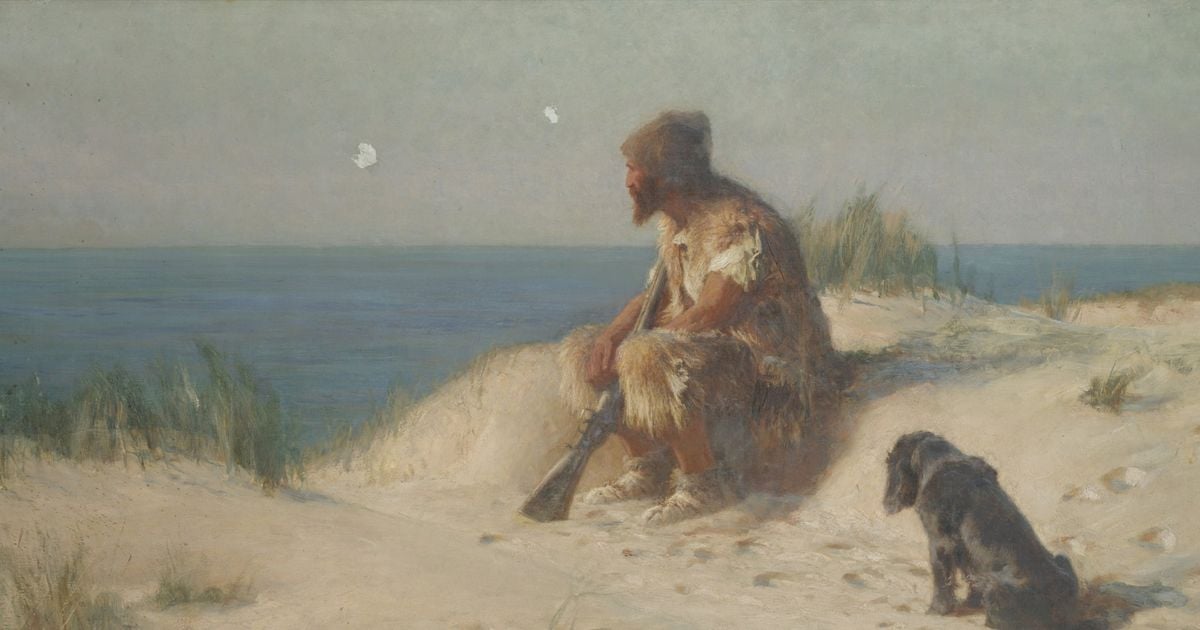
Crusoe went aboard the next day, though the ship did not sail that night. Two of the five men swam out in the morning and begged to be taken, even if they were hanged, because the other three would murder them. Some time afterwards they were whipped and pickled, and grew quiet. Crusoe carried off his goat-skin cap, his umbrella, and a parrot, with money too tarnished to pass for silver, and left on 19 December 1686. He had been on the island twenty-eight years, two months, and nineteen days, and the date was the same day of the month as his escape from the Moors at Sallee. On 11 June 1687 he reached England, thirty-five years absent, and known to nobody.
The widow who had kept his money was poor. He forgave what she owed. In Yorkshire his father was dead, only two sisters and two children of a brother remained, and nothing had been left for him. Almost two hundred pounds from the ship's owners would not settle him. In April he and Friday found, in Lisbon, the Portuguese captain who had once taken him up off Africa. Age had changed them both. The partner in the Brazils was rich. Trustees who believed Crusoe drowned had given a third of his profits to the king and two thirds to the monastery of St Augustine. He could claim the land again. He could not recover what had already been spent. The captain, who had received the early profits, owed four hundred and seventy moidores. He paid a hundred in gold and offered his share in his son's ship. Crusoe refused the ship.
Within seven months sugar, tobacco, gold, and the accounts arrived together. Above five thousand pounds was his, and a plantation of above a thousand a year. The shock made him ill until a physician let blood. He settled a hundred moidores a year on the captain and fifty on his son, and sent a hundred pounds each to the widow and his sisters. He sometimes regretted having professed himself a Papist in the Brazils, but he stayed away chiefly because he knew no safe hands for the money. He turned the cargo into bills of exchange, then could not make himself sail for England. Two ships he had nearly chosen were lost, one taken by the Algerines and one wrecked on the Start, near Torbay. He left Lisbon by land. Friday came with him, and the travellers did him the honour of calling him captain.
Snow held them twenty days at Pampeluna. Friday had never seen it, and the cold was sharp after Spain. A guide offered a winding way over the mountains if they went armed against wolves. On 15 November he brought them to a height where Languedoc lay green below. About two hours before night, three wolves and a bear rushed from a hollow onto the guide. Friday shot the wolf that had seized the man. The guide was bitten in the arm and above the knee. The others came up through the trees and still could not tell what creature lay dead.
Defoe understood something about human nature that still applies today: money doesn't just change your circumstances—it changes how everyone around you behaves. Crusoe's experience in 1719 mirrors what happens to working-class Americans today who receive settlements, inheritances, or even significant raises. Suddenly, family members who never called start asking for loans. 'Friends' appear with business opportunities. Landlords and merchants adjust their expectations. This isn't necessarily malicious—it's predictable human behavior. People see resources and instinctively position themselves to access them. The challenge isn't the money itself, but learning to distinguish between genuine relationships and opportunistic ones. Crusoe's wisdom lies in his immediate gratitude toward those who helped him when he had nothing—the Portuguese captain, the widow who managed his affairs. These people proved their character when there was no financial benefit to them. This same principle applies today: the people who supported you during your worst times deserve consideration during your best ones. But the reverse is also true—those who only appear when you have something to offer reveal their true priorities. The real skill isn't managing money, it's managing the relationships that money exposes.
Explore this chapter with AI to uncover deeper meaning and practical takeaways.
AI Discussion