
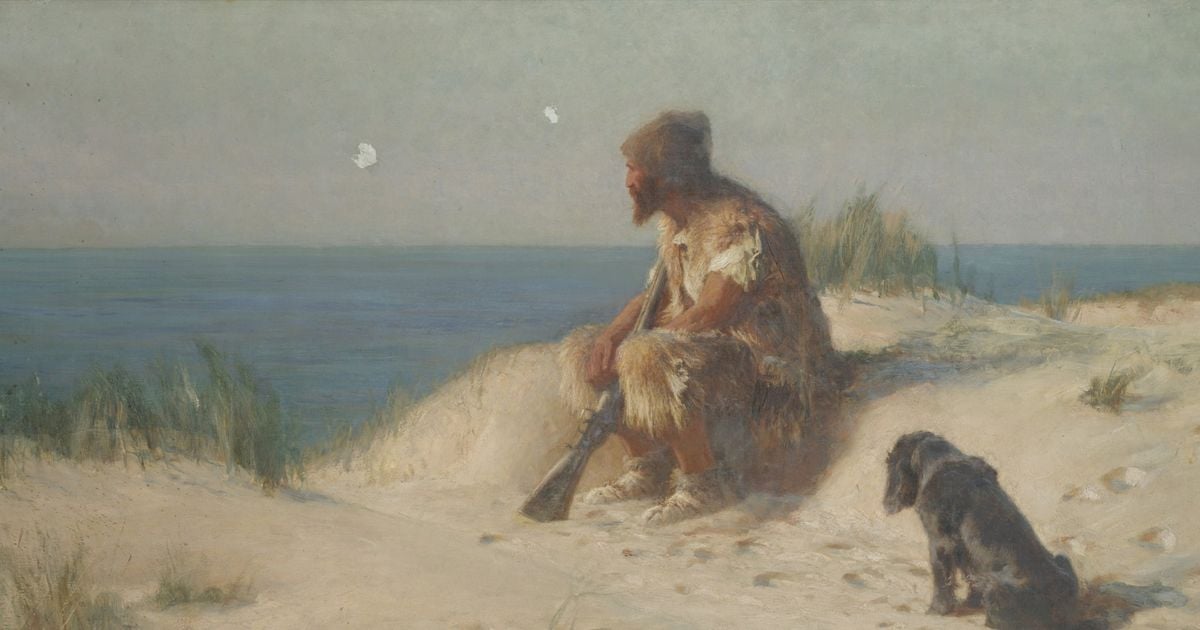
Crusoe said they would build a canoe as large as that rotten hull, and Friday should go home in it. Friday asked why he was angry. He had wished them both there, not himself sent off alone. When Crusoe insisted, Friday put a hatchet in his hands and told him to kill Friday rather than send him away. Crusoe, seeing the tears, promised never to send him off if he would stay. The wish to escape remained, and it rested on the seventeen bearded men. Friday chose a tree near the water, wood like fustic, and wanted to burn it hollow. Crusoe taught him the tools. In about a month they had a canoe for twenty men. After near a fortnight on rollers she was afloat, and Friday paddled her faster than Crusoe had imagined.
The mast was a young cedar that Friday shaped. Old sails, kept six-and-twenty years, were mostly rotten, but two pieces made a three-cornered sail of the kind Crusoe had used escaping from Barbary, with a foresail and a rudder besides. Near two months of that work left Friday able to handle sail and helm, though the compass stayed dark to him. Crusoe entered his seven-and-twentieth year, kept the anniversary of his landing, and went on planting, pressed by a sense that he should not be another year in the place. The rains came. They hauled the boat into the creek, Friday dug a dock, they dammed her dry at low tide, and boughs thatched her like a house while they waited for November and December.
One morning in the fair season he sent Friday for a turtle. Friday flew back over the wall, counting canoes so that Crusoe heard six. There were three. A dram of rum steadied him. From the hill the glass showed one-and-twenty people, three prisoners, and three canoes, landed where the wood met the sea. Crusoe set out to kill them all, Friday sworn to stand with him, then cooled on the march because these men had done him no wrong. He would watch unless a clearer call came. From a tree at the wood's edge, Friday saw them eating one prisoner while a bound bearded man waited his turn. The glass showed a white European tied with flags. At about eighty yards, two stooped to untie his feet. Crusoe and Friday fired together. Three died and five were wounded in that first blast. The second, with smaller shot, scattered the rest, and more fell as they ran.
On the beach, Friday shot two who had reached a canoe. Crusoe cut the prisoner free and asked in Portuguese what he was. The man answered in Latin that he was a Christian, then said he was a Spaniard. A pistol and a sword put him back into the fight, and he shot the attacker who had thrown him. Four of the twenty-one escaped by sea. Boarding another canoe to follow them, Crusoe found a second man bound hand and foot. Friday kissed him, danced, and at last said it was his father. The chase stopped. Within two hours a north-west wind rose and held all night, and Crusoe could not suppose that canoe lived, yet he did not know. Friday ran home for water and bread. Neither man could walk, so a hand-barrow brought them to the wall. Crusoe would not break it. In about two hours a tent of old sails and boughs stood outside, and they ate stewed goat there while Friday interpreted. Next day he buried the dead. His father thought the survivors would blame thunder and spirits, not men. Crusoe kept all four of them watching, still unsure whether that canoe had reached home.
Defoe wrote Robinson Crusoe during an era when individual moral action could reshape entire communities. Today, working-class Americans face the same fundamental choice Crusoe confronted: when do we intervene in situations that aren't technically 'our business'? The stakes feel higher for us because we have less job security, fewer connections, and more to lose. But this chapter reveals something crucial about moral courage - it's not about having power, it's about using whatever influence you have strategically. Crusoe wasn't a king or general; he was a shipwrecked survivor with limited resources. Yet he recognized that witnessing harm creates responsibility. In our workplaces, neighbourhoods, and families, we constantly encounter the Intervention Paradox. A coworker faces discrimination. A neighbour deals with domestic violence. A family member struggles with addiction. The voice in our head says 'stay out of it' - but Crusoe shows us that neutrality often enables the very harm we're trying to avoid. The key isn't reckless heroics; it's strategic action with allies. Document what you see. Find others who share your concerns. Choose your moment. Your sphere of influence is your sphere of responsibility. The question isn't whether you have the right to intervene - it's whether you can live with the consequences of staying silent.
Explore this chapter with AI to uncover deeper meaning and practical takeaways.
AI Discussion