
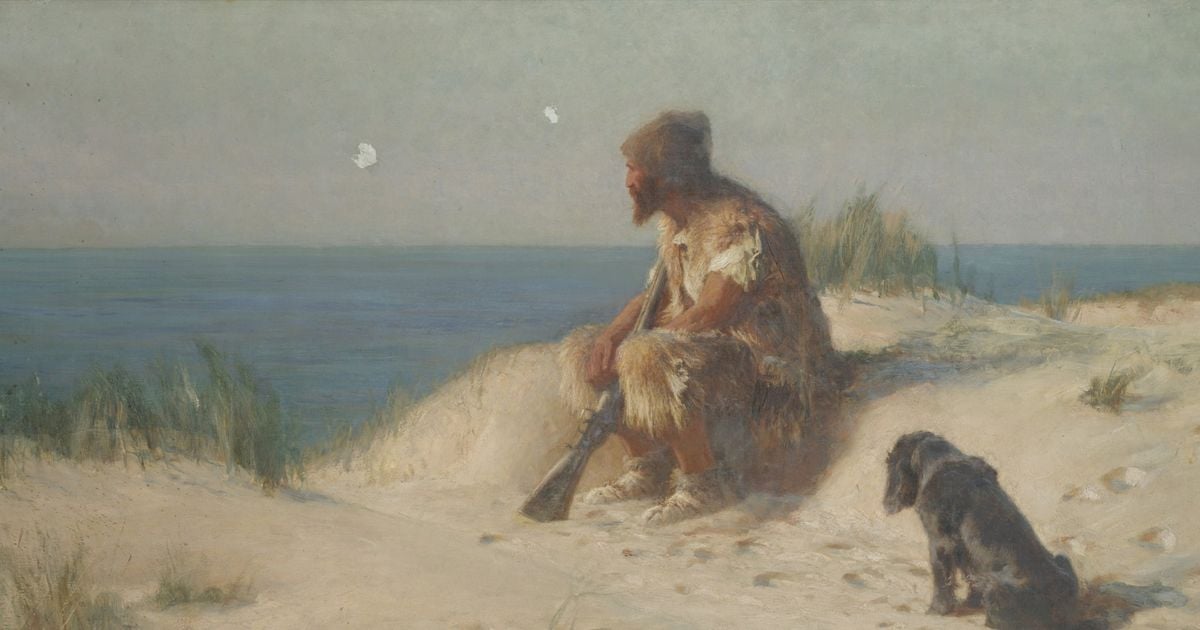
A few days after they returned to the castle, Crusoe took Friday into the woods to feed him on flesh that was not human. A she-goat lay in the shade with two kids. He signed Friday to be still and shot one. Friday did not see it fall. He ripped at his waistcoat, knelt, and begged not to be killed. Crusoe laughed, showed him the dead kid, and, while Friday fetched it, reloaded and shot a parrot he had taken for a hawk. Friday would not touch the gun for days, and alone he asked it not to kill him. Boiled meat pleased him, though he spat out the salt. Roasted the next day on a string before the fire, it pleased him more, and he said he would never eat man's flesh any more.
Once he saw that beaten corn became bread, he learned to make it. A larger field followed, because two mouths had to be fed, and he worked the harder when he understood the corn was for them both. Asked about the fight, he said his nation fought the better, yet he had been taken where the enemy were more numerous, and carried off for want of a canoe. They ate men too. On the north-west shore he had been at a feast of twenty men, two women, and one child, which he counted by laying stones in a row. Offshore the current reversed between morning and afternoon, and no canoe was lost. Crusoe came to place the island by the Orinoco and Trinidad, and the people as Caribs. White bearded men lived beyond the setting of the moon. The way there, Friday said, was two canoes, meaning one boat as big as two.
Asked who made the sea and the woods, he named Benamuckee, older than the moon, to whom all things said O. Only the old men, the Oowokakee, went up the mountains and brought the answers down. Crusoe called that a cheat and spoke of God and the devil, until Friday asked why, if God is stronger, God does not kill the devil now. Judgment hereafter did not satisfy him. Why not long ago? Told that the wicked are spared so they may repent, he said Crusoe, he, and the devil would all be pardoned. Crusoe stopped, prayed for a better answer, and came back to repentance and to Christ.
The ruined ship's boat opened a different hope. Friday remembered one like it driven to his country, and white men saved from drowning. He counted seventeen on his fingers. They had lived there about four years, were fed, and were left in peace, for his people ate men taken in war and not those they had made brother with. When Friday saw that shore from the eastern hill and danced, Crusoe went cold for weeks, afraid of a return with a hundred or two for a feast. Friday never noticed, and his answers would not feed the fear. He would go only if Crusoe went, and he would tell them to pray and to stop eating men. Wanting the seventeen bearded men, Crusoe showed him the small frigate, which Friday handled well, and then the first great boat. Two or three and twenty years of sun had split it rotten. Friday said a boat of that size would carry food enough.
Crusoe discovers that Friday's innocent questions about Christianity force him to examine beliefs he's never really questioned. Friday asks why an all-powerful God doesn't simply destroy the devil: a question that exposes gaps in Crusoe's theological knowledge. This pattern reveals something crucial about expertise: the more we know, the more we take for granted. Experience creates blind spots. We stop questioning the basics because we've moved past them. But newcomers haven't accepted these assumptions yet. They see contradictions we've learned to ignore and inefficiencies we've adapted to. This is why companies hire fresh graduates alongside experienced workers, why successful managers listen to new employees' observations, and why the best teachers know that explaining something to someone else deepens their own understanding. The danger of expertise isn't ignorance: it's certainty. When we become the authority, we risk closing ourselves off to new information. But when we stay curious about our own knowledge, when we welcome questions that challenge our assumptions, we turn teaching into learning. The student's confusion becomes the teacher's clarity. Their fresh perspective becomes our competitive advantage.
Explore this chapter with AI to uncover deeper meaning and practical takeaways.
AI Discussion