
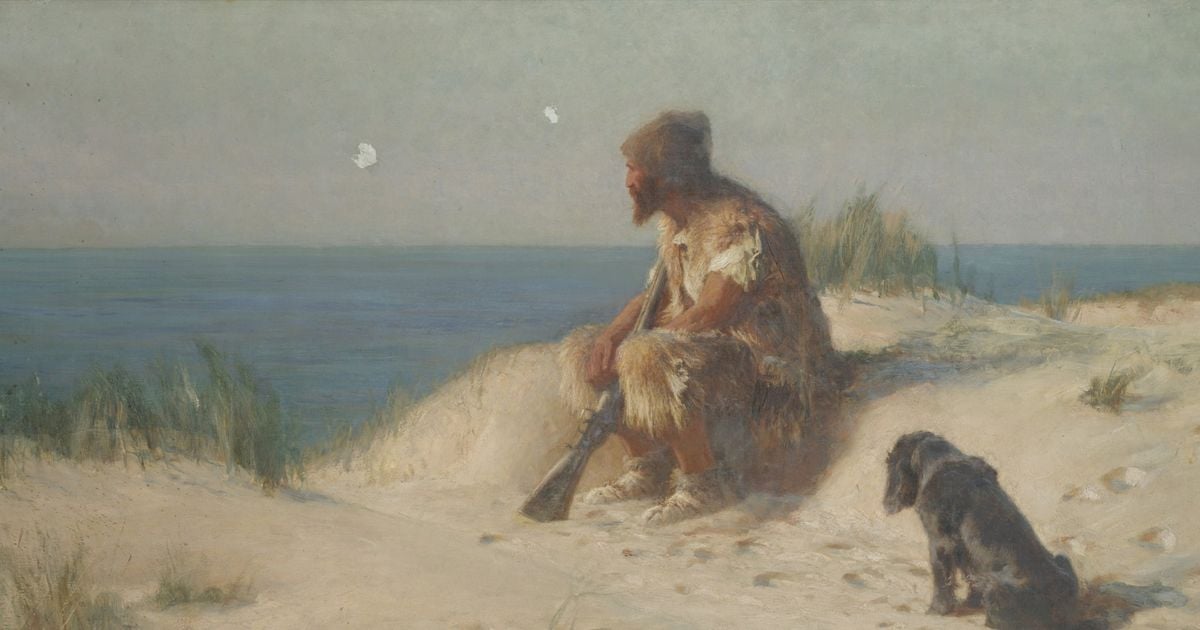
After the wreck, Crusoe laid the boat in her old harbour and for near two years walked freely only towards the east. His head was still full of escape. On a rainy March night in his four-and-twentieth year he lay awake in the hammock, unable to sleep, turning over a voyage to the mainland. The thought heated him for two hours, and then sleep came. He dreamed of two canoes and eleven men landing with a captive they meant to kill. The man broke away, ran into the grove before the fortification, and became his servant and pilot. He woke joyful, then sank when he found it was a dream. Out of the disappointment he kept one resolve: he would try to seize a prisoner already condemned to be eaten, though his heart trembled at the blood. For above a year and a half he watched the west end and the south-west corner almost every day. No canoe came, and the wait only made him more eager.
One morning five canoes were ashore on his side, the people out of sight. From the hill, his head below the skyline, the glass showed no less than thirty, a fire, and dancing. Two prisoners were dragged out. One was knocked down and cut open. The other ran along the sand towards Crusoe, gaining on the three who followed. He swam the creek in about thirty strokes. Two pursuers swam after him. The third could not, and turned back. Crusoe took his two guns, placed himself between the runner and the hunters, and beckoned. He knocked the first man down with the stock of his piece. The second fitted a bow, so Crusoe shot him dead. The runner came by steps, kneeling, kissed the ground, and set Crusoe's foot on his head. He spoke, and the sound was the first human voice Crusoe had heard in above twenty-five years besides his own. The stunned man sat up. Crusoe lent the sword, and the runner cut off that enemy's head at one blow, then buried both bodies in the sand. Crusoe led him to the farther cave, not the castle, and gave him bread, raisins, and water.
The man was about twenty-six, tall, with long black hair and a bright olive colour in his skin. Crusoe named him Friday, for the day his life was saved, and taught him to say Master, and Yes and No. In the morning Friday pointed at the graves and signed that they should dig the bodies up and eat them. Crusoe answered with disgust, and Friday came away at once. From the hill the canoes were gone, the two dead men left unsearched. At the feast place the ground was dyed with blood, and bones and scorched flesh lay about. Friday's signs said four prisoners had been brought and three eaten, and that he was the fourth. Crusoe made him burn the remains. Friday still wanted the flesh, and Crusoe let him know he would kill him if he took it.
At the castle he dressed Friday in linen drawers from the gunner's chest, a jerkin of goat's skin, and a cap of hare's skin, then lodged him in a tent between the two walls, the door barred at night and the ladders pulled in. The precaution soon looked needless. Friday was faithful, and Crusoe set himself to teach him to speak. Life grew easier, and he began to feel that if no more of those enemies came, he might never wish to leave.
In Defoe's time, class and wealth supposedly determined a person's worth: yet Crusoe discovers that Friday, deemed a 'savage' by European standards, possesses the same capacity for loyalty and moral feeling as any gentleman. This wasn't just progressive thinking; it was revolutionary. Today, we still struggle with similar assumptions. We think trust can be purchased with benefits packages, bought with expensive gifts, or manufactured through smooth talking. But real trust: the kind that survives crisis: only develops when someone proves they'll choose your wellbeing over their own comfort. The CNA who stays late with a scared patient, the neighbour who helps during your emergency, the friend who tells you hard truths when you need to hear them: these people earn trust through demonstrated character. Friday's instant devotion wasn't about gratitude; it was recognition that Crusoe had revealed his true nature under pressure. Modern workplaces, relationships, and communities all operate on this same principle: people remember who showed up when it mattered, not who talked a good game. The question isn't whether someone can be trusted: it's whether they've proven they're willing to risk something meaningful for your welfare.
Explore this chapter with AI to uncover deeper meaning and practical takeaways.
AI Discussion