
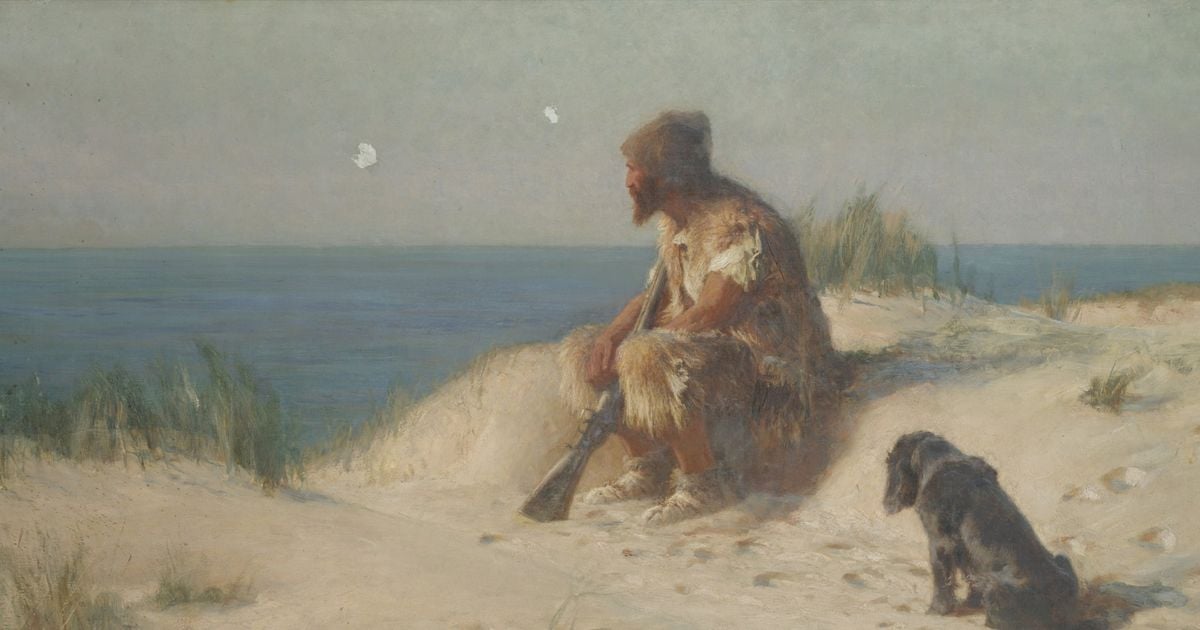
In his twenty-third year he was nearly content, Poll speaking and kids feeding from his hand, if only the visitors would stay away. The December harvest put him in the fields before daylight, and a fire showed about two miles off, on his own side. Flat on the hill with his glass, he counted nine naked people round a small fire and two canoes waiting for the flood. He could not tell men from women. They danced, and paddled off when the tide made west. Two hours later, under the weight of his arms, he reached the hill of his first dreadful find. Three more canoes had been there. Blood, bones, and flesh lay on the shore, and every canoe was making for the main.
Above fifteen months brought no further sign he could see, only bad sleep and attacks he dared not begin, lest a shot call down two or three hundred canoes. On the sixteenth of May, by his wooden calendar, a storm blew in his four-and-twentieth year, and a gun sounded at sea, then a second half a minute later. He kept a signal fire on the hill until daybreak. More guns answered. At dawn a shape lay full east and did not move. From the south rocks he saw a ship wrecked on the concealed rocks that had once saved him. Out of the pity came a longing new in its force, repeated until his hands clenched: that one soul had been saved to speak with him. Some days later a drowned boy washed up in a blue shirt, with two pieces of eight and a tobacco pipe. The pipe was the better find.
He loaded bread, water, a compass, rum, and food, and paddled to the north-east point. Fear of the currents put him into a creek until, from a hill, he saw that the flood set in along the north shore and could carry him home. He slept in the canoe and reached the wreck in less than two hours. It was a Spanish ship jammed between rocks, her stern beaten in. A starving dog swam to him. Two drowned men lay in the cook-room with their arms about one another. He took two chests, a cask of about twenty gallons, a powder-horn, and a few tools, and was back about an hour within night.
He carried the cargo to the new cave, not the castle. The cask was poor rum. The chests held silver-tipped cordial bottles, shirts, sweetmeats, and about eleven hundred pieces of eight, with six doubloons and small bars of gold. Shoes from the drowned men were pumps, not the English shoes he wanted more than the coin. The money was dirt under his feet. He laid it up in the cave anyway, thinking that if he ever reached England the rest of the wealth in the wreck might wait until he returned.
Defoe wrote Robinson Crusoe during the birth of modern capitalism, when England was discovering that individual wealth accumulation could become society's organizing principle. Yet this chapter reveals capitalism's hidden vulnerability: money only has power within social relationships. Crusoe's gold means nothing because he has no society to spend it in, no community to impress, no family to provide for. The same pattern plays out today in different forms. The small business owner who works 80-hour weeks to build wealth but loses touch with family and friends often discovers their success feels meaningless. The person who climbs the corporate ladder but eats lunch alone every day. The retiree with a full bank account but no one to call on holidays. Even in working-class communities, we see this when someone gets a big promotion or inheritance but finds themselves isolated from friends who now see them as 'different.' Healthcare workers witness this constantly: wealthy patients who are desperately lonely, their money unable to purchase genuine human connection. The pattern suggests that true wealth requires both material security and social connection. Building one without the other creates a hollow victory. The question becomes: how do we pursue financial stability while maintaining the relationships that give our success meaning?
Explore this chapter with AI to uncover deeper meaning and practical takeaways.
AI Discussion