
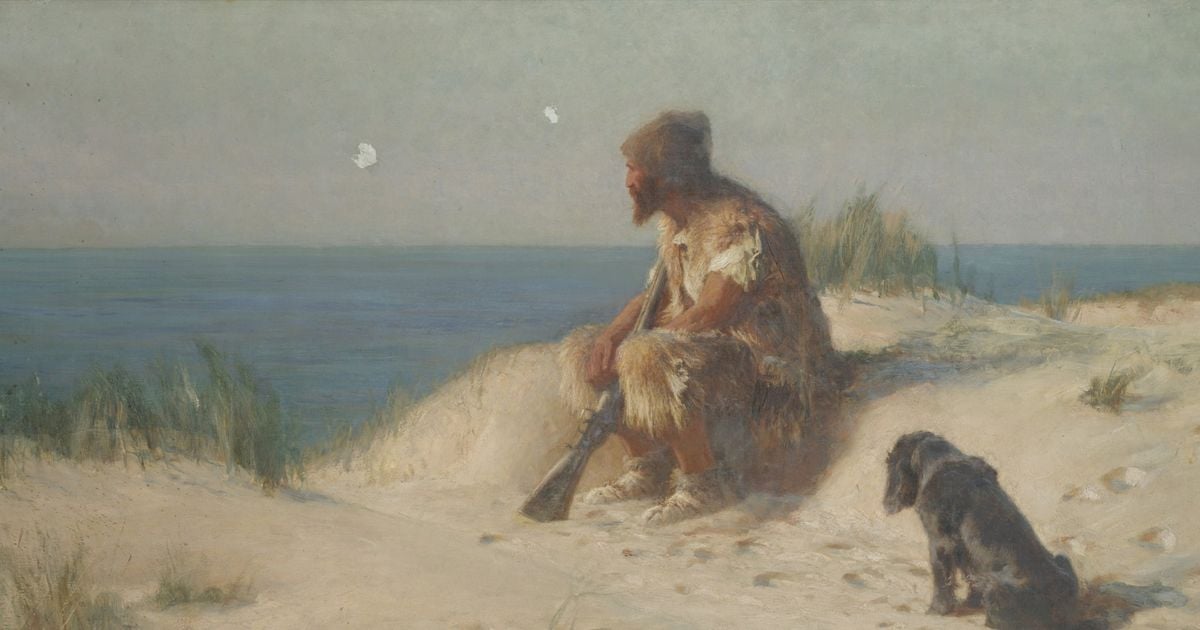
Crusoe's fear of the footprint would not let his goats stay where any visitor might find them. They were meat without powder and without the hunt, and he could not bear to lose them and start again. In the thick woods where he had once nearly lost himself, he found a damp hollow and a clear piece of near three acres, almost fenced by the trees. In less than a month he closed it and moved ten young she-goats and two he-goats there. Two years of that uneasiness had already changed his prayers. He still spoke to God, but as a man who expected each night to be murdered and eaten before morning.
Searching for a second pasture, he went farther west than ever and thought he saw a boat. He had no glass with him, and the speck was gone once he came down. At the south-west point, skulls, hands, feet, and other bones covered the shore, with the mark of a fire and a circle dug like a cockpit. He vomited, fled towards home, and then stopped to thank God that these visitors did not search his side of the island. Almost eighteen years had passed with no footstep near his habitation. Even so, for almost two years he kept to the castle, the bower, and the wood enclosure, and he would not go to his boat. Afterwards he still refused to fire. For two years, he believed, the gun never went off, though he carried it with two pistols and a bare cutlass.
He planned, night and day, to destroy the next party and save their victim. Five or six pounds of powder under their fire would waste a store already within one barrel, and he could not time the blast, so he chose an ambush instead. He loaded two muskets with slugs and smaller bullets, the fowling-piece with swan-shot, and his pistols with about four bullets each, and he found a hollow thicket to fire from. For two or three months he watched each morning from a hill about three miles off. No boat came, and the empty watch cooled him. They had done him no injury, and killing a captive was no more a crime to them than killing an ox was to him. One man escaping might bring thousands back. He thanked God on his knees, and for near a year he never climbed the hill to look. He moved the boat into a cove under high rocks at the east end, taking the mast, the sail, and the thing like an anchor, so that no sign of a boat remained.
He still feared noise and smoke, and he would not drive a nail near home. In the woods he made charcoal under turf, as he had seen done in England, so a fire at the castle would not betray him. Cutting branches, he found a hollow. Two shining eyes sent him rushing out, and a sigh like a man in pain brought him back with a flaming stick. An old he-goat lay dying of age. The next day six candles of goat's tallow lit a crawl of nearly ten yards into a vault whose roof rose near twenty feet, the walls flashing until he could not tell diamonds from gold. He moved his spare arms there. The powder barrel he had taken wet from the sea had caked on the outside and kept near sixty pounds sound in the centre. He left only two or three pounds in the castle. The goat died in the cave mouth the next day. Crusoe buried him under the rock, and the powder stayed in the dark.
Crusoe's two-year obsession with slaughtering cannibals reveals how quickly 'self-defence' can morph into something predatory. He starts legitimately afraid but gradually becomes someone who fantasizes about mass murder. The scary part? It feels completely justified to him every step of the way. This pattern shows up everywhere in modern life. The parent who discovers online predators and becomes obsessed with monitoring every digital interaction. The homeowner who experiences one break-in and begins viewing every stranger as a potential threat. The employee who faces workplace bullying and starts plotting elaborate revenge schemes. Each person feels righteous because they've been hurt or frightened. But there's a line between reasonable precaution and becoming consumed by the threat. Crusoe crosses that line when his planning becomes more about satisfying his rage than actually protecting himself. His breakthrough comes when he realizes the cannibals aren't evil by their own standards: they're just different. The real question isn't whether our fears are valid, but whether our responses are proportional and whether we're solving problems or feeding wounds.
Explore this chapter with AI to uncover deeper meaning and practical takeaways.
AI Discussion