
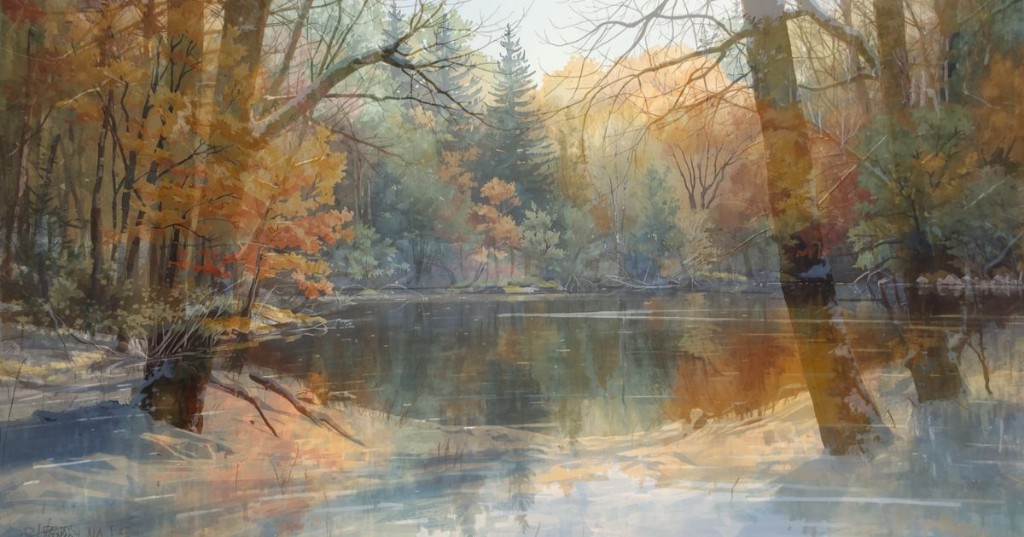
Walden Pond in winter becomes both laboratory and philosophical text. Thoreau opens by chopping through ice to fetch morning water, finding beneath the frozen surface a quiet parlor of fish suspended in amber light, a discovery that launches his central claim: the deepest things are not above but underfoot, available to anyone willing to look down rather than up.
The local fishermen who work the pond all winter embody this principle. They consult no books and hold no credentials, yet know the pond in its bones, pulling grown perch from frozen water, reading the food chain from grub to pickerel to man. Their bodies carry knowledge that scholars cannot reach. They live closer to natural rhythms than any naturalist's study penetrates.
Against village lore that Walden is bottomless, Thoreau does what no one has bothered to do: he measures. Compass, chain, sounding line, more than a hundred readings across the frozen surface. The depth resolves at one hundred seven feet, not bottomless but remarkable, measurable, and following strict natural law. The real discovery comes when he maps his soundings: the deepest point falls precisely at the intersection of the pond's greatest length and greatest breadth. This is not coincidence but geometry, and Thoreau extends the principle immediately to ethics. Draw lines through the length and breadth of a person's daily behaviors and you locate their character's depth at the same crossing. The pond becomes a tool for self-examination.
The chapter's final movement is disruption. A hundred workers descend on the ice, cutting and stacking it into a structure like a vast blue fort, bound for Charleston, Calcutta, Bombay. Thoreau watches from his window for sixteen days as they work the frozen surface that was his solitary yard. Then they leave. In thirty days the pond will return to itself, unmarked. But the ice they cut will travel to distant ports, melt into rivers that reach the Ganges, mingle with water the Brahmin's servant draws at the temple. His simple pond, measured foot by foot, turns out to be in conversation with every body of water on earth, and every person who draws from any of them draws, without knowing it, from Walden.
Thoreau discovered that locals assumed Walden Pond was bottomless simply because they'd never bothered to measure it properly. They preferred the mystery to the work of finding out the truth. This same dynamic plays out constantly in modern workplaces and communities. We often assume the loudest person is the smartest, the most dramatic situation is the most important, or the most visible worker is the most valuable. But Thoreau's methodical approach reveals something crucial: actual depth requires intersection, where sustained effort meets broad understanding. In our hyperconnected age, this distinction becomes even more critical. The coworker who posts constantly about their achievements might have less actual depth than the quiet person who's been steadily mastering both their technical skills and their understanding of how people work together. The neighbour who complains loudest at town halls might understand less about local issues than someone who's spent years quietly observing and learning. Thoreau's lesson isn't about being anti-social or dismissing all visible effort, it's about developing the patience to look deeper. When we can distinguish between performance and competence, between noise and signal, we make better decisions about who to trust, who to learn from, and how to develop our own capabilities. The question becomes: in your own life, where might you be mistaking the dramatic for the deep?
Explore this chapter with AI to uncover deeper meaning and practical takeaways.
AI Discussion