
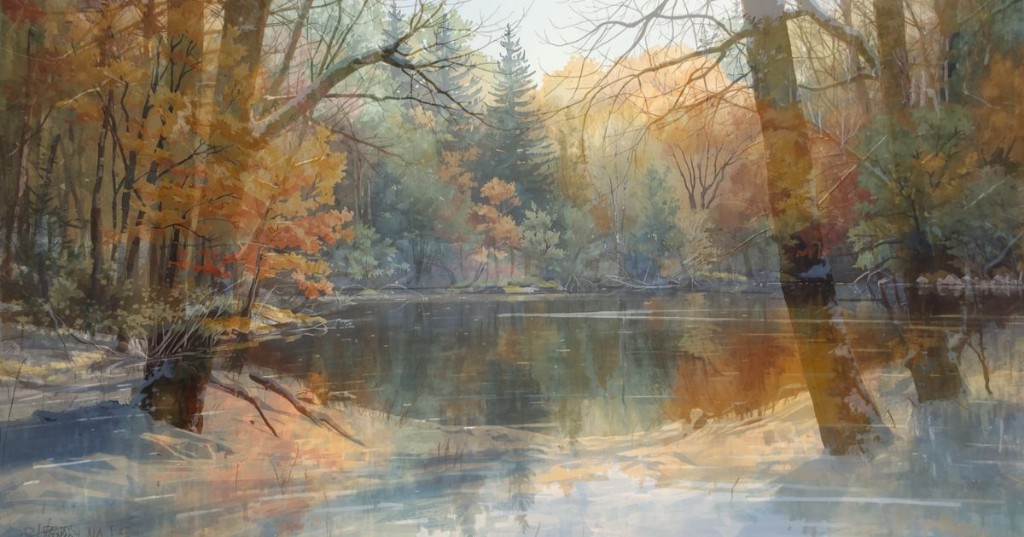
Spring arrives through a long sequence of surrenders, and Thoreau documents each one. The chapter opens not with flowers but with data: temperature readings, comparative ice thickness, dated records of when Walden has opened each year since 1845. Because of its greater depth and its lack of a through-stream, Walden is the last to break up and the most accurate register of the season's absolute progress. The pond thunders and booms as its ice responds to solar heat, a sensitivity that surprises Thoreau: something so cold and thick-skinned, attuned to atmospheric changes as finely as mercury in a thermometer.
The season announces itself in episodes rather than a single event. An old man who knows nature as well as if "she had been put upon the stocks when he was a boy" goes to Fair Haven Pond expecting ducks, lies still for an hour, and then hears what sounds like vast fowl approaching. He stands up in haste, gun ready, only to discover that the whole field of ice has drifted to shore and is grinding against it. Change arrives with the sound of something vast, even when nothing visible is moving.
The chapter's intellectual center is the railroad cut. When frost leaves the earth in spring, sand and clay flow down the bank in forms Thoreau cannot stop cataloguing: they become leaves, lobes, rivers, veins, liver, and fingers. He sees in a single thawing hillside the blueprint of all living form. Leaf, lung, lobe, and language share the same root; the earth follows the same generative logic as the bodies on its surface. This is not metaphor but direct perception. The earth is alive, always composing its next form, and the evidence is a railroad embankment in March. "The earth is not a mere fragment of dead history," he writes, "but living poetry like the leaves of a tree."
Spring returns in layers. The ice honeycombs and vanishes in a single warm rain. Grasses flame up on the hillsides, green not yellow, the symbol of perpetual youth. Red squirrels riot under the floorboards, deaf to Thoreau's complaints. The first sparrow of spring makes histories and chronologies feel beside the point. Geese arrive honking low over the woods, wheel at the sight of Thoreau's lamp, and settle on the pond. He passes his first spring night in the woods.
The moral implication is as direct as the physical one. A single warm spring morning can forgive what winter has accumulated. The neighbour who was yesterday a drunkard moves through the morning at work, renewed, every fault momentarily forgotten. Spring operates like grace: not earned, not permanent, but available to everyone who does not refuse it. Thoreau records his departure from Walden, September 6, 1847, as plainly as he recorded ice temperatures. He has witnessed one full cycle, and the cycle has taught him that the earth is not a record of past events but a living poem, always composing its next line.
Thoreau spent two years obsessively documenting Walden Pond's behavior, tracking temperatures and ice patterns with scientific precision. This wasn't nature worship, it was practical intelligence gathering. He understood that survival depends on reading your environment accurately. In 1854, missing seasonal signs could mean starvation. Today, missing workplace signals can mean unemployment. Missing relationship patterns can mean isolation. Missing health signals can mean crisis. The fundamental challenge remains the same: most of us live on autopilot, reacting to dramatic changes instead of preparing for predictable ones. Thoreau's method was simple but revolutionary, pay attention systematically, document patterns, trust what you observe over what you hope. He tracked pond temperatures not because he was obsessed with weather, but because he was training himself to see reality clearly. This skill transfers directly to modern life. The coworker who suddenly stops making eye contact isn't being moody, they're signaling a relationship shift. The manager who starts scheduling more one-on-ones isn't being supportive, they're gathering information. The friend who cancels plans twice isn't busy, they're creating distance. When you learn to read these signals without judgment, you gain the power to respond strategically instead of reactively. The question isn't whether change is coming, it's whether you'll see it early enough to navigate it successfully.
Explore this chapter with AI to uncover deeper meaning and practical takeaways.
AI Discussion