
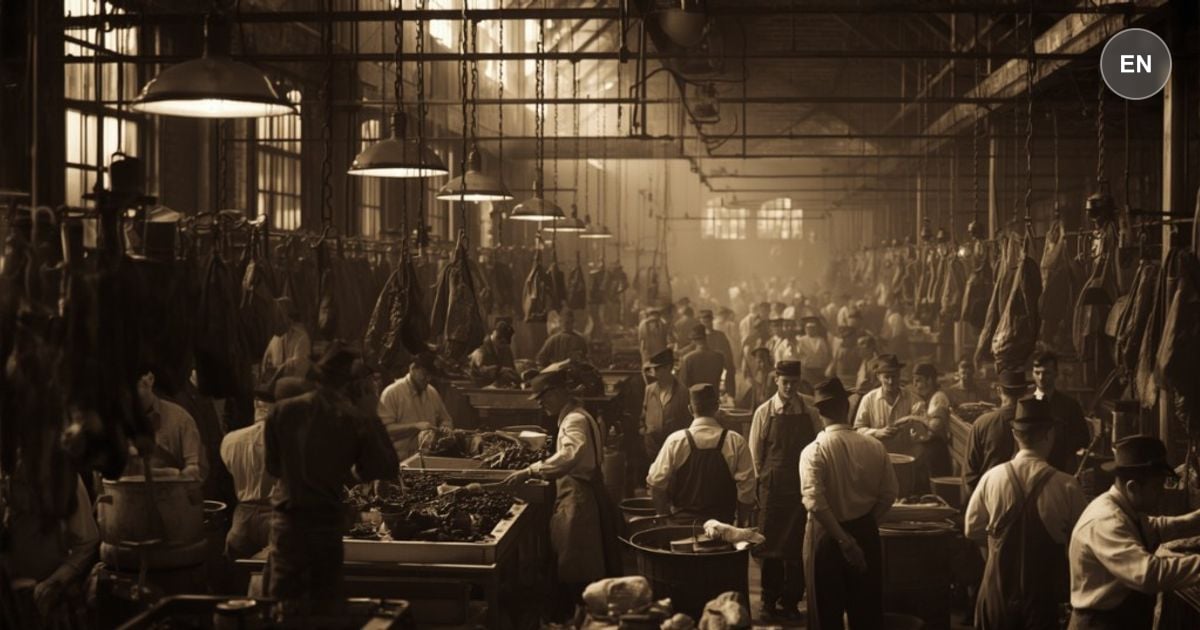
In his role as delicatessen seller, Jokubas Szedvilas knows a Durham special policeman whose job is to pick men for hire. He will try for old Antanas and for Jonas. Jurgis wants no help. He stands at Brown's not half an hour before a boss notices the height of him and runs a pantomime: Speak English? No; Lit-uanian. Job? Je. Shovel guts. See door. Tomorrow at seven. Jurgis runs home yelling that he has a job. The family's relief is complete enough to go sightseeing with Jokubas, who treats the yards like his own estate and quotes newspaper numbers with pride. Twenty-five thousand pens. Rivers of cattle on raised chutes. Hogs that climb by their own legs into a building from which none return. They use everything about the hog except the squeal, Jokubas says, pleased to pass off the guides' old joke as his own. The only green plot in Packingtown sits in front of Brown's general office.
On the killing wheel a hog is jerked off its feet and borne aloft, and the shriek that follows makes the women go pale. Once started, the hog never comes back. Visitors weep; Jurgis mutters that he is glad he is not a hog, then watches hundreds of men make pork by applied mathematics, each man two or three cuts, a head vanishing through a hole in the floor. Jokubas whispers that tourists see only what the packers permit. He offers to show rooms where spoiled meat is doctored, and he translates the cleanliness signs with a sarcasm Jurgis will not hear.
On the beef floor the pace has nothing to match it except a football match. Knockers drop steers with sledge hammers. Men work through blood at the ankles. A government inspector chats and lets tubercular carcasses pass. Durham's other buildings swallow what fell through the floor: soap and lard, fertilizer, glue, combs from horns, pepsin from stomachs, violin strings from entrails. Nothing is wasted. Jurgis feels the whole establishment has taken him under its protection and become responsible for his welfare.
He is glad he did not see the place before his triumph, because the size of it would have overwhelmed him. Now he has been admitted. He is a part of it. He does not yet know that he is already Brown's employee in a city where Brown and Durham are legally required to be deadly rivals, ordered to try to ruin each other under penalty of fine and imprisonment. He walks out still grateful, as if the plant were sunshine and rain.
Sinclair shows us something uncomfortable: how victims participate in their own exploitation through grateful compliance. Jurgis doesn't just stumble into a bad situation, he actively embraces it, running home with joy, proud to be part of the machine that will destroy him. This isn't stupidity; it's survival psychology. When you're drowning, you don't question the rope thrown to you. But systems of exploitation count on this desperation. They know hungry people don't negotiate. They know grateful people don't complain. They know people fleeing worse situations will accept almost anything. Modern examples abound: gig economy workers celebrating 'flexibility' while losing benefits and job security; students taking on crushing debt for degrees that may not pay off; families grateful for any healthcare access, even if it bankrupts them. The trap isn't just economic, it's psychological. We tell ourselves we're lucky, blessed, chosen. We become invested in defending the system because admitting exploitation means admitting our gratitude was misplaced, our hope was naive. Recognition is the first step out. When we can see how desperation distorts our judgment, we can make clearer choices. We can be grateful for opportunities while still demanding better conditions. We can appreciate what we have while working to change what we shouldn't have to accept.
Explore this chapter with AI to uncover deeper meaning and practical takeaways.
AI Discussion