
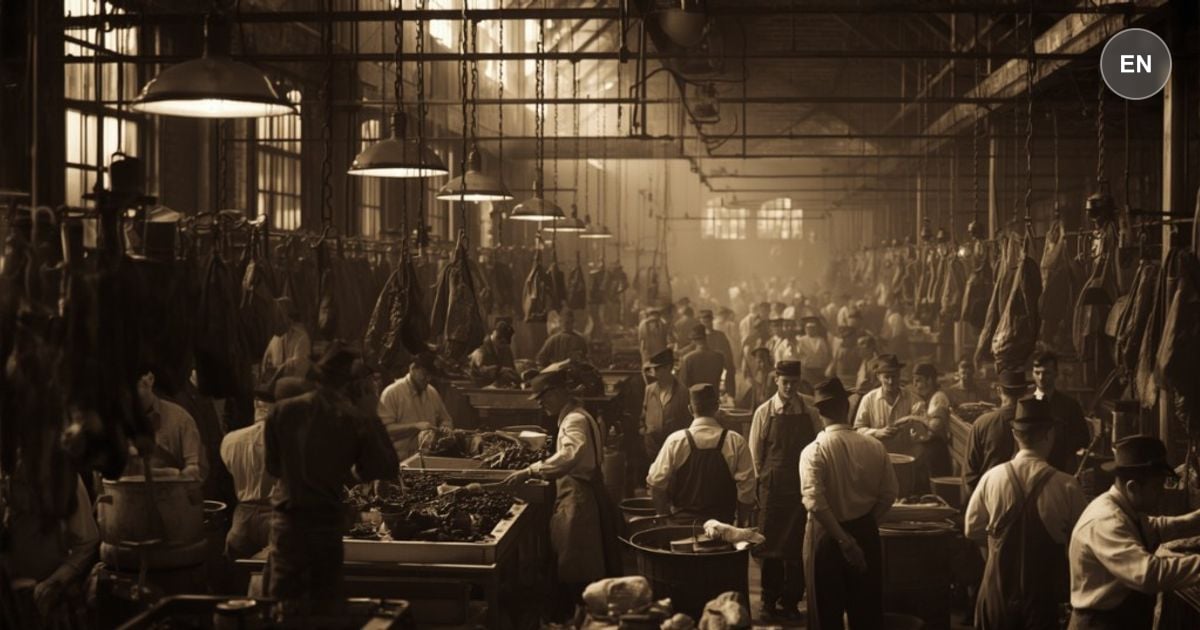
Jurgis talks lightly about work because he is young and a giant besides. Older men tell him how the stockyards break bodies; he laughs and calls them silpnas, puny fellows, and says his back is broad. He has been in Packingtown only four months. Bosses already like the sort of man who runs where he is sent and cannot imagine being beaten. The story of how he got here begins in Lithuania, on a few acres of cleared wilderness. One brother vanished into the army. A sister's husband bought the place when old Antanas decided to leave. Ona would not marry away from Teta Elzbieta. Jonas named America, where a friend had grown rich, and Jurgis figured three rubles a day into a future: marry Ona, be free of officials and the army, and count himself as good as any other man.
To raise the passage money he sold himself to a railroad contractor and tramped nearly four hundred miles to Smolensk. Filth, bad food, cruelty, and overwork did not break him. He sewed eighty rubles into his coat, dodged the company gamblers, and walked home when they tried to kill him. In summer twelve of them set out, Marija joining at the last moment after she rose up against the Vilna farmer who had beaten her since childhood. An agent trapped them with officials on the passage. In New York a man in a blue uniform led them to a hotel whose rate card was not in Lithuanian and charged them ruinous prices to leave. They knew one word, Chicago, and when they tumbled onto Dearborn Street they were still lost. They crossed the road to avoid policemen until one of those same uniforms found them cowering in a doorway, found an interpreter, and taught them a new word: stockyards.
The trolley carries them into the smell they have been tasting for an hour. Chimneys throw oily black columns as if from the centre of the world. Jokubas Szedvilas, who keeps the delicatessen on Halsted Street, rescues them at last and sends them to Aniele Jukniene's boardinghouse, where mattresses block the front door, chickens patrol the porch, and the same beds rent to day and night shifts. Aniele is doubled with rheumatism. Eleven boarders already in her debt have left for Kansas City. There is nothing better to be had. A few days of American prices have already killed the dream of easy riches; they spent home wages on railroad food and arrived poorer than they had imagined.
What follows is a walk through made land. Packingtown's streets sit on garbage dumps. Children play in green pools and rake city refuse for scraps. Brickyards fill holes with waste. Winter ice is cut from festering sumps and sold without a thought for germs. On the trolley the odour thickens until they can take hold of it. Some drink it in; others cover their faces. Yet as the sun sets, the chimneys bloom black and brown and grey and purple against the sky, and the sordid suggestions fall away. Arm in arm, Jurgis and Ona watch the yards become a vision of employment for thousands, of freedom, of life and love and joy. When they walk home he is already saying it: tomorrow he will go there and get a job.
Sinclair reveals something uncomfortable: our best qualities can become our greatest vulnerabilities. Jurgis's optimism, work ethic, and determination, traits we celebrate, make him the perfect target for exploitation. This isn't about becoming cynical; it's about understanding how predatory systems operate. They don't just prey on desperation. They actively cultivate and weaponize hope. Modern examples are everywhere. MLM schemes target ambitious people with dreams of financial freedom. Gig economy platforms market 'flexibility' to people who need income, knowing they'll work below minimum wage chasing entrepreneurial dreams. Healthcare systems exploit workers' desire to help patients, loading them with impossible caseloads. Dating apps monetize loneliness by selling hope while designing algorithms that keep users paying and scrolling. The pattern is consistent: legitimate opportunities help you build skills and advance, while exploitative ones profit more from your participation than you do. The key isn't losing hope, it's learning to protect it. Before committing to any 'opportunity,' find people who've been there three years and listen to their unfiltered experience. Trust pattern recognition over promotional materials. When you can distinguish between genuine opportunity and hope-based exploitation, you're not being negative, you're being strategic.
Explore this chapter with AI to uncover deeper meaning and practical takeaways.
AI Discussion