
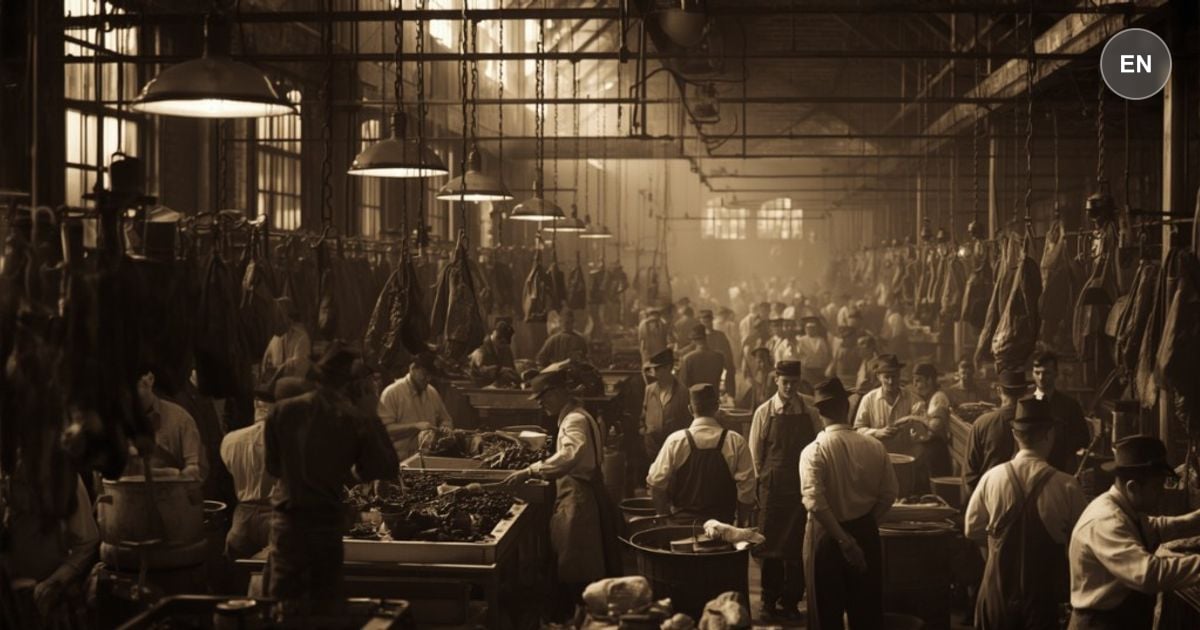
While Jurgis walks the yards looking for work, little Kristoforas dies. He is Elzbieta's last child, over three and no bigger than a one-year-old, crawling in drafts with rickets and a hip that never let him walk. His brother Juozapas already lost a leg under a wheel. An hour after smoked sausage that morning, which may have been tubercular pork condemned as unfit for export, the boy is in convulsions. Kotrina is alone with him. A doctor comes after the last howl. Only Elzbieta is inconsolable. Jurgis says the city must bury him. She screams at a pauper's grave. Marija puts in ten dollars; Elzbieta begs the rest from neighbours; the child gets a mass, a hearse with white plumes, and a wooden cross. She weeps at the floor where he crawled. A Chicago billionaire had brought a European surgeon for the same disease in his own daughter, and the surgeon had offered to treat poor children. Elzbieta did not read the papers. She would not have had the carfare anyway.
The lowest work in Packingtown waits in Durham's fertilizer mill, away from visitors, where tankage is dried and ground and the air is a blinding sandstorm of bone dust and ammonia. Men talk of it in whispers. Jurgis applies and hopes he will not be taken. In June heat the grinding-room boss beckons. Jurgis shovels a brown river of powder into carts he cannot see. In five minutes he is coated; in fifteen he is dazed; in half an hour he vomits until he can barely stand. Streetcar passengers rise and leave when he sits. At home the food tastes of him and the family vomits. He goes back anyway. By week's end he can eat again, though his head never stops aching. He is a fertilizer man for life.
Summer work lets them pay debts and talk of sending Vilimas and Nikalojus back to school. The boys have learned swearing, cigar stumps, dice, and the names of the houses on the Levee; they sleep in doorways when the weather is fine so long as a half-dollar comes home. Jurgis sees the next step as not coming home at all. Elzbieta takes their place on the sausage line. Thirteen-year-old Kotrina keeps house, the crippled brother, and the baby. Elzbieta stands motionless from seven until half-past twelve and again until half-past five in a damp dark room the colour of the sausage she stuffs. The machines birth endless casings. The woman twisting links works so fast the eye cannot follow, piecework racing with death, two wrinkles in a pale forehead, and visitors who stare as at a beast and then remember they should move on. She does not move on.
Sinclair shows us something crucial about how power operates: it doesn't just limit your choices, it eliminates them entirely while maintaining the fiction that you're choosing freely. Jurgis 'chooses' the fertilizer plant the same way people today 'choose' predatory loans or gig work without benefits, when starvation is the alternative, it's not really a choice. The system is designed this way. Notice how information gets hoarded: Elzbieta never knew about the surgeon who could have saved her child because that knowledge wasn't meant for people in her neighborhood. Today, we see the same pattern, free legal aid, healthcare programs, and educational opportunities exist, but they're not advertised where working people will see them. The cruelest part is how the system creates hierarchies among the exploited. Fertilizer workers look down on the unemployed, sausage workers look down on fertilizer workers, keeping everyone focused on the person below instead of the system above. We see this today in debates about minimum wage workers versus welfare recipients, or documented versus undocumented workers. The real question isn't whether people are making good or bad choices, it's whether they're being offered real choices at all. When you can recognize the architecture of impossible choices, you stop blaming individuals for systematic problems and start looking for the alternatives they don't want you to see.
Explore this chapter with AI to uncover deeper meaning and practical takeaways.
AI Discussion