
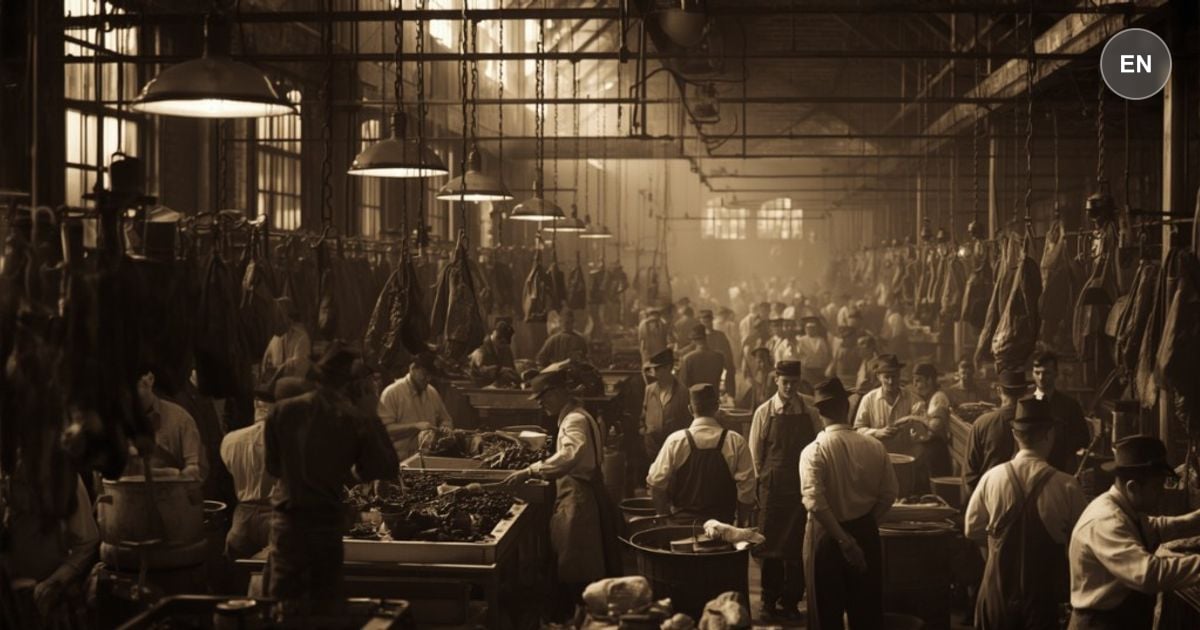
For three weeks after the sprain Jurgis does not leave the bed. The swelling will not go down. He talks himself into walking, then limps to Brown's, where the boss is willing to turn the replacement into the snow. Pain stops him an hour before closing. Two men help him to the car. He sits in the snow until someone finds him. A doctor they should have called at the start wrenches the tendon into place and tells him two months of quiet, or he may lame himself for life.
Three days later another storm. Jonas, Marija, Ona, and Stanislovas set out before dawn. At noon the boy comes back screaming: his fingers are frozen. They hold them to the fire. Jurgis, chained to the bed, swears he will kill the child if the screaming does not stop. In the morning he beats Stanislovas with a stick so the boy will go back to the lard machine. Three finger joints stay ruined, and after that every fresh snow means another beating. Ona finds her place saved only because the forelady failed to come. About the end of March Jurgis sees Ona's bankbook: three dollars left in the world. Then Jonas does not come home on a Saturday night. Durham's says he took his week's money and left. He may have fallen into a rendering tank. More likely he walked toward green country after two years yoked to a truck in the cellars, unpaid in thanks, crowded from the fire. Income falls by more than a third while mouths fall by one. They borrow from Marija and from Tamoszius. Vilimas, eleven, and Nikalojus, ten, are given a quarter each and sent to sell papers. A man steals their money; a newsman thrashes them for trespass; they learn to sneak onto cars and cry so a stranger pays the fare. They bring home twenty or thirty cents. Ona grows paler in the spring rains and weeps at night asking if Jurgis still loves her. He has grown matter-of-fact under the bills and can only try to remember when he last spoke cross.
In late April the doctor gives him a bandage and leave to work. On Brown's killing floor the foreman says it has not been possible to keep the job. Jurgis knows that means a man already there is easier to keep. He stands in the doorway like an outcast, then takes his place with the unemployed mob. He is thin, seedy, no longer the man bosses walked toward on the first day. Union brothers cannot speak him into a place. Watchmen learn his face and order him out. When the morning crowd fails he goes home and plays with Kotrina and the baby. He sees the meaning plainly: he is second-hand, a damaged article. The yards wore him out with speed-up and carelessness, and now they do not want him. Most of the men beside him were overworked until an accident or a sickness laid them down. Unless the firm is legally liable, a job back is only courtesy, and courtesy lasts two years if a lawyer has already been sent. He still has to find work before the next winter. The pitiful little face of his wife is what keeps him from the saloons.
Sinclair's 'damaged article' concept reveals something chilling about how economic systems treat human beings. Jurgis becomes worthless the moment his body can't keep pace with industrial demands, not because he's lazy or incompetent, but because the system is designed for disposal, not repair. This isn't a historical artifact. Today's gig economy operates on identical principles. Uber drivers are 'deactivated' for low ratings without appeal. Amazon warehouse workers are terminated for missing productivity targets while injured. Restaurant chains schedule workers just under full-time to avoid benefits, then cut hours when business slows. The language has evolved, we say 'rightsizing' instead of firing, 'independent contractors' instead of employees without rights, but the mechanism remains unchanged. Systems extract maximum value from human labor, then discard people when they become inconvenient. The most insidious part is how this disposal gets disguised as personal failure. Workers blame themselves for not being 'flexible' enough, not 'adapting' to changing markets. But Sinclair shows us the truth: this isn't about individual inadequacy. It's about systems designed to prioritize efficiency over human dignity. Recognizing this pattern doesn't make it disappear, but it does something crucial, it shifts responsibility back where it belongs and helps workers prepare for a reality where loyalty flows only upward.
Explore this chapter with AI to uncover deeper meaning and practical takeaways.
AI Discussion