
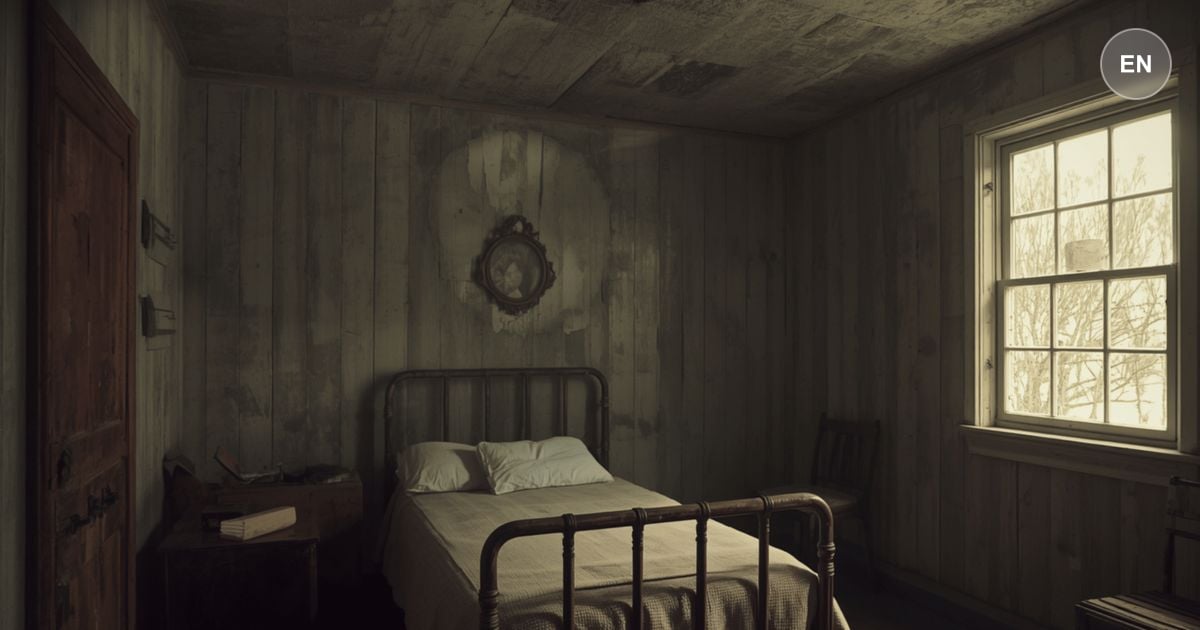
Once a month, the whole house holds its breath. This is Ceremony night, and everyone in the Commander's household feels it differently: dread dressed as duty, jealousy dressed as piety, violation dressed as scripture. Cora polishes surfaces and avoids Offred's eyes. Rita mutters under her breath. Serena Joy puts on her Wife's blue dress like armor, and somewhere behind a closed door, Offred hears her crying. The house tightens around everyone inside it.
Offred bathes, oils her skin when she is permitted to, and pulls on her red dress. She eats lightly because nausea comes afterward. She has learned to treat the Ceremony the way you learn to treat bad weather: you know it is coming, you know it will be violent in its own way, and your only job is to survive it. Before she even climbs the stairs, she begins practicing absence. She rehearses leaving her own body behind.
Dinner is performance. Fred speaks about politics. Serena agrees. The Marthas serve. Offred sits silent, eating what is put in front of her. Nick is not at the table, but she is aware of him anyway, a quiet presence at the edge of her attention. She wonders whether the Guardians joke about what happens upstairs. She wonders whether Fred actually believes the theology he enforces.
Flashbacks to Luke pull at her throughout the evening. His touch was chosen. There was laughter. The contrast with what is about to happen is almost unbearable, but she holds onto those memories anyway because they remind her that her body once belonged to her.
In the kitchen, Serena grips Offred's hand with painful force. It is a preview of the Ceremony itself: physical contact without consent, intimacy hollowed out and made into policy. Offred understands, in that moment, that Serena is also trapped. The Wife has more room to hate, more status, more comfort, but she did not choose this either. The system that harms Offred also uses Serena.
The lamps come on. Prayers begin. The Bible sits open to Genesis, ribbon marking the passage that Gilead has turned into law. Offred climbs the stairs. Her heart beats fast, the way an animal's does when it senses danger and has nowhere to run.
There is a difference between what a system asks for and what it actually takes. Gilead asks Offred to show up. What it takes is harder to name: the use of her body, the performance of her compliance, and the slow erosion of her sense that she has any say in what happens to her. The Ceremony is designed to look like participation. It has prayers, a ritual order, assigned positions, a passage from scripture. It looks like something everyone agreed to. Nobody in that room agreed to it. Atwood is precise about this. The Wife cries beforehand. The Marthas avoid eye contact. Offred rehearses leaving her own body behind. The system does not need enthusiasm or belief or even silence. It only needs bodies in the room. This is how many institutions operate right now, not through force alone but through the architecture of participation. A hospital system that requires nurses to sign off on staffing ratios they know are unsafe, because refusing means losing the job. A church that requires attendance at events where a member who harmed someone will also be present, because absence would be read as disloyalty. A family that expects everyone at the holiday table, performing togetherness, because the alternative is being cut off. In each case, the institution frames the demand as duty, tradition, or care. It rarely names what it is actually asking you to absorb. Atwood gives us a tool for seeing through that framing. She shows us that the cost of enforced participation is not just the moment itself. It is the rehearsal. The preparation. The way you have to hollow yourself out in advance just to get through it. The question worth sitting with is this: in your own life, where are you showing up not because you chose to but because the cost of not showing up was too high? And what are you holding onto, quietly, that the system has not managed to reach?
Explore this chapter with AI to uncover deeper meaning and practical takeaways.
AI Discussion