
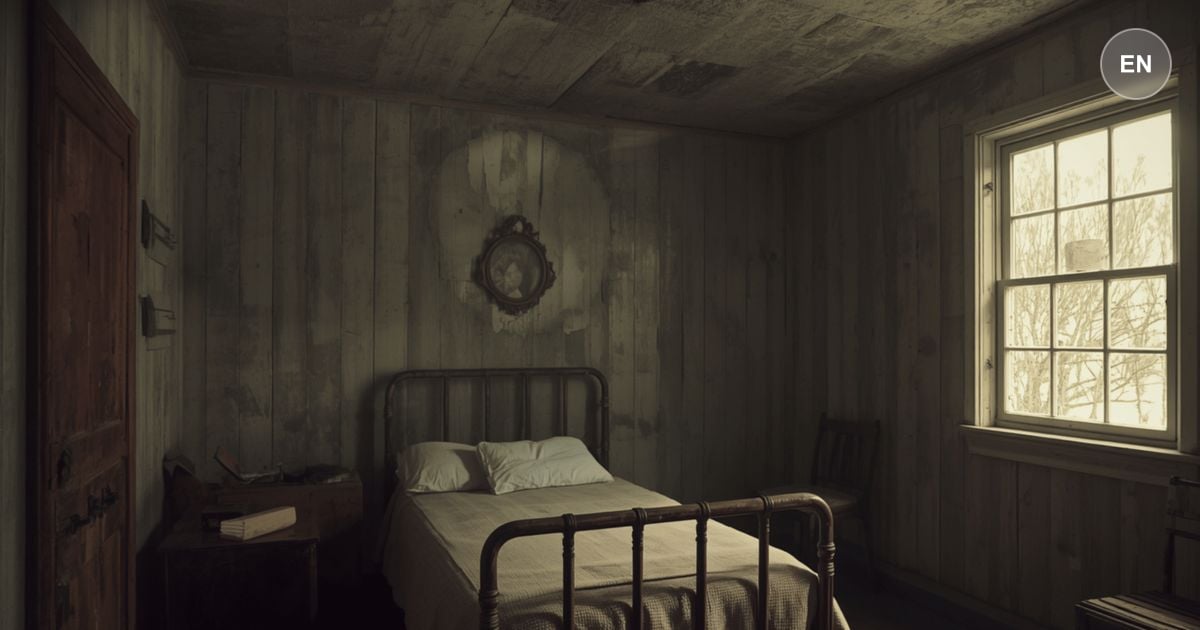
Once a month, the state of Gilead claims Offred's body through a ritual it calls the Ceremony. The Commander Fred reads from Genesis, the story of Rachel giving her handmaid Bilhah to Jacob, as if old words can make a new wrong holy. Then Serena Joy lies on the bed and holds Offred's head in her lap, not out of tenderness but because Gilead requires the Wife to be present. The three of them form a shape the regime calls legitimate. Offred calls it something else, though she cannot say it aloud.
She survives by going somewhere else inside herself. She counts ceiling cracks. She remembers the colour of the ocean, the sound of Luke's voice. Her body stays in the room; the rest of her does not. This is not weakness. It is the oldest human defense against powerlessness, the ability to protect the self by shrinking it down to a point that cannot be touched.
Afterward, the household reassembles itself as if nothing happened. Fred adjusts his uniform and returns to being a statesman. Serena releases Offred's head the way you drop a tool you are finished using. Offred walks downstairs feeling scraped hollow. She washes with cold water. She does not sleep. Instead she composes sentences in her mind, letters addressed to a daughter she cannot name out loud, words she cannot write down.
The chapter also carries the weight of the woman who came before her. The previous Handmaid in this house hanged herself in the closet. Offred now understands the graffiti scratched into the wall in a way she did not before. Someone endured this same room, this same ceiling, this same monthly calendar built around her body, and chose rope over one more month of it. That knowledge does not break Offred. It clarifies something for her.
Atwood never sensationalizes any of this. The horror lands harder because it is described with such flatness, such procedural calm. That is the point. Gilead has turned violation into paperwork, into theology, into duty. The most dangerous thing about systems like this is not their violence. It is their patience. They do not need you to agree. They only need you to show up.
Offred whispers a Latin phrase she does not fully understand yet. She decides it means: do not let the bastards grind you down. Meaning, she is learning, is its own form of resistance.
There is a specific kind of wrong that is almost impossible to fight because it never announces itself as wrong. It shows up on time. It uses the right words. It has a form you can fill out and a process you can follow and sometimes even a prayer you can say over it. Atwood understood this in 1985, and the insight has only grown more useful since.
Gilead did not invent the transformation of harm into procedure. It perfected a technique that institutions have used for a very long time. The Ceremony in this chapter is not chaotic or violent in the way we usually picture violence. It is orderly. It has assigned positions and a reading from scripture and a beginning and an end. The Commander does not think of himself as a predator. He is fulfilling a function. Serena Joy does not think of herself as complicit. She is performing her role. Offred does not think of herself as a victim, at least not in the way the word usually works, because the whole structure of the ritual is designed to make victimhood feel like misunderstanding.
This is what makes procedural harm so durable. It does not need your agreement. It only needs your presence. Show up enough times and the showing up itself starts to feel like consent, even to you.
You can find this pattern in places that have nothing to do with Gilead. A nursing home that is chronically understaffed holds mandatory training sessions on patient dignity. A meatpacking plant posts safety posters above the line where workers lose fingers at a documented rate. A school district requires teachers to document every accommodation for a student with disabilities while cutting the staff who would actually provide them. The paperwork is real. The intention behind the paperwork is real. The harm is also real. All three things exist at once, and the paperwork makes it very hard to say so without sounding like you are the one who does not understand how things work.
Offred's response is the one worth studying. She does not fight the ritual directly. She names it, privately, precisely, in her own language. She keeps the truth of what is happening alive inside herself even when she cannot say it out loud. That act of internal naming is not passive. It is the thing that keeps her a person rather than a function.
What would it take to name something in your own life that has been wrapped in procedure for so long it has started to feel inevitable?
Explore this chapter with AI to uncover deeper meaning and practical takeaways.
AI Discussion