
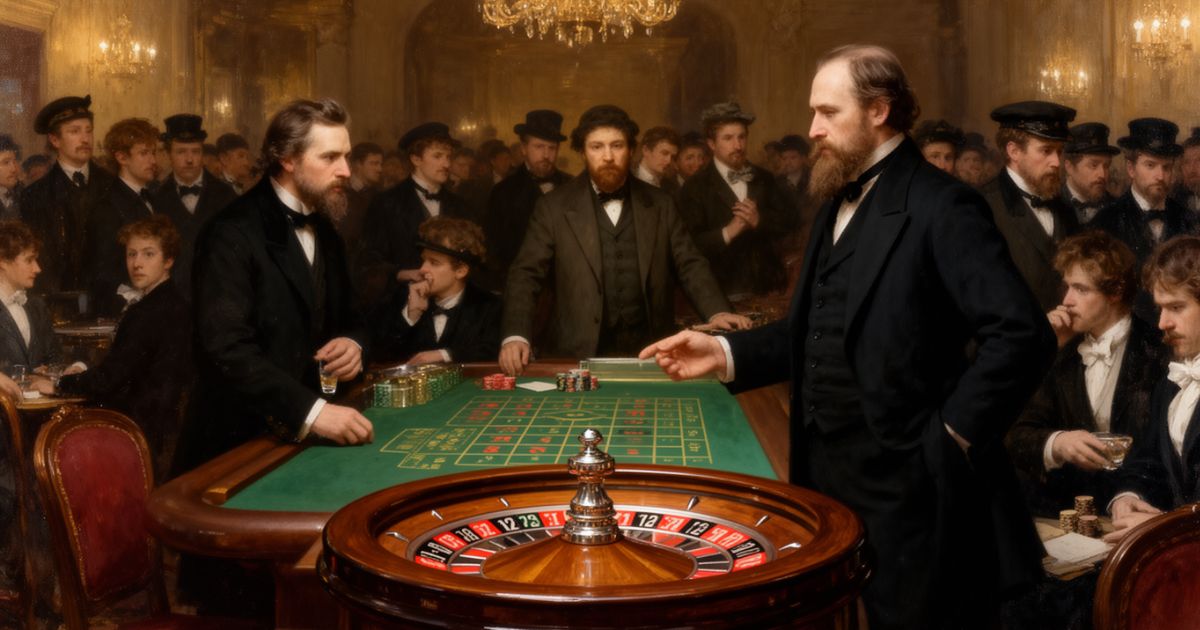
Two days later he is still the cause of the noise, and he cannot tell whether he ran amok or did the thing as a schoolboy does, from the desk, out of mischief. It came of Polina. She had told him only to take off his hat. He stepped into the middle of the carriage-way, bowed, and said in French that he had the honour to be the Baroness's slave: Madame la Baronne, j'ai l'honneur d'être votre esclave. The bow and the effrontery were his own invention. The Baron growled Hein. Alexei answered Ja wohl. The Baron brandished his stick and asked if he was mad. Alexei drew the sound out until the Baron and Baroness almost fled. When he was still a hundred paces off, she rose and set out for the hotel with the children. At the portico he said he had done the piece of idiocy. Have you? Then you can take the consequences. She did not look at him.
He walked on into a neighbouring principality, ate an omelette, and came back at eleven to a summons. The General stood by the writing-table. De Griers lolled on the divan. Alexei gave them the Berlin story of Ja wohl, and the pleasure grew as he made it grosser. The Baron had complained in the Casino. The General had given his word that Alexei would cease to belong to the household, then admitted the Baron had not required it. The parting money is forty gulden and three florins, and from tomorrow the General will not answer for the hotel. Alexei says the fault is the General's, for answering for a tutor of twenty-five who is not his son and not his ward. The General hears a challenge, and tells the Frenchman so. The Frenchman laughs. The fury breaks into pleading. He catches Alexei by the hand. O Alexis Ivanovitch, Alexis Ivanovitch. He must move with especial care, and he will take him back when they leave this place. Alexei promises that everything shall be done decently and in order, and goes toward the door.
The person he means to frighten is not the Baron. He wants Polina to beseech him to stop, and still to see that he is no draggle-tailed cockerel. On the stairs the chambermaid says the General's sister, Maria Philipovna, has left by the night train for a cousin at Carlsbad. The trunks were packed early in the day. Three days ago there were high words with the General. He guesses they were about Blanche. Something decisive is approaching.
Dostoevsky understood something modern psychology has confirmed: we create drama when we feel powerless. The narrator can't make Polina love him, so he picks a fight with strangers where he gets to be the noble defender of his honor. It's not about the Baron and Baroness, it's about psychological relief. This pattern repeats across every workplace, family, and community. The employee who can't get promoted starts conflicts with coworkers. The parent struggling with a rebellious teenager becomes the neighborhood watchdog. The patient frustrated with slow recovery takes it out on the nursing staff. Each manufactured crisis provides temporary emotional relief, we get to feel righteous and in control, while avoiding the harder, real problem. Dostoevsky shows us this isn't moral weakness; it's human psychology. The narrator knows his behavior is self-destructive but can't stop because the alternative, facing his powerlessness with Polina, feels unbearable. Recognition is the first step toward change. When we name this pattern, we can channel that frustrated energy more productively. Instead of creating chaos, we can focus on what we actually can control, even if progress feels slower.
Explore this chapter with AI to uncover deeper meaning and practical takeaways.
AI Discussion