
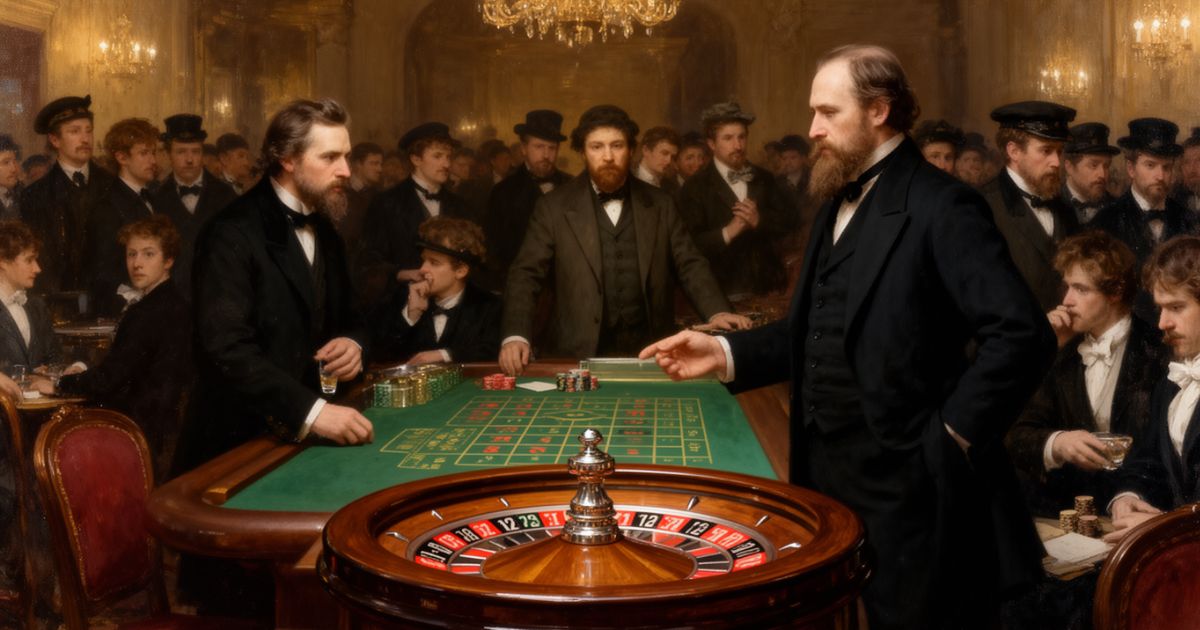
On the walk to the fountain she calls the Marquis a brute, and the word stops Alexei, because he has never heard her say it. The General is mortgaged to De Griers with all his property. If the grandmother does not die, the Frenchman will own what he now holds only in pledge, and Blanche will never become the General's wife. Polina shudders at the telegrams that ask whether the old woman is dead, then asks why he is so cheerful about the money he has already lost for her. He still has a hundred and twenty gulden. He is certain that the moment he plays for himself he will win, and that she may take what she needs. She grimaces. Then she tells him she is in debt. She borrowed, and she must pay it back. She says she is bound to win at the tables. She cannot tell why. That assurance is now her only resource. He tells her it is a drowning man catching at a straw. She reminds him that two weeks ago he was just as certain, and that he was not joking. The day's losses have raised a doubt, and still he answers that he must win, because it is the one resource he has left. She says that perhaps one cannot help winning if one is fanatically certain of it. She doubts he can take anything seriously.
He asks if the debt is the Frenchman's. She asks if he is drunk. He answers neither. He tells her that slaves cannot be shamed. She says that if he will not purchase her, he still means to purchase her respect. The rustle of her dress, he says, is enough to set him biting his hands. He reminds her that on the Shlangenberg he whispered she had only to say the word and he would leap. She says that would have been of no use to her. His eyes are full of blood, and the foam has caked on his lips. He swears he would have leapt for a jest, or for contempt, with a spit in his face. She says she believes him, in a tone of such disdain that he knows she stands in peril. Then she asks, and waits, whether he would kill whomever she wished. He says he will. She tells him she will bid him do it, or else he must renounce her, and that he would kill the person and then kill her for having sent him away. The man still has no name. His heart shakes.
She bursts out laughing. The children are playing by the bench, opposite the alley where the carriages set people down before the Casino. There is the fat Baroness Burmergelm, and her tall, wizened Prussian with a stick. Take off your hat, she says, say something in French, and let me see the Baron thrash you with his stick. Instead of murders and tragedies, she wants a good laugh. Go, for such is her will. He says the fancy will do the General a disservice, and through the General a disservice to her. She calls him a trifler. She says his eyes are swimming with blood only because he drank too much at luncheon. She knows the errand is foolish and wrong. She wants the laugh all the same. She is already laughing on the bench. He has turned away in silence, as excited as a schoolboy, and the stick has not yet moved.
Dostoevsky understood something that modern psychology confirms: desperation makes us vulnerable to manipulation because it narrows our perception of options. When the General's family faces financial ruin, they can't see alternatives to gambling or accepting the Marquis's humiliating terms. When the narrator obsesses over Polina, he can't imagine life without her approval, so he'll do anything to keep it. This tunnel vision is exactly what manipulators count on. They don't create your desperation - they just exploit it. In today's gig economy, this pattern repeats constantly. Workers accept unsafe conditions, unpaid overtime, or harassment because they need the income and believe they have no alternatives. Patients stay with doctors who dismiss their concerns because they fear losing access to care. People remain in toxic relationships because they've been convinced no one else would want them. The manipulation follows a predictable escalation: small requests that seem reasonable, then bigger asks framed as tests of loyalty, then demands that compromise your values but feel impossible to refuse. Each 'yes' makes the next request harder to deny. The antidote isn't eliminating desperation - that's often beyond our control. It's learning to recognize when someone is using our vulnerability against us rather than helping us address it. Real support builds your options and strengthens your position. Manipulation keeps you dependent and isolated.
Explore this chapter with AI to uncover deeper meaning and practical takeaways.
AI Discussion