
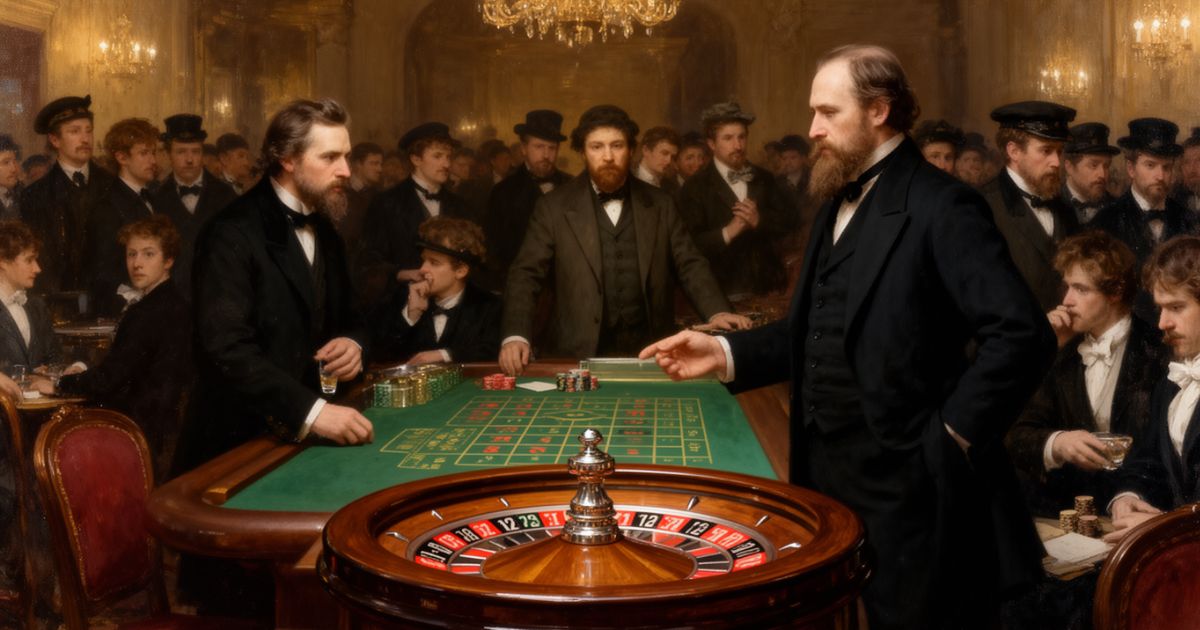
He tells the maître d'hôtel that the bill is now his own. He has a hundred and sixty gulden left, and he thinks and feels as a man who is about to be rich, though he has not yet won anything. He is on his way to Mr. Astley at the Hôtel de l'Angleterre, hat already in his hand, when De Griers walks in. The Frenchman has never come to the room before. He is affable, and he praises the room, until he hears the name Astley. Then he stops, and looks grave.
He has come from the General, to ask that last night be dropped. The Baron will not receive Alexei. There are police. At the first favourable chance the General will take him back and credit the salary. Alexei says the Baron must first express his own regret, in full, or any apology will look like a bid for the post. De Griers mentions Blanche, and a marriage that is not yet settled, because they are waiting on news from Russia. Alexei asks if that news is the General's mother. De Griers gives him a look of hatred. Alexei says he was about to ask Astley, nephew of Lord Piebroch, to go as his second. The Baron will have to receive an Englishman of that rank. De Griers, who had grown hard, grows soft. Alexei rises and reaches for his hat. Only then does the Frenchman take out a small wafer-sealed note, and say he must carry an answer back.
The hand is Polina's. Stop playing the fool. She has need of him. He promised to obey. Remember the Shlangenberg. If necessary she will bid him. The postscript asks him to forgive last night. His lips go pale, and he begins to tremble. He tells De Griers she need not disturb herself, and asks why the note waited so long. The Frenchman says he did not know what was in it, and that he wanted first to learn how far Alexei meant to go. Alexei asks whether it was to be handed over only in the last resort, if nothing else would appease him. Perhaps, says De Griers, and he goes out with the smile. Alexei goes down the stairs. The Baron is already dropped. The circumstances she said she might explain are still later.
Dostoevsky understood something chilling about human nature: the people we love most can become the most effective weapons against us, often without even knowing it. In 1867 Russia, this played out in aristocratic drawing rooms. Today, it happens in break rooms, living rooms, and boardrooms across America. The pattern is always the same: someone who can't control you directly finds someone who can influence you emotionally, then uses that person as a messenger. Your abusive boss can't fire you for whistleblowing, so they get your work friend to mention how 'difficult' things have become for the whole team. Your toxic ex can't manipulate you anymore, so they use your children to deliver guilt trips about 'breaking up the family.' Insurance companies deny your claim, then have your own doctor suggest maybe the treatment isn't really necessary. The manipulation works because it comes wrapped in genuine care from someone whose opinion matters to you. The messenger often believes they're helping, protecting you from making a 'mistake.' But ask yourself: why isn't the real decision-maker talking to you directly? Who benefits when your own feelings are turned against you? When someone truly respects you, they speak to you themselves. When they send intermediaries carrying emotional appeals, they're not protecting you - they're protecting their own interests. The question isn't whether the messenger cares about you. The question is: who's really pulling the strings?
Explore this chapter with AI to uncover deeper meaning and practical takeaways.
AI Discussion