
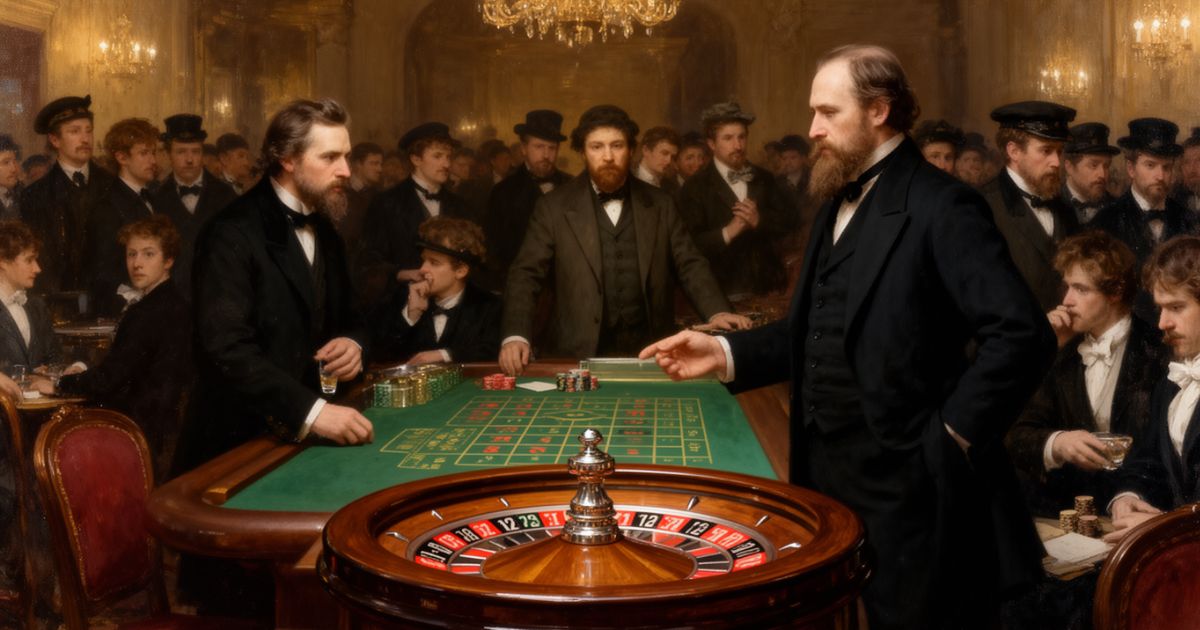
This morning she handed him six hundred gulden, and he set two conditions. He would take nothing if he won. That evening she would say why she needed the money, and how much. She promised. There was a crowd, and men with ruled papers lost exactly as he did. In five minutes he had about four thousand gulden in his hands, which was the moment to leave. Instead he wanted to slap Fate on the cheek and put out his tongue at her. He set down the largest stake the rules allow, four thousand, and lost. Then he staked what remained, and lost that too. He walked the park in a stupor until he could tell her, before luncheon, that the money was gone.
At the table Blanche has already seen him in the rooms, and the Frenchman asks whether the money was his own. Alexei fires up and says it was. The General asks where it came from. Alexei says he began with a hundred gulden and lost five or six thousand in two rounds. Nothing shows on Polina's face. She lets the lie stand, so he takes that for his cue, and remembers that tonight she still owes him the explanation. The Frenchman says a man ought to go more carefully, and that Russians are no good at the game. Alexei answers that roulette was devised for Russians, because they exhaust capital out of folly and are glad of a way to grow rich in two hours without work. He would rather wander in tents than bow to a German father who saves gulden, leaves the daughter without a dowry, and sells the younger son, while the eldest waits twenty years to marry. He wants the money for himself. He does not regard his person as something to be given over to capital. The General tells him he is becoming insufferable whenever he is given the least chance, and leaves the sentence unfinished. The Frenchman has understood little of it. Polina has looked on with serene indifference.
The six hundred are gone. She seems to have heard neither his voice nor any other. The explanation she promised is still tonight.
Why do we transform our worst decisions into philosophical statements? Dostoevsky understood something profound about human psychology: we'd rather be wrong for noble reasons than right for ordinary ones. His gambler doesn't just lose money - he loses it while challenging Fate itself, turning compulsive betting into cosmic drama. This pattern transcends class and century. The working parent who maxes out credit cards doesn't admit poor financial planning; they're 'prioritizing their children's happiness over materialistic concerns.' The employee who shows up late doesn't acknowledge time management issues; they're 'refusing to let corporate culture control their authentic self.' The student who fails doesn't admit lack of preparation; they're 'too creative for standardized testing.' These aren't lies exactly - they're psychological survival mechanisms. Admitting simple failure requires facing shame and taking responsibility. It's easier to construct a worldview where our destructive choices represent deeper values. But this protection comes at enormous cost. When we can't honestly assess our failures, we can't learn from them. We repeat the same destructive patterns while feeling increasingly righteous about our choices. Recognition is the first step toward change. When you hear elaborate justifications for simple failures - especially your own - pause and ask what truth is being avoided.
Explore this chapter with AI to uncover deeper meaning and practical takeaways.
AI Discussion