
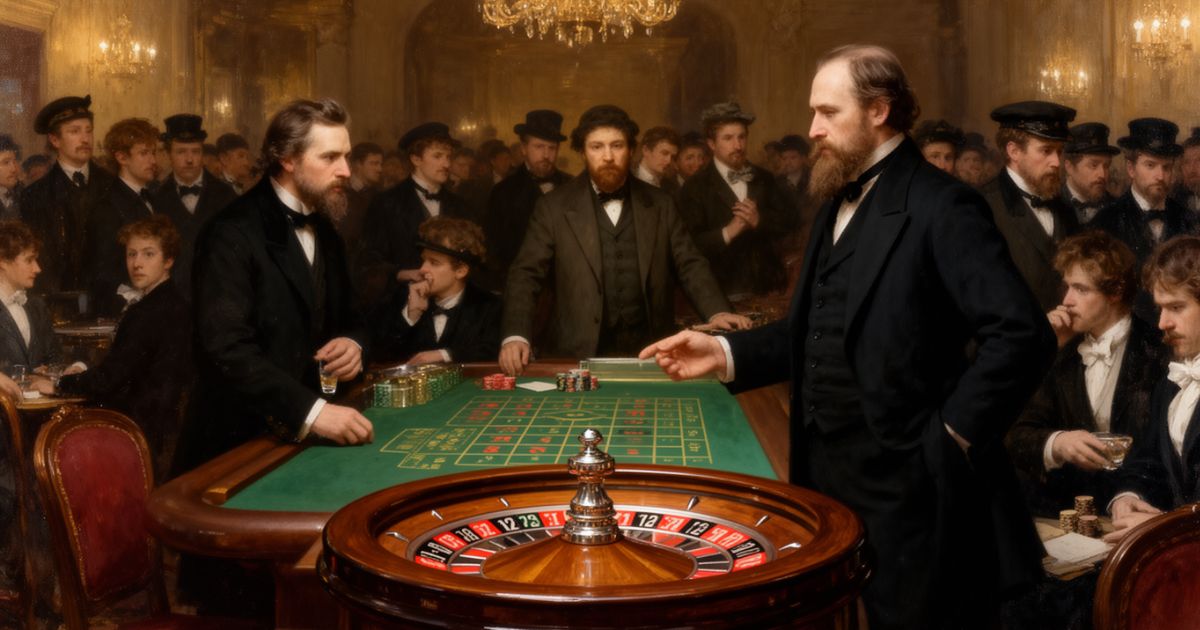
Sixteen hundred gulden are in his hand, and the thought that spoils them is simple. If he had been playing for himself, the wheel would not have paid. He entered the rooms angry because the stake was Polina's. A hundred of her gulden went down, thirteen took the first fifty, and then red kept paying until he could not remain in the crowd. He snatches up the pile and leaves. The win has arrived as proof that the money was never his.
He had never seen roulette. A thousand descriptions had not taught him the rules, and the rooms are not the heaps of gold the journalists praise for nothing. Most of the crowd plays for petty sums. What disgusts him is the humility with which they stand at the tables, and the gentleman's trick of pretending the gold does not matter. The General stakes three hundred francs, leaves the winnings down, loses twelve hundred, and rises with a smile, though Alexei is sure the purse is chafing him. A Frenchman can lose thirty thousand and not murmur. Other hands reach in and take a win, then ask for witnesses. Alexei did not come to watch that show. He came to stand in it. The wish to win makes the squalor feel close, until he admits he is lying to himself, and the luck, when it comes, belongs to her errand.
He does not reach her until after supper. The Frenchman is absent, and the General is expansive enough to warn him that losing would compromise the household, and that winning would compromise it too. Alexei hands Polina the sixteen hundred and tells her that next time he will not play for her. He wishes to play for himself. She offers him eight hundred to go halves, if he will gamble only on those terms. He refuses. Playing for anyone else, he says, he would probably lose. She does not hear it as a refusal. She places great hopes on his roulette, so of course he will do as she wishes, and she leaves before the refusal can become the last word. The pile is hers again. The next stake, in her mouth, is still hers.
Dostoevsky understood something modern psychology has confirmed: success that doesn't feel genuinely ours creates internal conflict rather than satisfaction. When the narrator wins at the casino using Polina's money, his triumph becomes a burden because he knows it's not really his victory. This reveals a fundamental truth about human motivation - we need to feel ownership over our achievements for them to provide genuine satisfaction. In working-class life, this pattern appears constantly but often goes unrecognized. The employee whose manager takes credit for their ideas, the student whose wealthy friend pays for their certification, the person whose family connections land them a job - all experience this same hollow feeling. The success is real, but it doesn't feel earned. What makes this particularly insidious is that society tells us we should just be grateful for any opportunity, which makes people feel guilty for their resentment. But that resentment is actually healthy - it's our psyche protecting our sense of agency. The key insight is learning to distinguish between genuine partnership and disguised control. True partnership preserves your ownership over the outcome, even when others provide resources. Disguised control uses resources to create obligation and dependency. Understanding this difference helps us navigate opportunities without losing ourselves in the process.
Explore this chapter with AI to uncover deeper meaning and practical takeaways.
AI Discussion