
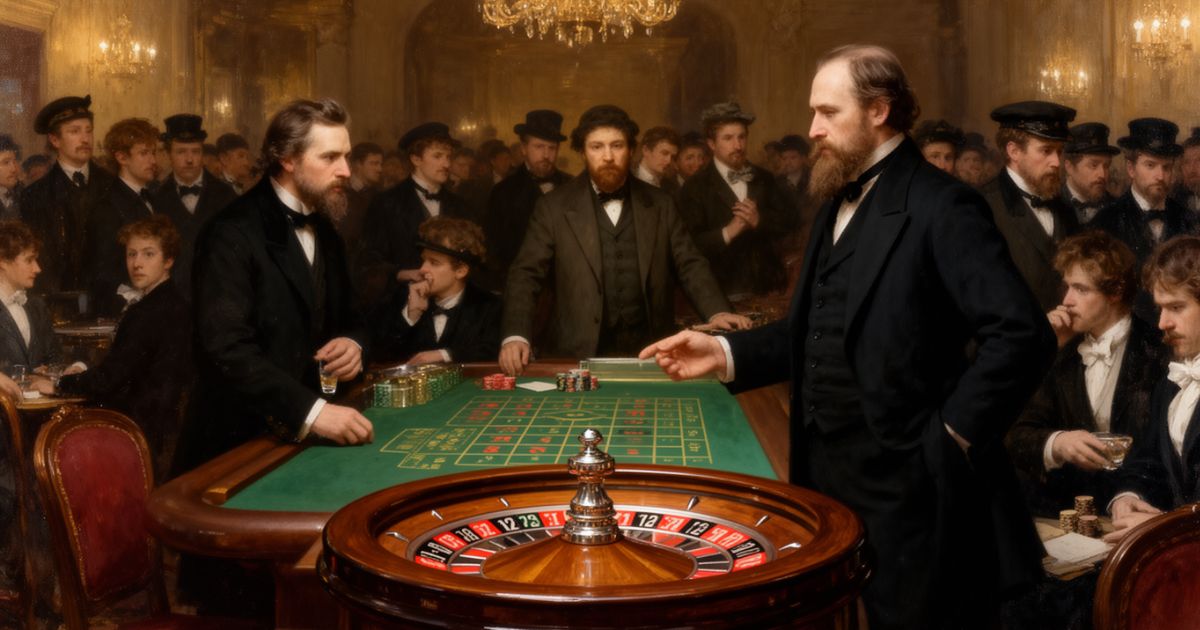
Polina sends the children away and keeps him. On a bench by the fountain she tells Alexei she hates him because she has allowed him to go so far, and hates him still more because he is necessary to her. For the time being she wants him, so she must keep him. Then she puts seven hundred florins in his hand and tells him to play roulette and win what he can. The hatred does not send him off. It is the sentence that holds him.
He has come back after two weeks to a household that will not meet his stare. The General counts out a hundred thalers of Alexei's own money and orders the children kept clear of the casino, because a tutor at the tables would compromise a house that has just acquired money from somewhere. Alexei has already changed two thousand-franc notes at the hotel counter, enough for the place to take them for millionaires for a week. Blanche, her mother, and the man the servants call Monsieur le Comte ride out in that costume, and strangers stop to stare, while no one names the source. At luncheon the quiet place of a tutor is no longer bearable. He tells the table, in French, that he once threatened to spit into Monsignor's coffee, calls himself a heretic and a barbarian, and shows the visaed passport. The General is furious. Mr. Astley is delighted and asks him for a drink. The afternoon talk with Polina starts on the diamonds, which brought seven hundred from Paris, not the two thousand she expected, and she says she must have money or she is ruined. Under that shortage sits a dying grandmother in Petersburg, waited on for a year and a half. The Marquis began to court Polina once he heard she might inherit. Blanche will be the General's wife if that news is true. He puts his questions as if he had a right to them. She tells him he ought to pay for the privilege.
He takes the first path to the left. At the table he had already asked why he still dances attendance on this family. On a train in Switzerland he spoke her name aloud in his sleep. Now he swears he detests her. He would take a knife to her with pleasure, and he would leap from the Shlangenberg with the same pleasure if she told him to. She seems to know he cannot have her, and that knowledge pleases her. The florins are still in his hand. She has already told him where to take them.
Dostoevsky understood something psychology wouldn't formally recognize for another century: intelligence can be a trap. His narrator sees every angle of his exploitation yet walks deeper into it. This isn't stupidity, it's the curse of the aware. When you understand exactly how you're being used, that knowledge creates a special kind of rage. And rage demands expression. The narrator's gambling isn't random self-destruction; it's calculated defiance. 'You treat me like garbage? Fine, I'll prove you right.' This pattern haunts modern workplaces where the most perceptive employees often burn out fastest. They see the unfairness, the favoritism, the empty promises. But instead of leaving, they channel that clarity into self-sabotage, working themselves sick, picking fights, or numbing out. The intelligence that should protect them becomes the weapon they use against themselves. Recognition is the first step toward freedom. When you catch yourself thinking 'I'll show them' through self-harm, pause. Ask: who exactly are you punishing? The people exploiting you rarely notice your suffering, they're too busy benefiting from it. Your destruction doesn't teach them lessons; it confirms their low opinion of you. Breaking this cycle requires redirecting that sharp awareness outward, toward boundaries and exits, rather than inward toward justified revenge against yourself.
Explore this chapter with AI to uncover deeper meaning and practical takeaways.
AI Discussion