
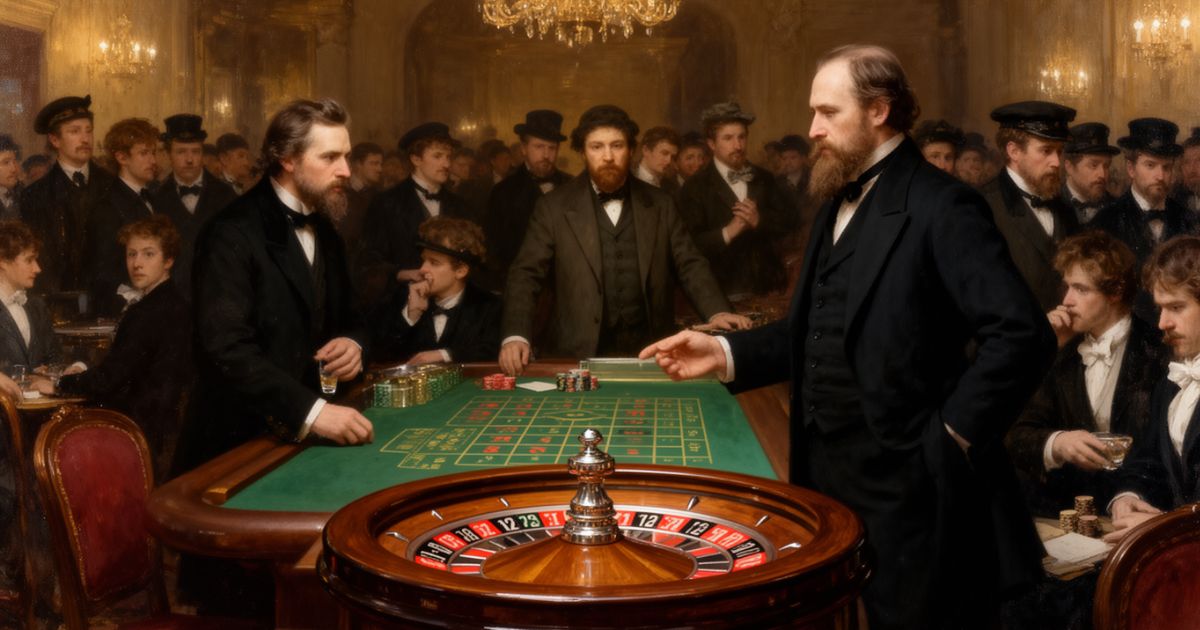
Of Paris he can only say that it was a delirium. In a little over three weeks his hundred thousand francs come to an end. The other hundred thousand he has already given her, fifty at Frankfurt and fifty in Paris on a note of hand. Within a week she wants the rest. Et les cent mille francs qui nous restent, tu les mangeras avec moi, mon utchitel. She is grasping with her own money. His purse, inspected every day, never holds more than a hundred francs. What do you want with money? He does not dispute it. The flat cost fifty thousand francs. She calls it wretched means, used with care and taste. The other fifty bought the carriage and the horses. She ties his tie, calls him an utchitel who won two hundred thousand francs, and wants him to walk behind her with a pencil. He makes no objection, so she begins the quarrels herself. He stares at the ceiling. She leaves, and is back in ten minutes.
The new horses cost sixteen thousand francs. Surely you are not angry? No. He is only tired. She says she can sell them for twenty thousand. His hundred thousand was only a beginning. The quicker it goes the better. Afterwards he will go to Homburg and win another hundred thousand, and she knows he will bring it to her. She had not loved him, she says, because she thought him only a tutor, quelque chose comme un lacquais. He has seen her with Albert. Il faut que jeunesse se passe. Do not give him any of my money. The hundred thousand lasts nearly a month. Eighty thousand goes on things she buys. None of her debts, she says, will fall on his head. Any other woman would have let him go to prison.
A week after they reach Paris the General arrives, shaking, fresh from a week's delirium, and expecting to be turned from the door. She throws her arms around him. He follows her on the Boulevards, and when she goes without him he sulks, then hunts the room for a thing he cannot name. Once she kisses him and he weeps. She says she left the General for Alexei's sake, and that Alexei ought to be ashamed. He laughs. She sends him to walk the General, as she might send a servant with a spaniel. The General still addresses him as a superior. My unfortunate children, he says, on the way to the theatre. He will not hear De Griers's name. A week before they part, Blanche says the grandmother is really ill, and bound to die. Mr. Astley has telegraphed. The General will do in a back room, on his pension. She will be Madame la Générale. If he grows jealous, the notes of hand are already in Albert's name. Very well, Alexei says. Marry him. They marry as du Placet, not de Cominges, and he paces the room, repeating the name. She weeps. Tu étais bon enfant. She puts two notes of a thousand francs into his hand, and will not give more, because he would gamble it away. He has five hundred francs left, and a watch. He is waiting for Mr. Astley. Then Homburg. Not Roulettenberg until next year.
Dostoevsky understood something profound about human psychology: sometimes we become addicted to our own exploitation. The narrator doesn't stay with Blanche because he loves her, he stays because being used feels safer than being responsible for his own life. This pattern reveals itself everywhere in working-class communities today. The employee who won't report workplace violations because 'at least I have a job.' The family member who enables addiction because confrontation feels harder than being slowly drained. The person who stays in toxic relationships because loneliness seems worse than mistreatment. Healthcare workers who accept impossible patient loads because fighting back feels more dangerous than burning out. Each situation offers the same devil's bargain: certainty through degradation. The narrator finds strange peace in watching Blanche systematically destroy him because her exploitation provides structure to his chaos. When self-worth becomes damaged enough, being controlled feels more comfortable than being free. This isn't stupidity, it's a survival mechanism that's outlived its usefulness. The key insight is recognizing when you're choosing familiar pain over uncertain growth. Dostoevsky shows us that some addictions aren't to substances but to patterns of powerlessness. The first step toward breaking free isn't dramatic confrontation, it's simply noticing when you're trading dignity for predictability.
Explore this chapter with AI to uncover deeper meaning and practical takeaways.
AI Discussion