
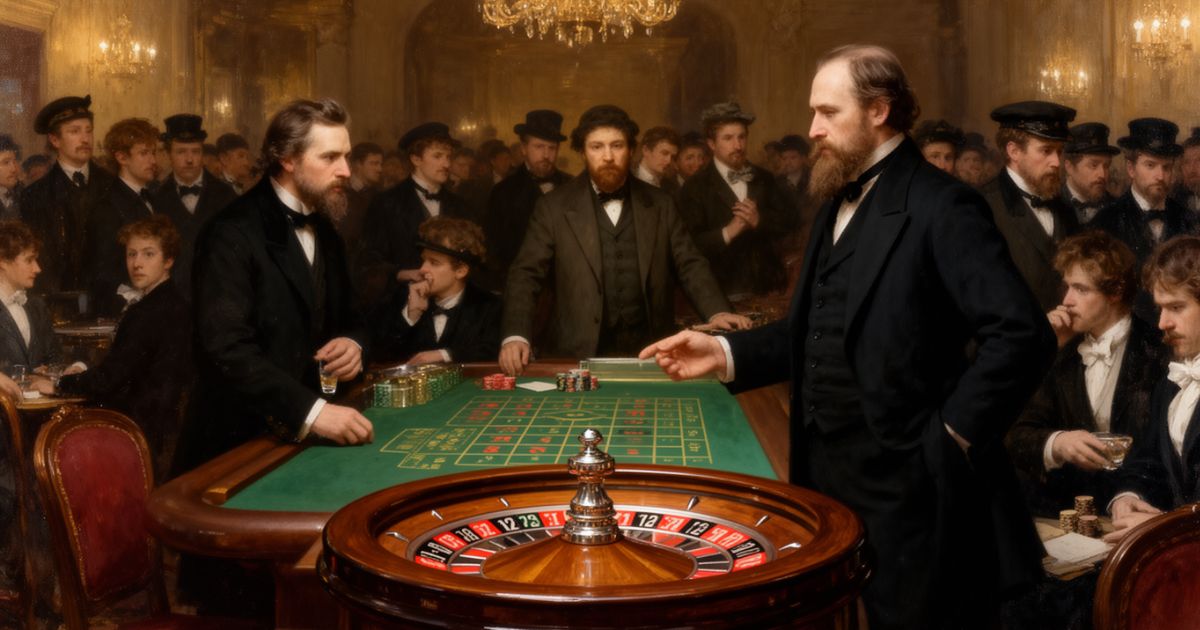
A year and eight months have passed, and he reads the notes to distract himself. He had left off just as he was going to Homburg, full of hope. Now he is worse than a beggar. A fig for beggary. He is zero. Tomorrow he may rise from the dead. He did go to Homburg, and to Roulettenberg, and to Spa, and to Baden, where for five months he was lacquey to a Privy Councillor named Heintze, after someone paid two hundred thalers and took him out of prison. He does not know who. By stinting meat and drink he saved seventy gulden, and one evening he resigned and went to the table. It was not the money. He wanted Baden to talk of him, and perhaps to tell Polina, though he knew he would only spend it on another Blanche. Within five minutes the seventy gulden are seventeen hundred, and he tells himself he is a member of mankind again. He counts them until three in the morning. Half an hour before the train he loses fifteen hundred florins. He has been at Homburg a month, at the smallest stakes, growing caked in the mire.
In the public gardens he still has fifty gulden, and the hotel bill is paid. If he loses them he must be a lacquey again, or find a family that needs a tutor. Astley is on a bench. Do not tell me anything. I know the past twenty months. Was it you who bailed me out? No, though he knew Alexei was there. Are you never going to give up gambling? Damn the gambling. He would have given it up, were it not that he is losing. Astley says he spoke that in despair, and therefore truly. Has he any other work? None. His dreams do not rise above rouge and noir. Only until he has rehabilitated himself. Then you will be here another ten years. I will remind you, on this bench. Where is Polina? In Switzerland. Do not ask. You never really knew her. She was ill, and still is. His mother and sister kept her in the north of England. The grandmother died and left her seven thousand pounds, and she travels now with his sister's family. The children are in London. The General died in Paris last month, of a stroke, and Blanche had all he received from the grandmother transferred to herself. Of De Griers, Astley will not speak.
It was at her request that he came, to report what Alexei feels, and hopes, and remembers. She did love you. I tell you because you are utterly lost. Even if she still loves you, you would remain where you are. Your life is over. You chose to be a lacquey rather than a thief. Take these ten louis. More I will not give, because you would gamble them away. If you would leave the tables and go home, I would give you a thousand pounds. At present the two sums are the same. Alexei will take the money if Astley will embrace him. They part in sincere affection. Words are only words, he tells himself. He must act. He must think of Switzerland. Tomorrow. Today it is too late, but tomorrow. He has fifteen louis, though he began with fifteen gulden. He remembers a night when he had lost everything, and a hundred paces from the Casino a gulden rattled in his pocket. Perhaps he would need it for a meal. He turned back and staked it on manque, and in twenty minutes he had a hundred and seventy gulden. No; tomorrow all shall be ended.
Dostoevsky understood something modern neuroscience confirms: our brains prefer predictable suffering to unpredictable improvement. The narrator could have taken Astley's money and started fresh, but recovery felt more frightening than the familiar cycle of loss. This isn't weakness, it's how human psychology works. Change requires us to become someone new, while addiction lets us stay who we are. In 1867 Russia, gambling was the escape for men trapped between social classes, neither peasant nor aristocrat. Today, we have different hells but the same pattern. The woman who stays in an abusive relationship because at least she knows what to expect. The worker who won't apply for better jobs because rejection feels worse than current misery. The person drowning in debt who buys lottery tickets instead of making a budget. We tell ourselves we're hoping for the best, but we're actually choosing the devil we know. The narrator's tragedy isn't that he gambles, it's that when offered genuine love and real opportunity, he chooses the fantasy over the work. Recovery demands we grieve the person we were and trust in someone we've never been. Sometimes the most radical act isn't fighting your demons, it's walking away from the familiar battlefield entirely.
Explore this chapter with AI to uncover deeper meaning and practical takeaways.
AI Discussion