
She has come with all she has to bring. On the table is an open letter in De Griers's hand. He is leaving. He regrets the past. He hopes she has found nothing in him unworthy of a man of honour. Friends in St. Petersburg will sell what the General mortgaged. A part of those debts he gives back, so that she may sue her stepfather for money that was hers. His memory of her will remain graven in his heart. She expected nothing. Long ago she read him. He thought she might sue, and become a nuisance, so she doubled her contempt and waited. If the telegram had come, and they were legatees, she would have flung him a quittance for the debts and dismissed him. She has hated him. She would throw fifty thousand roubles in his face, and spit, and rub the spittle in. The paper that returns the mortgage is not in the General's hands. She will not go and live with the grandmother, and she will not kneel to anyone. Alexei says he will kill De Griers in a duel. The man is in Frankfort for three days. She smiles. De Griers would only ask him first to return the fifty thousand francs. It is nonsense. Then Alexei says, What of Mr. Astley? Her eyes flash. Does he wish her to leave him for Astley? She has never spoken to him like that. She sits, because she cannot stand. He tells himself she loves him, and that she came to his room, and he had not understood. Give me one hour, he says. Wait here. He runs. She calls after him. He does not turn.
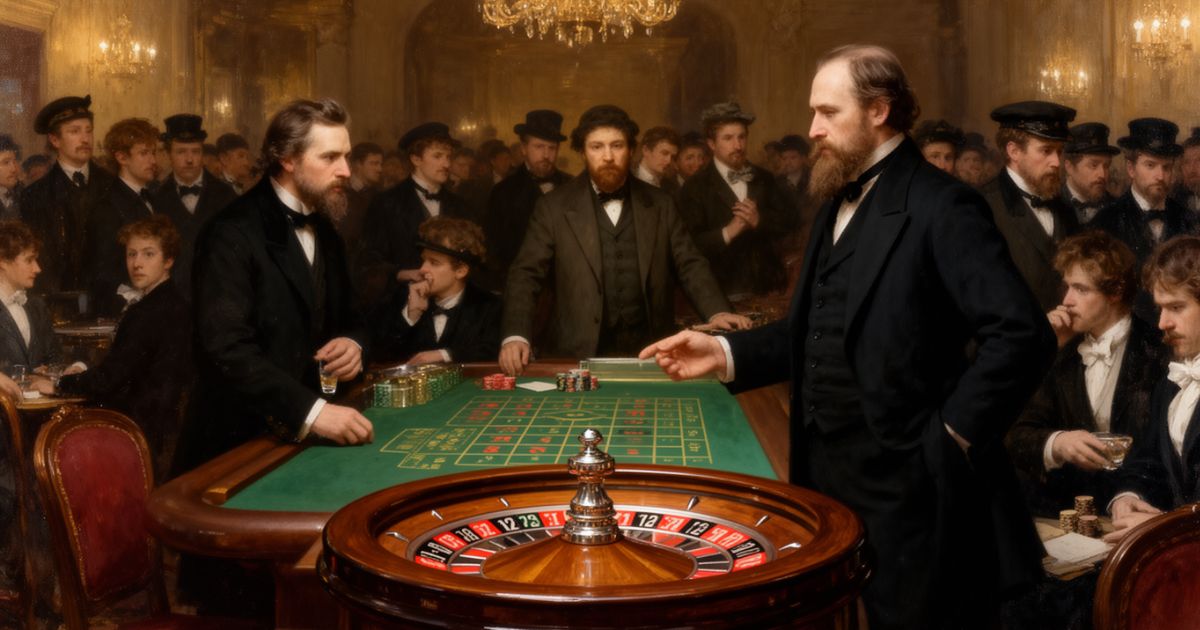
It is a quarter past eleven. At the grandmother's table the word in front of him is Passe. He has not heard the numbers. He throws down twenty ten-gulden pieces. He wins, and he moves the whole pile, and then a horror takes him. He must win. His life is on the red. Rouge. After that he loses, and then Quatre pays him, and the black turns up, and he cannot remember the order. Half an hour has gone. A croupier says he has won thirty thousand florins, and the bank must close the table. He moves to the next salon, and the crowd moves with him. He wins another thirty thousand, and that bank closes too. A man at his elbow and a pale woman tell him to go. He slips a note for five hundred gulden into her hand, and her fingers press his.
He does not know trente et quarante. The red has come up seven times, and he stays with it, because he wants the room to see the risk. A voice says he has won a hundred thousand florins. What more did he need? He stuffs the notes into his pockets and fills the hands held out to him. Two men near the exit tell him to leave early tomorrow, or he will lose it all. He does not heed them. The avenue is dark. He feels only the pleasure of power. Polina flits ahead of him as someone he will show it to. He can scarcely recall what she said, or why he left her. At the end of the avenue he is afraid, and he runs. The hotel lamps. She is still on the sofa, a candle in front of her, her hands clasped. He flings the pile upon the table. He has not yet said what he went to fetch.
Dostoevsky captures something universal about human psychology: when someone we love is in crisis, our brains shift from logical calculation to magical thinking. The narrator doesn't gamble strategically - he gambles religiously, convinced that his devotion to Polina will manifest as supernatural luck. This isn't really about gambling; it's about the intoxicating fantasy that our feelings can control outcomes beyond our actual power. We see this pattern everywhere today. The parent who maxes out credit cards for their child's medical treatment, certain that love will somehow make the money work out. The employee who quits without backup to save a failing relationship, believing passion will provide. The small business owner who bets everything on one expansion, convinced their dedication guarantees success. The healthcare worker who works dangerous overtime because they believe their commitment protects them from consequences. What makes this pattern so dangerous is that it occasionally works - just often enough to keep us believing. The narrator's winning streak feels like cosmic validation, proof that the universe rewards pure hearts. But sustainable love shows up in careful planning and manageable risks, not spectacular gestures that could destroy everything we're trying to protect.
Explore this chapter with AI to uncover deeper meaning and practical takeaways.
AI Discussion