
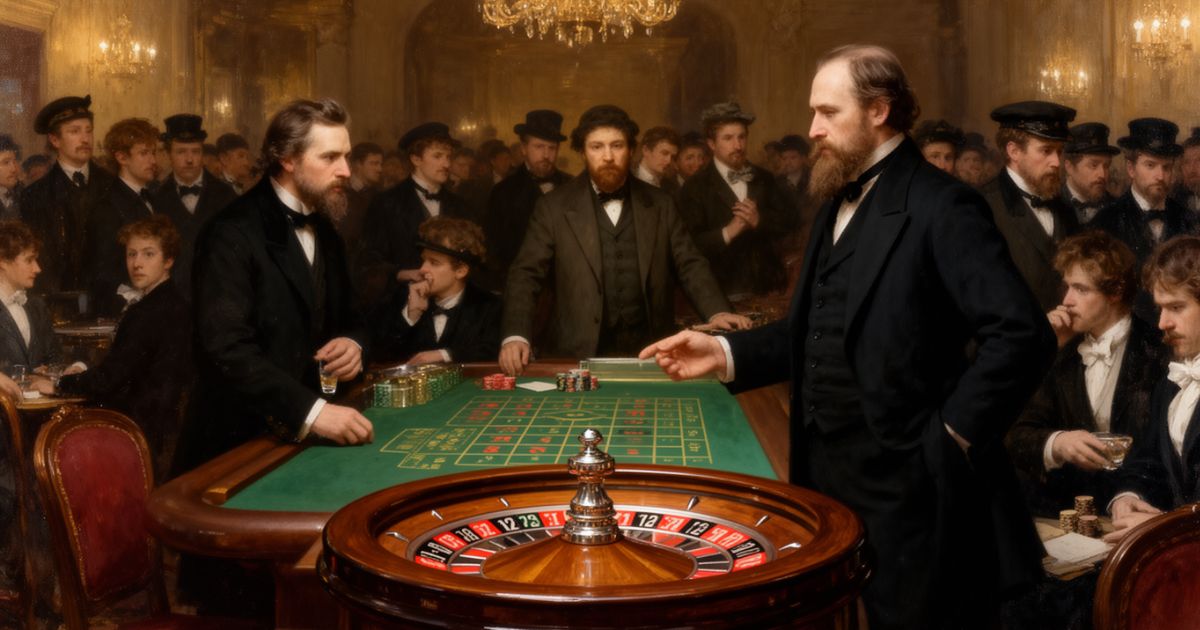
Almost a month has passed, and he is writing in a melancholy little German town, reading Paul de Kock because he is afraid of any serious book. He was not there for the rest of it. Next day the grandmother lost every gulden, and he learnt it from Potapitch. One man stood on her right and one on her left, staking red against black, until the police turned their pockets out. A third called himself a Polish gentleman of honour and swore he would not take a kopeck, and because he began to win she could not send him away. When she played her last note, the men behind the chair forgot her and staked it themselves. Potapitch reckons ninety thousand roubles that day, besides the day before. Three times she had begun to win, and could not leave the table.
At eleven, before she had gone out, the General confesses his debts and his passion for Blanche, then rages that the grandmother is sullying the family honour. She turns him out with her stick. It is a real stick. He wants the police told that a respected old lady has gone out of her mind. De Griers shrugs, laughs in his face, and by evening has left the hotel, after a secret talk with Blanche. From morning she will not look at the General. He meets her on the arm of the Prince, and no one bows. By evening she has found that the Prince has not a copper, and wants to borrow of her to play, and she shuts herself in her room. Alexei finds Astley walking from the station. Frankfort. On business. On business. At the Hotel des Quatre Saisons, Astley nods and is gone. Alexei has no question he can form. Polina is in the park with the nurse and the children. To his salute she gives a slight bow. He writes to her. Have you, or have you not, any need of my life? If you have, he will be in his room. Three minutes later the lacquey brings the compliments of a certain person.
At seven the General seizes both his hands. Save me. Have some mercy. He goes down on his knees and begs Alexei to go to Blanche and beseech her to marry him. She has scarcely remarked my existence, Alexei says. The General cannot hear it. In Russia, he says, old women like her are placed under restraint. De Griers has gone, and everything is mortgaged. Of the money from Paris, perhaps seven hundred francs are left. How will you pay the hotel bill? The General looks at him as if he has not heard. At eight the grandmother is back, her head drooping. Not a groat. She must take the train at half-past nine. She asks Astley for three thousand francs for a week. He counts them out under a note of hand, bows, and goes. She will not let the General have any of her money. He is a blockhead. At the station she thanks Alexei for his disinterested assistance, and asks him to remind Prascovia. On the way back, the nursemaid says there is nothing new. In the General's room, Blanche and the General are laughing, and her mother sits on the sofa. The trunks for the first morning train to Paris are already packed, and the General does not know. Alexei does not go in. He opens his own door. In the half-dark a figure sits by the window, and does not rise. It is Polina.
Dostoevsky understood something modern psychology confirms: stress doesn't change people, it reveals them. When the Grandmother loses her fortune, we don't see her becoming weak—we see her maintaining dignity despite devastating loss. When the General faces financial ruin, we don't witness his transformation into a pathetic figure—we observe the weakness that was always there, previously hidden by his expected inheritance. This distinction matters enormously in our own lives. We often excuse people's bad behavior during tough times, thinking 'they're not usually like this' or 'the stress is making them act out.' But Dostoevsky suggests the opposite: stress strips away the social performance and reveals core character. The helpful colleague who becomes backstabbing during layoffs wasn't corrupted by fear—they were always calculating, just previously well-fed. The romantic partner who becomes cruel during financial pressure wasn't changed by money stress—they were always self-centered, just previously comfortable. This doesn't mean we should be harsh or unforgiving, but it does mean we should gather intelligence. Watch how people treat service workers when their order is wrong. Notice who helps during family emergencies versus who finds excuses. Observe which friends check on you during your hard times. This behavior predicts how they'll act when bigger crises hit your relationship. Most importantly, decide now who you want to be when everything falls apart, because your crisis character is your true character.
Explore this chapter with AI to uncover deeper meaning and practical takeaways.
AI Discussion