
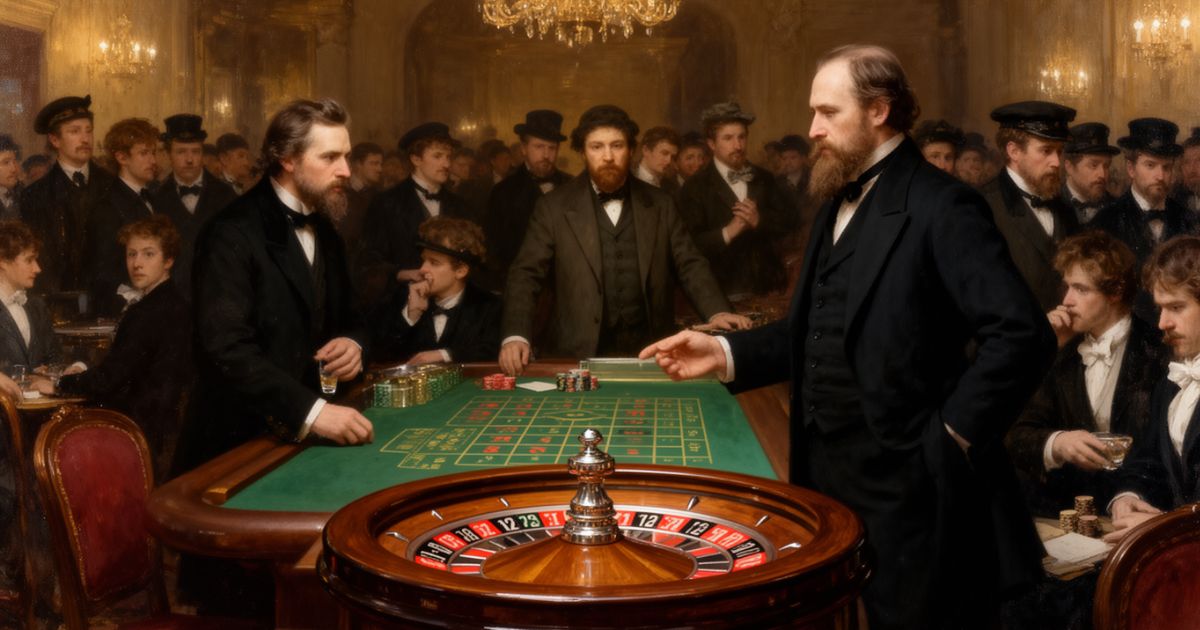
She sends Potapitch and Martha home. The Baron and Baroness pass on their way to the Casino, and she only says Ah. Her chair is set beside the croupier. Twelve ten-gulden pieces on zero, again and again. A hundred and forty-four are gone, and zero may not come before night. A thousand gulden on the red comes back. To the devil with that zero. Four thousand gulden on the red. She sits bolt upright. Zero takes the four thousand, the number she had been begging for all morning. It is your fault, she tells Alexei, for making her stop staking on it. Go. Then, hastily, stay. It is I who was the fool. He will not advise her, because she will only blame him. Stake another four thousand. She cannot rest until the losses are won back. They win once. Then twelve thousand gulden of her own are gone. In the satchel there are only bonds. Take me to the money-changer.
On the avenue the General, De Griers, and Blanche meet them. Polina and Astley are not there. No time to stop. Alexei says she has lost the morning's winnings and twelve thousand gulden besides, and is going to change the bonds. Stop her, the General whispers. You stop her yourself. There is a view, and trees, and milk on the fresh grass. Have done with your milk. She calls the clerks thieves, takes twelve thousand florins in gold, and waves the account aside. Once she has begun she cannot be held. De Griers leans in with figures, and she lets him have one stake. Zero. Away with you, you infernal Frenchman. An hour later everything in hand is gone. What a silly old fool I am. Pack. We are returning to Moscow. I have fooled away fifteen thousand roubles. The train is at half-past nine. It is half-past eight.
He comes back and the party is in her rooms, more frightened that she is leaving than that she has lost. If she goes, who will repay De Griers, and Blanche will not wait. Away with you. It is not their money. Blanche laughs, Elle vivra cent ans, and goes out. So you have been counting on my death. She sends for Polina, who does not know for certain whether the General will marry the Frenchwoman. Come to Moscow. The house is large enough for a palace. Polina cannot come yet, and not without the little brother and sister. The Frenchman, the grandmother says, will never bring you good. Polina flushes. Alexei starts. Everyone seems to know, or he is the only one who does not. She kisses Polina's cheek and will not let her stay, and she puts five hundred gulden into Alexei's hands. He lies on the bed an hour. Potapitch knocks. She cannot rest. The train is in ten minutes. She has a roll of notes. Walk on ahead. He will not go. He will neither witness the play nor join it. He lays the five hundred on the little table her chair is passing. What folly, she shouts, and Potapitch must come. Later Potapitch says she lost all that had been changed, about ten thousand roubles, through the Pole she had given money that afternoon. She caught him twice, and pulled his hair. Then water, and her prayers, and sleep. She had said they were returning to Moscow. She is asleep, and the money from the bonds is already gone.
Dostoevsky understood something about addiction that modern psychology has confirmed: destructive behavior requires infrastructure. The Grandmother can't destroy herself in isolation—she needs the narrator's language skills, Potapitch's logistics, the family's silent participation. Each person who helps becomes part of the destruction machine, often with the best intentions. This dynamic appears everywhere in working-class life. Parents who keep bailing out adult children financially, preventing them from learning consequences. Healthcare workers who cover for colleagues' substance abuse, thinking they're protecting patients when they're actually enabling dangerous behavior. Friends who provide endless emotional support for someone's toxic relationship without ever saying 'this needs to stop.' The trap is that enablement feels like love. It feels cruel to let someone face consequences alone. But Dostoevsky shows us the mathematics: every act of 'helpful' participation makes the next destructive choice easier. The narrator finally breaks the cycle when he refuses to take the Grandmother back to the casino and returns her money. It's not abandonment—it's the recognition that sometimes the most loving thing you can do is refuse to participate in someone's self-destruction. The question becomes: how do you distinguish between helping someone through a crisis and helping them avoid the natural consequences that might actually save them?
Explore this chapter with AI to uncover deeper meaning and practical takeaways.
AI Discussion