
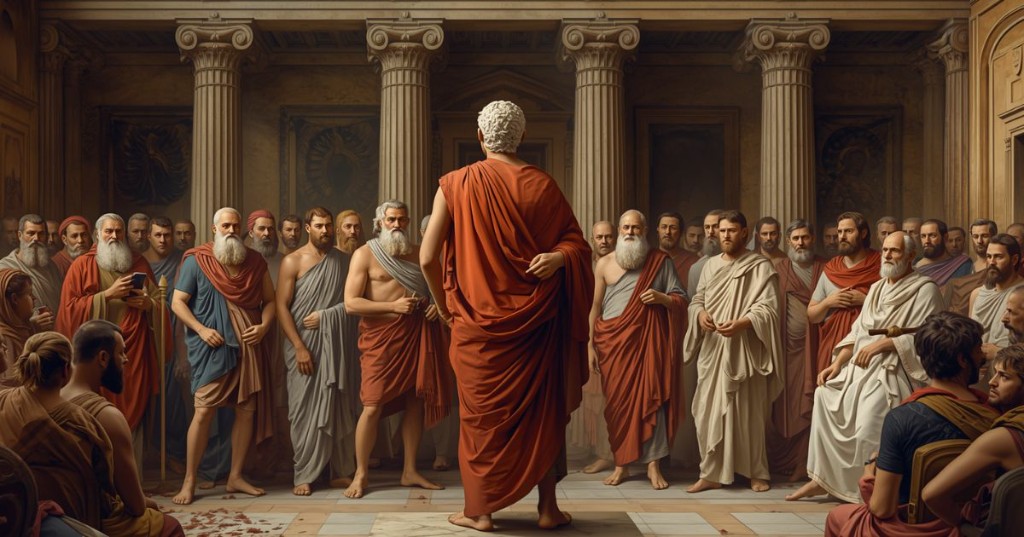
Socrates adds one last word before resting his defense. Some juror, he imagines, may be angry that other defendants wept, brought children, and staged moving spectacles while he, facing death, will do none of it. To that person he replies plainly: he is flesh and blood, not wood or stone. He has three sons, one nearly grown and two still young. He will not bring them here to petition for acquittal, not from pride or disrespect.
His first reason is public dignity. A man of his years and reputation should not demean himself with a doleful scene. He has watched eminent Athenians act as if death were unbearable and as if the jury could grant immortality. A stranger would think the city's best men no better than women. He will not make the city ridiculous, and the jury should condemn the performance, not reward it.
The deeper reason concerns justice itself. A judge's duty is not to grant favors but to judge according to law and oath. Asking for pity asks the jury to set aside sworn judgment. To overpower their oaths by entreaty would teach them oaths mean nothing, which would convict him of the impiety Meletus charges. He will not defend himself by proving the indictment true.
He closes by affirming belief in the gods in a higher sense than his accusers, and commits his cause to the jury and to God to be decided as is best for all.
Socrates reveals something counterintuitive: the moment you abandon your principles to save yourself, you've already lost what matters most. This isn't about being stubborn or self-righteous. It's about understanding that your reputation for integrity becomes your most valuable currency over time. When Maya refuses to manipulate emotions or throw others under the bus, she's making a strategic choice. People remember how you behave when everything's on the line. The warehouse workers will remember that Maya stood by her safety report even when it cost her. Future employers will see someone who doesn't fold under pressure. Her children will learn that principles aren't just pretty words you abandon when things get tough. Meanwhile, the employees who resort to tears and blame create a different reputation. They become known as people who can't be trusted in crisis, who will say whatever serves them in the moment. Managers learn to discount their word because they've seen them compromise it before. This pattern plays out everywhere: in family conflicts, financial troubles, workplace disputes, and community disagreements. The people who maintain their integrity during hard times build lasting respect and trust. Those who choose manipulation might win individual battles but lose the war for credibility. Socrates understood that how we handle pressure doesn't just reveal our character, it creates our character.
Explore this chapter with AI to uncover deeper meaning and practical takeaways.
AI Discussion