
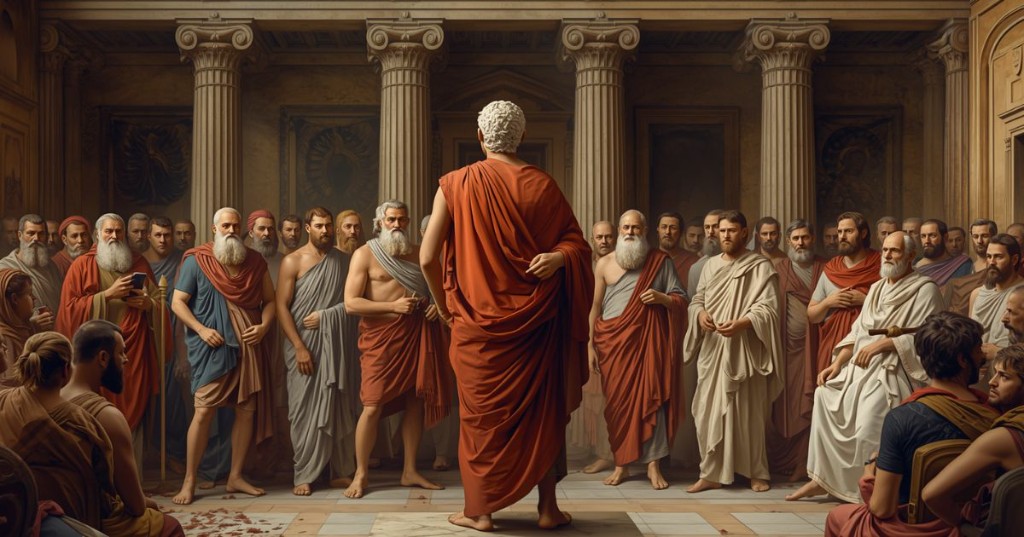
Socrates asks the jury to hear him out. If they kill a man like him, they will injure themselves more than they injure him. Meletus and Anytus can kill, exile, or disenfranchise him, but a bad man cannot truly injure a better one. The greater evil falls on whoever takes a life unjustly. He says he argues not for himself but for Athens, which should not sin against God by condemning his gift to the city.
He is a gadfly sent by God to sting a great noble steed grown sluggish with size. Kill him and the city may sleep until another gadfly arrives. The proof of his mission is poverty: he neglected his own affairs for years, exhorting citizens like a father or brother, and never took pay. His divine sign, a voice that forbids but never commands, kept him out of politics because an honest man fighting a corrupt multitude does not survive long in public office.
He offers actions, not words. As a senator he alone opposed trying the Arginusae generals illegally as a group, standing firm though orators threatened arrest and the crowd shouted. Under the Thirty Tyrants he refused an order to fetch Leon of Salamis for execution while four others obeyed. He went home instead, risking death, because wrongdoing mattered more than fear.
He denies having secret disciples or paid teaching. Anyone may listen; he professes to teach nothing. If he corrupted the young, their fathers and brothers should accuse him now. Instead Crito, Lysanias, Antiphon, Nicostratus, Adeimantus, whose brother Plato is present, and many others are ready to witness for the man Meletus calls a corrupter. They support him, Socrates says, because they know he speaks truth and Meletus lies.
Socrates reveals something uncomfortable about human nature: we often punish the people who tell us what we most need to hear. He positions himself as Athens' gadfly, sent by God to sting the lazy horse of state into action. This isn't metaphor, it's job description. Every workplace has its Socrates, the person who asks why policies make no sense, why safety gets ignored, why the same problems keep recurring. These people rarely get promoted. They get labeled difficult, negative, not team players. But here's what Socrates understood that we forget: comfort is the enemy of progress. Systems that aren't regularly challenged become corrupt, inefficient, and dangerous. The gadfly serves a vital function, even when that function makes everyone uncomfortable. The tragedy isn't that truth-tellers face resistance. The tragedy is when organizations silence them completely and then wonder why everything falls apart. Socrates knew his questions made him unpopular with those in power, but he also knew that without those questions, Athens would sink into moral and intellectual decay. Today's gadflies face the same choice: speak truth to power and face the consequences, or stay silent and watch the system rot from within.
Explore this chapter with AI to uncover deeper meaning and practical takeaways.
AI Discussion