
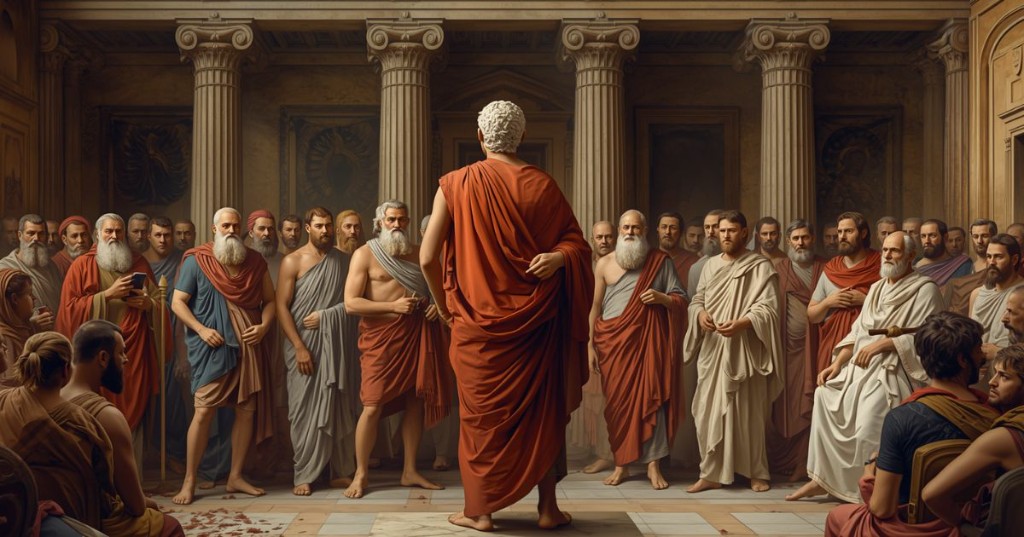
Socrates is not grieved by the condemnation. The vote was closer than he expected; thirty ballots the other way would have acquitted him, and Meletus alone would have failed without Anytus and Lycon. Meletus proposes death. Socrates asks what penalty fits a life spent exhorting Athens to virtue rather than pursuing wealth and office. Maintenance in the Prytaneum, he says, would be just; an Olympic victor gets less good done. He will not propose an evil penalty out of fear. Imprisonment, exile, and silenced exile all fail: other cities would drive him out, and he cannot hold his tongue because daily discourse about virtue is the greatest human good and the unexamined life is not worth living. His friends offer thirty minae as surety.
To those who condemned him he says he would rather die speaking as he did than live by weeping and begging. The difficulty is not to avoid death but to avoid unrighteousness; his accusers have been overtaken by the faster runner. He prophesies that killing him will not silence examination: younger accusers will hound them, and Athens will gain an evil name for murdering a man others call wise.
To those who would have acquitted him he notes a wonder: his divine sign, which usually stops him from error, said nothing all day. If death were evil, it would have warned him. Death may be dreamless sleep, which is gain, or a journey to true judges and poets and heroes, where questioning continues and no one is put to death for asking. No evil can happen to a good man in life or after death.
He asks his friends to trouble his sons as he troubled Athens if they care for riches over virtue or pretend to be something when they are nothing. The hour of departure has arrived: he goes to die, they to live. Which is better, God only knows.
Socrates faced execution with remarkable calm, and Elena faces career consequences the same way. What creates this kind of unshakeable composure? It's not fearlessness. Both know exactly what they're risking. The difference is clarity about what matters more than immediate comfort or safety. Most people under pressure make decisions from fear: they'll say anything, promise anything, compromise anything to make the pain stop. But some people have done the hard work of figuring out their non-negotiables ahead of time. When crisis hits, they're not making panicked calculations. They're consulting a pre-existing blueprint. Socrates had spent decades thinking about what makes life worth living. Elena has spent years watching shortcuts hurt people. Their calm comes from knowing that some things matter more than keeping their current situation intact. This isn't about being stubborn or self-destructive. It's about recognizing that certain compromises cost more than any consequence. The person who will lie to keep their job discovers they can't trust themselves. The person who stays silent about danger becomes complicit in harm. Sometimes the consequence of maintaining integrity is losing something important. But the consequence of abandoning integrity is losing yourself. Which price are you prepared to pay?
Explore this chapter with AI to uncover deeper meaning and practical takeaways.
AI Discussion