
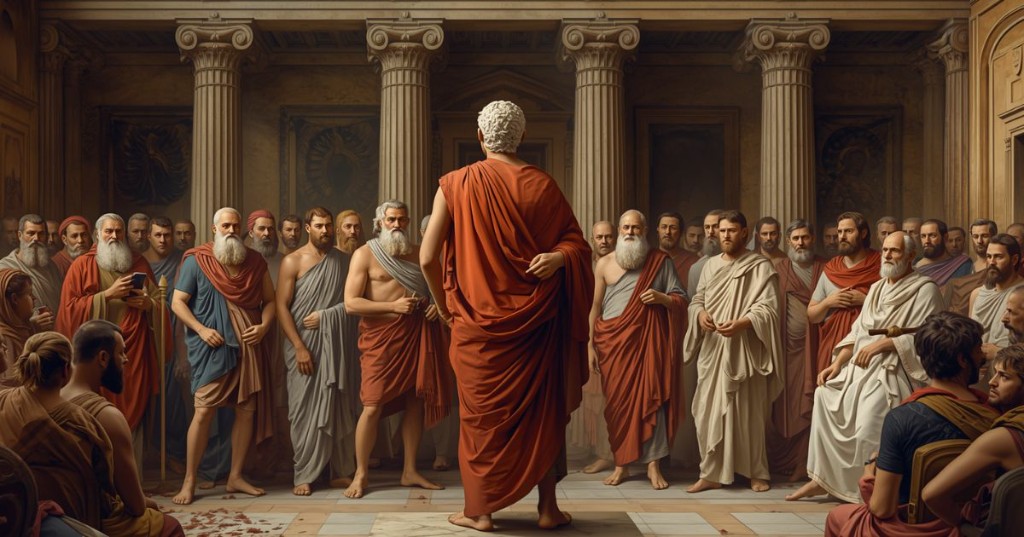
Socrates says he has answered Meletus and turns to the deeper danger: not the named prosecutors, but the envy and detraction of the world, which has destroyed many good men and will destroy more. Someone may ask whether he is ashamed of a life leading to an early death. He answers that a man worth anything does not calculate living or dying. He asks only whether an action is right or wrong.
Achilles shows the point. Warned that killing Hector would bring his own death, he chose dishonor over safety: let me die forthwith rather than live as a laughing-stock by the ships. Wherever a man is posted, he should remain there and think of disgrace, not death. Socrates did the same at Potidaea, Amphipolis, and Delium. It would be strange to hold his ground in war and then desert the post God has given him now out of fear.
The fear of death, he argues, is false wisdom: a pretense of knowing what no one knows. Death may be the greatest good, for all anyone can say. He does not claim knowledge of the world below, but he knows injustice and disobedience to God are evil. He will not avoid a possible good to escape a certain evil.
Suppose the jury offered freedom on one condition: stop questioning and philosophizing. He would refuse. He honors Athens, but he will obey God rather than the court. While he has life and strength he will exhort citizens to care for wisdom and the soul more than money and reputation. Virtue does not come from wealth; from virtue come money and every other good. If that teaching corrupts the young, he accepts the charge. He will never alter his ways, not even if he must die many times.
Socrates faced execution for refusing to stop questioning authority. Elena faces career stagnation for refusing to ignore safety violations. The stakes feel different, but the pattern is identical: institutions often pressure individuals to compromise their core purpose for institutional convenience. This creates what we might call 'everyday martyrdom,' where ordinary people must choose between personal security and personal integrity. The warehouse wants Elena to prioritize speed over safety. Ancient Athens wanted Socrates to prioritize social harmony over truth-seeking. Both institutions frame the choice as reasonable accommodation, but both are really asking someone to betray their fundamental purpose. What makes this pattern so powerful is how it reveals the difference between a job and a calling. Elena doesn't just work at the warehouse; she protects patients through her work. Socrates didn't just teach philosophy; he served God through questioning. When work aligns with purpose, external threats lose their power. The fear of consequences dissolves because the alternative means betraying everything you stand for. This explains why some people seem fearless in situations that would terrify others. They're not braver; they're clearer about what matters. The question becomes: have you found work that serves something larger than yourself, or are you just trading time for money?
Explore this chapter with AI to uncover deeper meaning and practical takeaways.
AI Discussion