
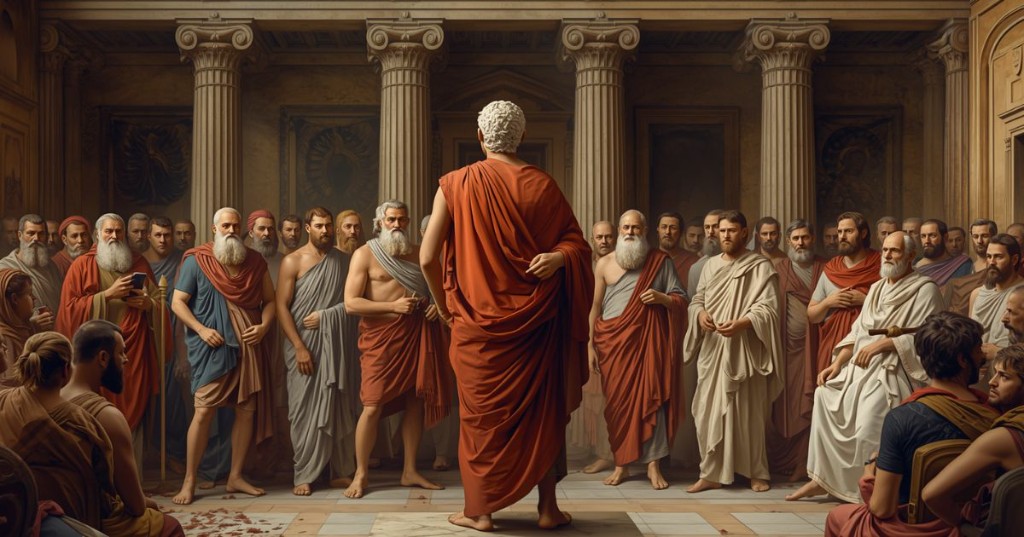
Socrates turns from the old accusers to the formal indictment led by Meletus, the self-described patriot. The affidavit charges him with corrupting the youth and introducing new divinities while rejecting the gods of the state. Socrates answers by accusing Meletus of doing evil himself: bringing a prosecution in pretended zeal over matters he has never seriously examined.
On corruption, he calls Meletus forward and asks who improves the young if Socrates alone corrupts them. Meletus hesitates, then names the laws, the judges, the audience, the senators, and finally every Athenian except Socrates. Socrates compares this to horse training: one skilled trainer helps horses, while many untrained handlers harm them. If Meletus were right, Athens would be miraculously fortunate, with one corrupter surrounded by universal improvers. The answer shows Meletus has never thought about youth at all.
He presses the logic further. Meletus says the corruption is intentional, yet a man who lives among his neighbors would not deliberately make them worse and then live with the harm. Either Socrates corrupts unintentionally, in which case the law calls for private warning rather than a criminal trial, or the charge fails. A court exists to punish, not to teach.
On impiety, Socrates forces Meletus to choose: different gods or no gods at all. Meletus chooses complete atheism and even attributes Anaxagoras' doctrines to him. Then Socrates springs the trap in the affidavit itself. Meletus swears that Socrates believes in spiritual and divine agencies, yet also denies that he believes in spirits or demigods. But demigods are gods or sons of gods. To believe in them while denying gods is as absurd as affirming mules while denying horses and asses. The indictment contradicts itself, and Meletus, Socrates says, has written a reckless riddle rather than a serious case.
Socrates exposes a dangerous assumption: that everyone is equally qualified to have opinions that matter. When Meletus claims everyone improves young people except Socrates, he reveals he hasn't thought about what expertise actually means. This pattern shows up constantly in modern life. Everyone has opinions about healthcare, education, or parenting, but not everyone's opinion carries equal weight. A nurse with fifteen years of experience understands patient care differently than someone who watched medical shows. A teacher who works with struggling readers knows more about literacy than a parent who thinks phonics is outdated. The challenge is distinguishing between legitimate expertise and loud opinions. Social media amplifies this problem by giving every voice equal volume. The person who 'did their own research' on vaccines gets the same platform as epidemiologists. The parent who homeschooled one child speaks with the same authority as career educators. Socrates shows us how to cut through this noise: ask people to explain their reasoning and demonstrate their knowledge. Real experts can walk you through their thinking step by step. They acknowledge limitations and uncertainties. Fake experts speak in absolutes and get defensive when questioned. This matters because in our daily lives, we constantly decide whose advice to trust, whose guidance to follow, whose expertise to respect.
Explore this chapter with AI to uncover deeper meaning and practical takeaways.
AI Discussion