
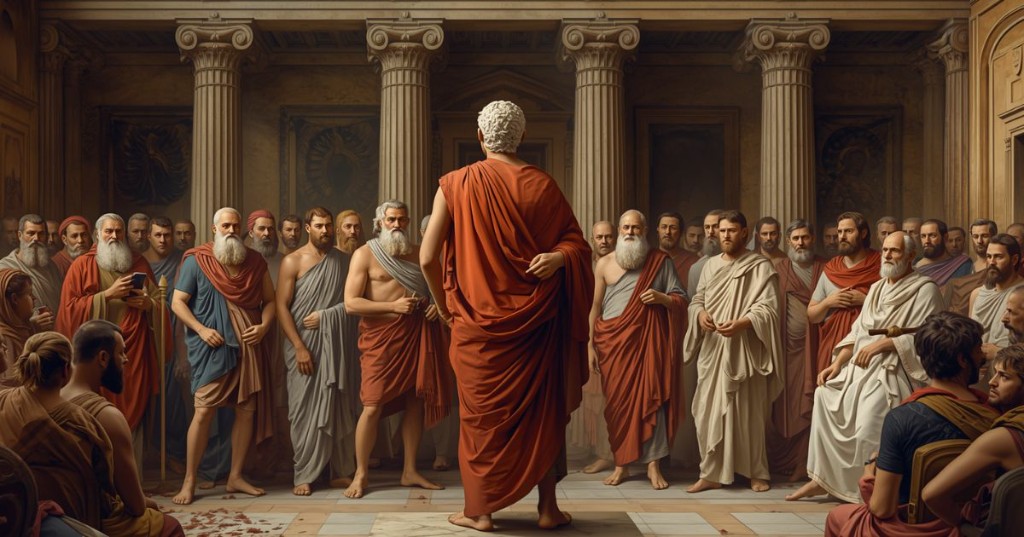
Socrates turns last to the artisans. Unlike the politicians and poets, they truly know their trades, and he admits they are wiser than he is in that respect. Yet even the best workmen repeat the same mistake: because they excel at one craft, they assume they understand high matters far beyond it. That false confidence overshadows their real skill. On behalf of the oracle, Socrates asks whether he would rather keep his ignorance without pretense or share both their knowledge and their blindness. He chooses to stay as he is.
The investigation has made him many dangerous enemies and spread calumny across Athens. People call him wise because he exposes ignorance in others, but he insists only God is truly wise. The oracle was not praising Socrates. It used his name to teach that human wisdom is worth little, and that the wisest person knows how little he knows. Obedient to the god, he keeps questioning anyone who seems wise, has no time for public affairs or private gain, and lives in utter poverty because of the work.
Wealthy young men gather to watch these examinations and begin imitating them. When pretenders are exposed, they do not blame themselves. They blame Socrates: this confounded misleader of youth. Asked what evil he teaches, they cannot say. They repeat the standard charges against philosophers: things in the clouds and under the earth, no gods, making the worse appear the better cause. They refuse to admit their pose of knowledge has been found out. Numerous, ambitious, and persuasive, they have filled Athens with loud calumny for years.
That is why Meletus, Anytus, and Lycon have set upon him, speaking for poets, craftsmen and politicians, and rhetoricians. Socrates says he cannot clear away such a mass of slander in a moment. He has concealed nothing. His plainness of speech makes them hate him, and he treats their hatred as proof that he is telling the truth.
Socrates discovered something dangerous about human psychology: competence creates confidence, and confidence seeks expansion. When people master one skill, they often assume their expertise transfers everywhere else. This happens because success feels good, and our brains want more of that feeling. The master craftsman who can build beautiful furniture starts believing he understands politics. The successful nurse who excels at patient care assumes she knows hospital administration. The skilled mechanic who fixes every engine thinks he can solve family problems with the same tools. This pattern dominates modern workplaces and relationships. Social media amplifies it further. People with followers in one area start pontificating about economics, politics, and relationships they know nothing about. The most dangerous person isn't someone who knows nothing. It's someone who knows something and thinks it's everything. When we challenge this false expertise, people don't get angry at themselves for being wrong. They get angry at us for exposing their ignorance. Socrates paid the ultimate price for this truth-telling. Today, the price might be social isolation, workplace tension, or damaged relationships. But recognizing this pattern protects us from both giving and receiving bad advice disguised as wisdom.
Explore this chapter with AI to uncover deeper meaning and practical takeaways.
AI Discussion