
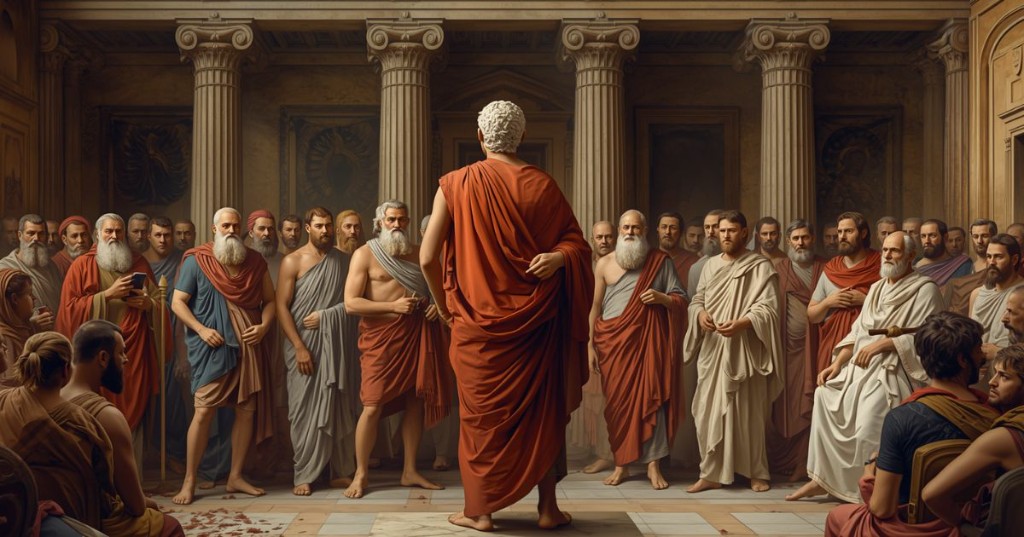
Socrates imagines a juror asking a fair question: if the rumors are baseless, why do they keep following him? He accepts the challenge and warns the jury not to interrupt, because what follows may sound extravagant. His strange reputation, he says, comes from a human sort of wisdom, not the superhuman kind his accusers invent. The witness is the god at Delphi. Chaerephon, an old friend who shared the city's exile and return, once asked the oracle whether anyone was wiser than Socrates. The Pythian priestess answered that no man was. Chaerephon is dead, but his brother in court can confirm the story.
The answer baffled Socrates. A god cannot lie, yet he knew he had no wisdom worth naming. His test was simple: find someone wiser and return to Apollo with a refutation in hand. He went first to a politician with a great reputation for wisdom and found the man thought himself wise without being so. When Socrates tried to show the gap, the politician hated him, and so did others who heard the exchange. Walking away, Socrates told himself the politician knew nothing and thought he knew; he neither knew nor thought he knew. On that one point, he seemed slightly better off.
He repeated the test again and again, knowing each conversation made enemies. Necessity drove him on: the word of God came first. He swears by the dog that the men most in repute were nearly the most foolish, while others less esteemed were often wiser. He calls these wanderings his Herculean labours, endured to see whether the oracle could be refuted.
From politicians he turned to poets. He brought them elaborate passages from their own work and asked what they meant, hoping to learn. Instead, he found that almost anyone present could discuss the poetry better than the authors. Poets write by inspiration, he concluded, like diviners who speak fine things without understanding them. On the strength of that gift, they believed themselves wise in matters where they were not. He left them for the same reason he left the politicians.
Socrates discovered something that explains half the frustrations in modern workplaces: success in one area makes people think they're experts in everything else. The mechanic who's brilliant with engines but insists he understands economics better than economists. The nurse who excels at patient care but thinks she knows more about vaccines than researchers. The contractor who builds perfect decks but gives terrible business advice. This isn't stupidity. It's how human psychology works. Real skill creates confidence, and confidence spreads beyond its original domain. The problem gets worse in our social media age, where everyone with a platform becomes an instant expert on everything from foreign policy to parenting. We've lost the art of saying 'I don't know' or 'That's not my area.' Socrates was called the wisest man in Athens not because he knew more than others, but because he was honest about what he didn't know. That honesty created space for actual learning. Today, we're drowning in confident ignorance while actual expertise gets shouted down. The person who admits uncertainty often knows more than the one who claims to have all the answers. How do we tell the difference between real knowledge and performed confidence in our own lives?
Explore this chapter with AI to uncover deeper meaning and practical takeaways.
AI Discussion