
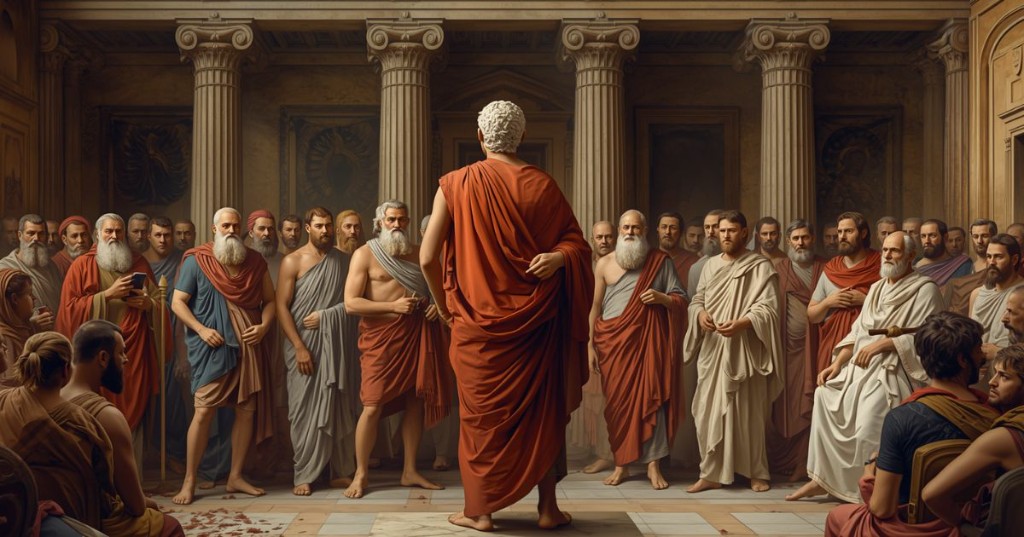
Socrates opens by splitting his opponents in two: the recent accusers he can name, and a far older set he cannot. He tells the jury he fears the old rumors more than Anytus and Meletus, because those stories took root when the jurors were children. For decades, Athens has heard of a Socrates who probes heaven and earth, makes weak arguments look strong, and sounds godless to anyone who confuses inquiry with impiety. Those charges went unanswered for years. There was no trial, no cross-examination, only repetition until the slander felt like common knowledge.
That is why he says he must fight with shadows. He cannot summon anonymous whisperers to the stand, and some of them had first convinced themselves before they convinced others. He asks the jury to let him answer the older slander first, since they have heard it longer and more often. The task is not easy: clearing away a reputation built over a lifetime in the space of one defense. He leaves the outcome to God and turns to the law.
The old affidavit, he says, matches what they saw in Aristophanes' comedy The Clouds: a man called Socrates walking on air and talking nonsense about nature. Socrates rejects the portrait. He has nothing to do with physical speculation and invites anyone present who has ever heard him lecture on such matters to speak up. The silence answers for them. From that test, he argues, they can judge the rest.
The charge that he is a paid teacher fails the same way. Real instructors like Gorgias, Prodicus, and Hippias travel city to city and earn fees honestly; he mentions Evenus the Parian, who charges five minae for wisdom Socrates does not claim to possess. Happy is Evenus, he thinks, if the knowledge is real. As for Socrates himself, he has no knowledge of that kind.
Socrates identifies something that still destroys careers and relationships today: the anonymous accuser problem. When specific people make specific charges, you can defend yourself with evidence and witnesses. But when 'everyone knows' something about you, when your reputation gets built through whispered conversations and cultural narratives, defense becomes nearly impossible. You're fighting ghosts. The accusers in ancient Athens used comedy plays and decades of gossip to paint Socrates as a dangerous intellectual before he ever set foot in court. Today, the same pattern operates through workplace whispers, social media pile-ons, and family narratives that assign permanent roles. Someone becomes 'the difficult one' or 'the irresponsible one,' and that label sticks regardless of actual behavior. The genius of anonymous accusation is that it feels like collective wisdom rather than individual attack. Nobody takes responsibility for starting or spreading the narrative. Everyone just 'knows' it's true. This makes the target look paranoid or defensive when they try to fight back. Socrates shows us that recognizing this pattern is the first step to navigating it. You can't cross-examine a rumor, but you can stop trying to defend against shadows and focus on building credibility through documented actions with people who actually witness your behavior.
Explore this chapter with AI to uncover deeper meaning and practical takeaways.
AI Discussion