
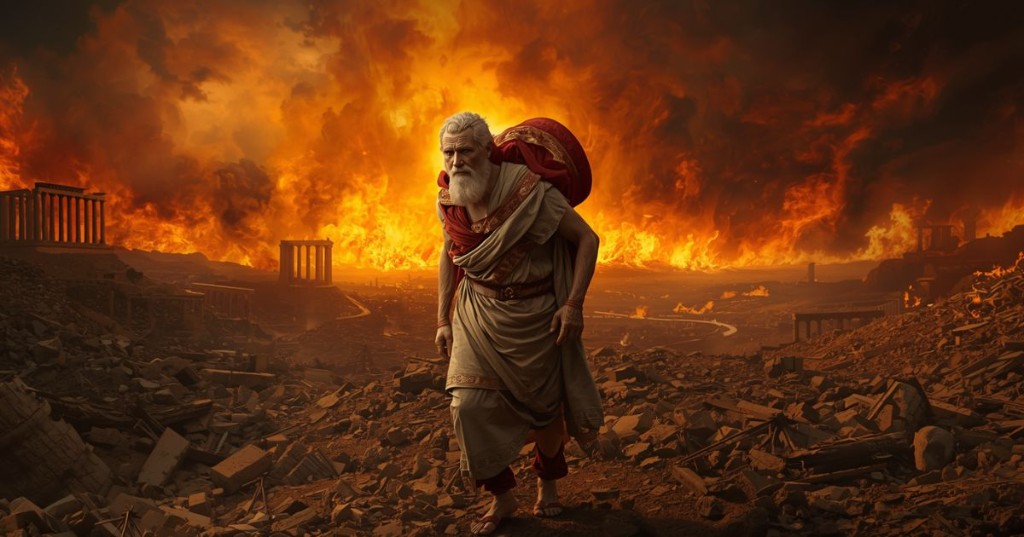
War preparations intensify on both sides. Turnus raids the countryside and sends Venulus to Diomedes, hoping Greek experience can stop Troy again. Aeneas, overwhelmed by the coalition massing against him, cannot sleep until the river god Tiber appears in a dream, promises that Italy is his fated home, and directs him upstream to Evander at Pallanteum. The god tells him to sacrifice a white sow with thirty piglets to Juno. At dawn Aeneas finds the omen exactly as foretold and sails up a miraculously calmed Tiber into Arcadian country that will one day be Rome's heart, though now it is huts, altars, and a small king's honest poverty.
Evander is celebrating Hercules' defeat of the monster Cacus when the Trojan ships appear. Young Pallas challenges the strangers, then welcomes them when Aeneas extends an olive branch. Despite the historic enmity between Greek and Trojan names, Evander remembers Anchises from a youthful meeting and offers alliance against the Rutulians who threaten both peoples. He shares his city's origin stories: Saturn's golden age, Cacus dragged from his cave, future sites of Roman law and ritual visible only as humble ground. The feast is rustic but sacred, and its moral is clear: civilization begins where monsters are dragged into daylight. Evander cannot field a vast army, but he sends Pallas with cavalry and connects Aeneas to the Etruscan city Caere, whose people revolted against the tyrant Mezentius and await a foreign leader prophecy permits.
Meanwhile Venus, terrified for her son, persuades Vulcan to forge arms. The smith and his Cyclopes hammer a shield, helmet, sword, and spear of supernatural quality. On the shield Vulcan embosses Roman history before it happens: Romulus and Remus, the Sabine women, Metius torn apart, Cocles at the bridge, Caesar and Augustus at Actium, conquered peoples in procession. When Venus delivers the armor, Aeneas marvels at beauty he cannot yet fully read. He lifts the shield and bears a future he will help found but not live to see in its imperial form. Thunder and celestial arms confirm Evander's commitment; the old king embraces Aeneas with tears for Pallas, knowing he sends his son into mortal peril.
Book 8 pairs human alliance with divine equipment. Aeneas' mission survives because he humbles himself to ask help, because old guest-friendship bridges ethnic hatred, and because a mother secures tools fit for the wars ahead. Evander's gift is not numbers but legitimacy, cavalry, and access to Etruria. Venus' gift is protection and prophecy cast in bronze. The shield especially teaches that national stories precede national institutions: before Rome's marble, there is a refugee camp on the Tiber and a king who says his roof once sheltered Hercules. Aeneas leaves Pallanteum strengthened, grieved, and visibly armed for the turning point of the war, carrying both Pallas' youth and Vulcan's forecast of glory.
Turnus' parallel diplomacy shows the war's international logic. By contacting Diomedes, the Rutulian prince appeals to shared Greek memory of Troy as existential threat, reframing Aeneas as invader rather than fated ally. Aeneas' anxiety before sleep is rendered as restless light on brass, a mind reflecting dangers without settling. Tiber's appearance gives not only direction but timeline: Alba Longa thirty years hence, sow and piglets for Juno, submission of the river itself. The omen's exact fulfillment the next morning validates dream with daylight, a pattern repeated across the poem whenever leaders must risk trust.
Evander's Pallanteum is Rome in embryo narrated backward. The king walks Aeneas through future Carmental gate, Argiletum, Tarpeian rock, and Capitol where Jove once thundered, all still rustic. His Cacus story is civic theology: monster hoarding stolen cattle in smoke and human gore dragged into daylight by Hercules, community founded on visible justice. The feast blends poverty and grandeur, lion skin throne and shared entrails, teaching Aeneas that dignity does not require marble. Evander's age and wound explain limited troops but not limited resolve. His rejection of Tuscan crown because prophecy demands a foreign leader mirrors Latinus' earlier recognition, suggesting Italy's political order requires outside legitimacy even when natives resist it.
Venus and Vulcan's interlude is comic and cosmic: love persuading the smith to arm her son while Cyclopes pause thunderbolt production. The shield's panels compress centuries: twins nursed by wolf, Sabine violence and reconciliation, Metius quartered, Porsena's siege, Cocles, Gauls on the Capitol, Caesar at Actium, conquered peoples in triumph. Aeneas cannot read every name yet lifts the whole. Evander's farewell to Pallas, fainting with preemptive grief, pairs human cost with divine equipment. Thunder, clashing armor in sky, and Tuscan muster complete the chapter's promise that the war will now change scale. Book 8 answers Book 7's coalition with alliance and artifact, showing that survival requires both Evander's table and Vulcan's fire, memory and metallurgy, son and shield, before Turnus strikes the camp Aeneas left exposed.
Virgil shows us something profound about human nature: our strongest allies often come from the most unexpected places, but only when we approach them with genuine vulnerability rather than polished professionalism. Aeneas doesn't win Evander over with military credentials or political promises, he wins him through an authentic story about his father and honest admission of his desperate situation. This pattern repeats constantly in working-class life. The coworker who helps you navigate a hostile supervisor isn't someone from your usual lunch group, it's the quiet person from another shift who remembers when you covered for them during a family crisis. The neighbor who watches your kids during your job interview isn't your closest friend, it's someone who appreciated how you helped their elderly parent with groceries. The union rep who goes to bat for you isn't responding to your seniority, they're remembering how you treated them with respect when others didn't. Crisis strips away our professional masks and reveals what really matters: authentic human connections built through shared stories and mutual respect. The question isn't whether you'll face overwhelming challenges, it's whether you'll recognize that your survival network extends far beyond your obvious circle, and whether you'll have the courage to reach out authentically when you need help most.
Explore this chapter with AI to uncover deeper meaning and practical takeaways.
AI Discussion