
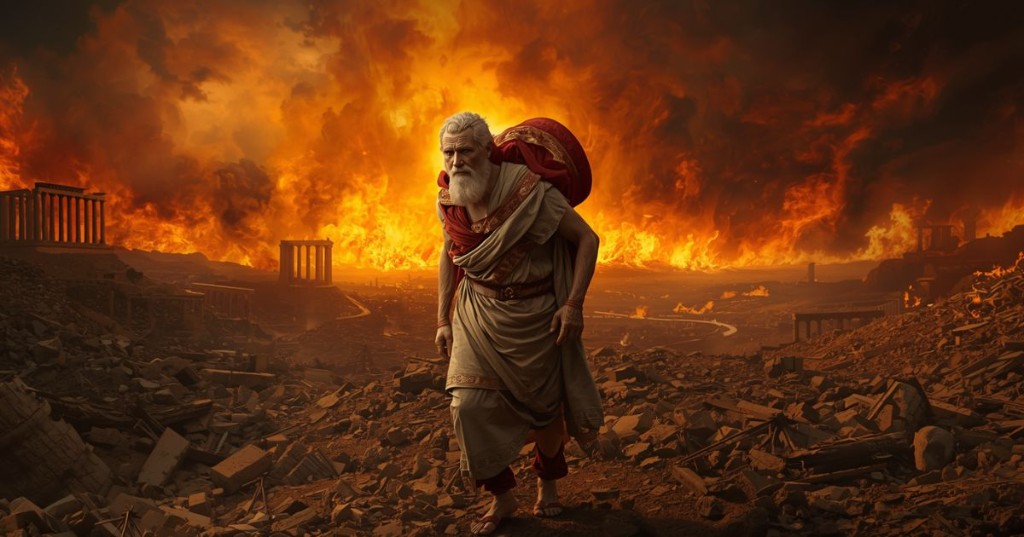
Aeneas buries his nurse Caieta at the place that will bear her name, then sails past Circe's coast with Neptune's help and enters the Tiber mouth at dawn. The omen is immediate: the land looks like home. When hunger forces the Trojans to eat their thin bread plates, Ascanius jokes that they are devouring the trenchers, and Aeneas recognizes the prophecy Anchises gave, that exile would end where they ate their tables. He hails the earth and household gods, sends ambassadors to Latinus, and begins fortifying a camp while scouts map the Latin towns. Latinus receives the Trojans hospitably, recalls oracles that forbid Lavinia to marry a Latin, and offers peace, land, and his daughter's hand. For a moment, destiny and diplomacy align.
Juno, watching from the sky, refuses acceptance. She cannot destroy Troy, so she will corrupt its arrival. Descending to the underworld's margin, she summons Alecto, a Fury who breeds civil strife. Alecto first infects Queen Amata with rage against the foreign marriage, driving her into a Bacchic frenzy in the woods with other mothers. Then she visits Turnus in sleep disguised as the priestess Calybe; when he dismisses her warning, she reveals her serpent-haired horror and plants a burning brand in his chest. Turnus wakes shouting for arms. Finally Alecto engineers a hunting clash: Ascanius kills a pet stag beloved by Silvia, Tyrrheus' daughter; local rustics rally, blood flows, and a petty quarrel becomes communal war. Latinus tries to hold the peace, but Juno opens the gates of war and the Latin nations arm.
Virgil then catalogs Italy's coalition: Mezentius the tyrant, Camilla the warrior maiden, Messapus, Clausus of the Sabines, and dozens more, each with homeland, style of fighting, and reason to fear Trojan settlement. Turnus becomes the charismatic center of resistance, not because he alone is villainous but because he expected the throne and bride that oracles now assign elsewhere. Lavinia never speaks; she is the symbolic prize around which men and gods collide. Latinus grows old and powerless as his household splits and his people demand war he knows is impious. The chapter ends not with battle joined in full but with Italy transformed from promised land into mobilized theater, every forge lit, every trumpet answered.
Book 7 explains how peace fails when outside agitators meet inside grievances. Alecto does not create resentment from nothing; she inflames Amata's fear of a foreign son-in-law, Turnus' wounded pride, and rural honour after the stag's death. Juno's policy is delay and damage: if Troy must rule Italy, it will rule a bleeding peninsula. Aeneas has reached his destination on the map but not in history. The fated meal promised rest; the opened war gates promise years of killing. Readers see that arrival is not achievement, and that communities entering new eras need more than oracles and hospitality. They need mediation of rivals, attention to those who feel displaced, and defense against actors who profit from conflict. Latinus tries and fails. Juno wins the chapter.
Virgil pauses to invoke Erato and widen the canvas because Book 7 is Italy's political map as well as Aeneas' landing. Latinus' household carries prophecy in laurel bees and altar flames around Lavinia's hair, signs the king reads as foreign marriage and war. Faunus' dream under Albunea's fumes forbids a Latin son-in-law, opening space for Aeneas while terrifying those who expected Turnus. The Trojan embassy led by Ilioneus speaks in the language of suppliants with dignity: common water, common air, temples for rescued gods, and gifts that recall Priam's scepter. Latinus offers land, alliance, and the unprecedented proposal that Aeneas come as son-in-law rather than mere guest. For a single movement, fate and statecraft rhyme.
Juno's speech from Pachynus is the chapter's ideological counterpoint. She lists every failed attempt to destroy Troy and resolves to corrupt the peace she cannot veto. Alecto's instructions are explicit: dissolve treaties, inflame kindreds, seed envy. Amata's possessed rhetoric compares Aeneas to Paris and mobilizes mothers with Bacchic performance. Turnus' initial skepticism shows he is not mindless; the Fury must reveal herself and burn him into belligerence. The stag episode matters because it is local and personal: Silvia's pet, Tyrrheus' restraint breaking, Almon killed, Galesus dying while preaching peace. Alecto blows the rustic horn and the hills answer. Latinus stands like a rock until Juno herself breaks the war gates he refused to open, literalizing how institutional peace fails when divine or partisan rage overrides law.
The catalog of allies is Virgil's census of Italy's diversity: Mezentius the blasphemer and his noble son Lausus; Camilla racing over grain without bending it; Messapus singing like seabirds; Clausus founding the Claudian line; Umbro the snake-charmer who cannot heal Italian wounds; Virbius marked by horses' fear. Turnus' shield already displays Chimaera fire and Io watched by Argus. The list warns Aeneas that he faces not one jealous prince but a civilization's worth of champions, each with honour codes and grievances. Lavinia's silence throughout underscores that women's bodies and futures remain stakes in male and divine strategy. Book 7 ends with trumpets, forges, and cavalry dust, the sound of a promised land becoming a battlefield because arrival triggered every fear of replacement that Juno knew how to weaponize.
Virgil understood something profound about human nature: some people need chaos to get what they want. Juno couldn't win through legitimate means, so she deployed Alecto to create artificial crises. This isn't ancient mythology, it's Tuesday at work. Think about the coworker who always brings up controversial topics during team meetings, or the family member who starts arguments at every gathering. They're not trying to solve problems; they're trying to create them. Why? Because chaos creates opportunity. In stable situations, existing hierarchies and relationships hold firm. But when everything is in turmoil, new alliances form and old rules break down. The person who manufactures the crisis positions themselves as either the solution or the victim, gaining power or sympathy they couldn't earn otherwise. Social media has weaponized this pattern. Platforms profit from engagement, and outrage drives engagement, so algorithms amplify manufactured controversies. A minor incident becomes a national crisis because someone benefits from the chaos. The same pattern plays out in workplaces where certain people thrive on office drama, in families where one member always needs to be the center of attention, and in communities where agitators exploit existing tensions for personal gain. Recognizing this pattern is crucial because manufactured crises feel real to everyone caught in them. The emotions are genuine, the stakes feel urgent, and the pressure to choose sides is intense. But understanding that someone is pulling the strings changes everything. You can step back, refuse to be weaponized, and address the real source of the problem instead of fighting the symptoms.
Explore this chapter with AI to uncover deeper meaning and practical takeaways.
AI Discussion