
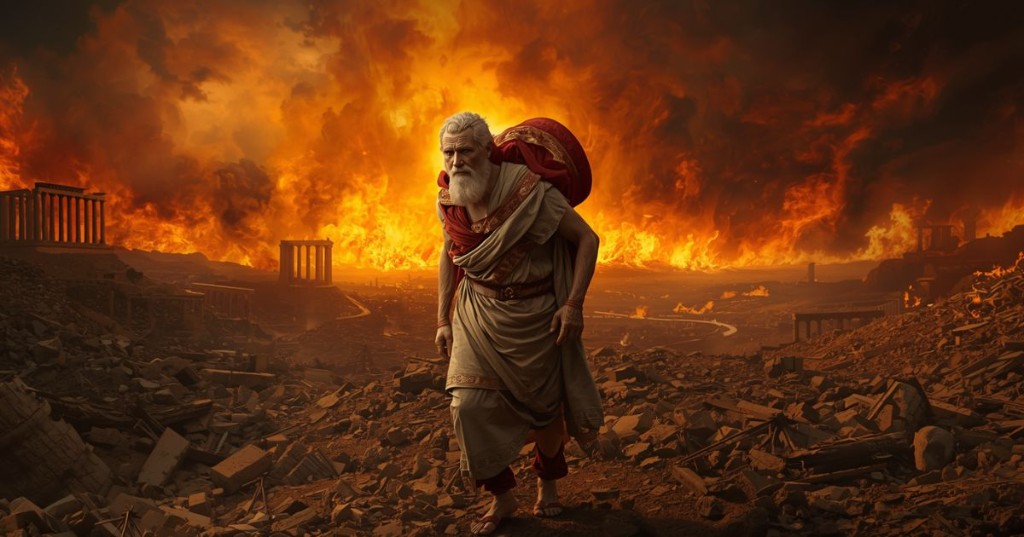
Aeneas lands at Cumae and climbs to Apollo's temple to consult the Sibyl, Deiphobe, who speaks for the god in terrifying bursts of prophecy. She warns that Italy awaits but brings worse wars than Troy: a new Achilles, a hostile queen, and rivers running red. Aeneas answers that he is already inured to suffering and asks only to descend to the underworld to see Anchises. The Sibyl explains the rules: find the golden bough in the forest, bury the unburied dead, then enter through Avernus with proper sacrifices. Aeneas obeys. Venus sends doves to guide him to the bough; the Trojans cremate Misenus with full honors; then priest and prince descend past Care, Death, and Sleep at the gates, cross Charon's ferry with the sacred branch, drug Cerberus, and walk the roads of the dead.
The underworld is a geography of consequence. Unburied souls wait a hundred years on the shore; suicides grieve in the Myrtles; warriors from Troy greet Aeneas, while Greeks flee his arms even in death. Palinurus begs burial and learns his name will mark a future place. Dido appears among lovers wounded by passion. She will not speak or even look at Aeneas. He weeps and protests that the gods compelled his departure, but she turns to Sichaeus, making clear that some wounds outlive explanation. The scene is among the poem's cruelest: duty may be justified and still unredeemable in the eyes of the harmed.
Beyond punishment fields and Tartarus, the Sibyl leads Aeneas to Elysium, where Anchises waits among the blessed. Father and son try to embrace; the shade slips through his arms three times like wind. Anchises then explains the soul's origin in cosmic fire, purification after death, and reincarnation through Lethe. To strengthen Aeneas for Italian wars, he parades the future Romans: Silvius, Romulus, the kings and consuls, Scipio, Cato, and the line culminating in Augustus. He shows Marcellus, radiant and doomed, and grieves the youth Rome will lose. The vision reframes Aeneas' private exile as national foundation. He returns through the gate of ivory, leaves the dead, and sails to Caieta as the living world reclaims him.
Book 6 is the poem's spiritual center. Aeneas cannot fight for Italy until he faces what he left behind and sees what his suffering will build. The Sibyl teaches preparation: ritual, burial, and credentials matter before forbidden journeys. Charon enforces boundaries; the bough purchases passage. Dido teaches that moral accounting in the afterlife may refuse the speaker a hearing. Anchises teaches that destiny is larger than personal happiness, yet personal happiness still matters, as the lament for Marcellus proves. Aeneas descends as a son seeking counsel and ascends as a founder carrying history in his chest, ready for the wars Latinus' welcome will not prevent.
The poem's architecture in Book 6 rewards close reading of procedure. Daedalus' temple doors display mythic crimes and crafts, reminding Aeneas that art and suffering are intertwined before he even asks the Sibyl for guidance. Her possessed speech under Apollo lists Italian wars with terrifying specificity, and Aeneas' reply is stoic: he has suffered worse. That exchange sets tone for the entire descent: not curiosity tourism but disciplined inquiry. Misenus' death by Triton's envy requires a funeral equal to a hero's, with washing, incense, trumpet tomb, and Corynaeus' purification. Only then does the golden bough yield to Venus' doves, as if piety unlocks access.
Inside the gates, Virgil catalogs psychological and political torments as physical geography. The elm of dreams, phantom monsters Aeneas must learn not to strike, Charon's refusal and concession, the unburied waiting century on the bank, suicides in myrtle shade, Tartarus with its transparent justice and eternal punishments for betrayers and tyrants: each scene asks what kind of state the living are building above. The Fields of Mourning make erotic loss eternal. Dido's refusal to engage is the antithesis of epic reconciliation; she restores agency by denying him even narrative closure. Deiphobus recounts Helen's treachery, proving the underworld is also a archive of betrayal.
Elysium reverses tone without erasing seriousness. Musicians, athletes, priests, and patriots dwell in gentle light while Anchises surveys souls waiting for rebirth at Lethe. The cosmology speech unites heaven, earth, water, and fire in one animating spirit, then explains purification and return to bodies through time. The pageant of Romans gives names to virtues Aeneas must embody indirectly: law, sacrifice, delay, courage, and tragic loss in Marcellus. Anchises' final instructions on Latin customs and wars translate vision into policy. The ivory gate departure leaves ambiguity about how much was dream, yet Aeneas returns to ships and burial of Caieta as a man who has seen the cost and scale of his mission. Book 6 makes internal preparation as necessary as external alliance, and no Italian battle can be fought well until this reckoning is complete.
Virgil understood something we've forgotten: the difference between being eager and being ready. In our culture of instant everything, we've lost respect for preparation time. We want the promotion without building the skills, the relationship without doing the emotional work, the business without understanding the market. But Aeneas can't just waltz into the underworld, he needs the golden bough, he needs to honor his obligations, he needs spiritual preparation. Skip any step and he either gets denied entry or gets destroyed by what he finds. This isn't ancient superstition; it's practical wisdom. Think about the people you know who rushed into major life changes, bought houses they couldn't afford, married too quickly, started businesses without market research, had kids before they were emotionally ready. The pattern is always the same: the descent is easy, the building is hard. Our economy profits from our impatience, selling us shortcuts and quick fixes. But real transformation has always required what Virgil called 'the golden bough', that specific preparation that can't be faked or skipped. The question isn't whether you're brave enough to take the leap. The question is whether you're disciplined enough to do the groundwork that makes the leap meaningful rather than destructive.
Explore this chapter with AI to uncover deeper meaning and practical takeaways.
AI Discussion