
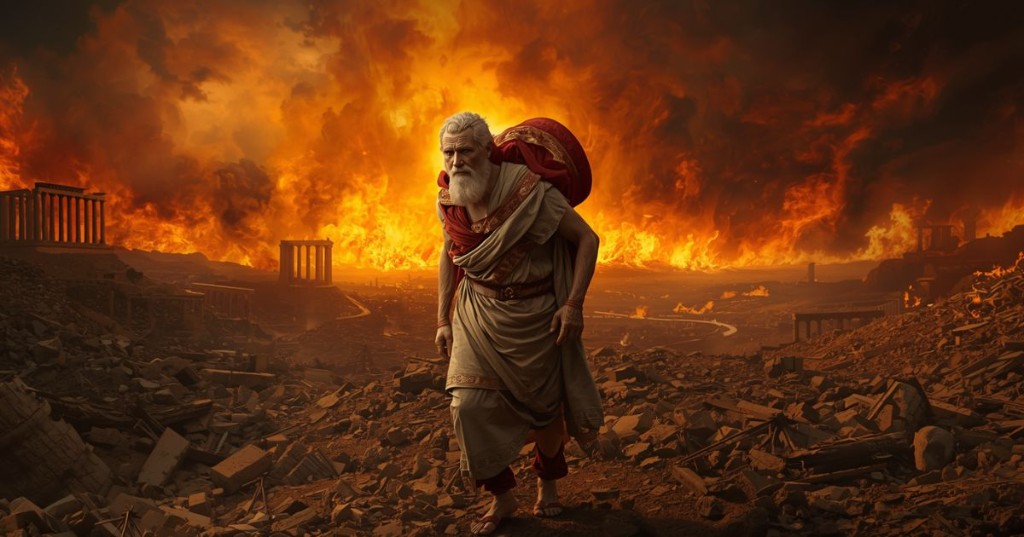
Aeneas leaves Carthage and sails toward Italy, but a storm drives him to Sicily, where King Acestes welcomes the Trojans. The timing is painful and providential: it is the anniversary of Anchises' death, and Aeneas decides to honour his father with funeral games rather than rush past grief. The competitions are elaborate and public. There are ship races, foot races, boxing, and archery, each with prizes carefully assigned so winners are crowned but no one is publicly humiliated beyond what honour requires. Virgil lingers on the details because these games are not mere entertainment. They knit a wandering people into a community, display leadership under observation, and convert private mourning into shared ritual. Aeneas presides as judge and host, managing envy as carefully as he manages the races. When Nisus trips to help Euryalus win, when Gyas throws his pilot overboard in rage, when Entellus knocks Dares senseless, the poem shows how competition exposes character under pressure.
While the men compete, Juno has not forgiven Troy. She sends Iris disguised as an old woman to the Trojan matrons, who are exhausted after seven years of exile and terrified of another sea crossing. Iris speaks as Beroe and claims Cassandra's authority in a dream, urging them to burn the fleet and end the voyage in Sicily. The women seize fire from Neptune's altars and torch the ships. Ascanius rides in from the boys' cavalry display and shames them by revealing his face; Aeneas arrives with the men.
Jupiter answers Aeneas' prayer with a miraculous storm that saves most of the fleet, though four ships are lost. The crisis forces a leadership decision Aeneas has postponed: not everyone can continue. Nautes advises him to leave the weary, the fearful, and those unfit for war with Acestes. Anchises appears in a dream and confirms the plan. Aeneas founds a city for those who stay, names it after Acestes, and sails on with the fighting men.
Before departure, Venus, fearing Juno's malice at sea, appeals to Neptune. The sea god grants safe passage for the Trojans but demands a price: one life for the many. Palinurus, the vigilant pilot who refused Sleep's trick once already, is overcome and falls overboard. Aeneas takes the helm himself and grieves, learning again that even divine protection has costs. The chapter balances ceremony and catastrophe. Funeral games honour the dead and train the living; ship-burning reveals fracture within the exiled nation; strategic settlement acknowledges different capacities among followers who once seemed united. Aeneas moves from Carthage's private tragedy toward Italy's public wars, but first he must accept that leadership means choosing who continues and who receives a different future.
The pattern is strategic retreat without abandonment. Aeneas does not condemn the women who burned the ships as mere rebels. He reads exhaustion, fear, and manipulated despair, then builds a permanent home for those who cannot face another ocean. The games showed how to channel rivalry into honour; the fire showed what happens when unmet needs explode; the colony at Acesta shows how a leader can honour limits while keeping the mission alive. Palinurus' death reminds us that collective survival often requires individual sacrifice, sometimes chosen, sometimes imposed. Book 5 ends with the fleet moving toward Italy under Neptune's promise, lighter in numbers but clearer in purpose, carrying men who accept war ahead while others secure peace behind.
Virgil's narrative patience in the games matters for how we read leadership. The ship race is not a single winner-take-all sprint but a sequence of decisions under pressure: Gyas hurls his cautious pilot Menoetes overboard; Sergesthus wedges his galley and shatters oars; Mnestheus rallies his crew with memory of Troy; Cloanthus prays to sea gods and wins by divine push at the mark. Each episode teaches that victory mixes skill, temper, luck, and piety. Aeneas compensates losers with gifts because public honour is currency in a refugee fleet.
The foot race gives Nisus and Euryalus their famous friendship test when Nisus slips in blood and trips a rival so the boy can win, earning Aeneas' balanced judgment. Boxing pits aged Entellus against brash Dares until the old champion kills the prize bull for Eryx and retires the gloves. Archery releases the dove by mistake and turns into omen when Acestes' arrow flames in the sky, which Aeneas reads as divine favor rather than scandal. Ascanius' mock cavalry drill previews Roman military pageantry and shows the next generation performing unity while the mothers prepare betrayal.
The ship-burning sequence is equally deliberate. Iris does not appear as a blazing goddess; she wears an old woman's face and speaks the language of exhausted loyalty, invoking Cassandra and Neptune's altars to make destruction feel sacred. Pyrgo alone names the deception, but momentum wins. Fire spreads through seams even after the women scatter in shame, and only Jupiter's storm limits damage. Aeneas' response combines ritual and policy: he tears his robe, prays, hears Nautes, sees Anchises, founds walls and senate for Acesta, builds Venus' temple on Eryx, and honors his father with annual rites before sailing.
Venus' appeal to Neptune is maternal diplomacy, and the sea god's bargain is unsentimental. Sleep defeats Palinurus not through cowardice but through divine drugging after he has already proven alert. Aeneas steers himself through Sirens' coast and names faith's cost aloud. Book 5 therefore trains readers to watch how communities celebrate, fracture, regroup, and pay for passage, long before Italian spears meet Trojan shields.
Aeneas faces a leadership paradox that plays out in every workplace, family, and community: sometimes the most loyal thing you can do is let people quit. The Trojan women who burn the ships aren't lazy or disloyal, they're communicating the only way they know how that they've hit their limit. Seven years of uncertainty, loss, and endless movement has broken something in them that can't be fixed by pushing forward. Modern leaders often miss this signal. We see someone struggling and double down on motivation, training, or consequences. We mistake force for leadership. But Aeneas learns something crucial: not everyone is built for the same journey, and that's not a character flaw. Some people thrive on uncertainty and risk; others need stability to function. Some can handle delayed gratification; others need immediate results. The women who stay in Sicily aren't failures, they're people whose strengths align with building and nurturing rather than conquering and exploring. The tragedy isn't that they wanted to stop; it's that it took burning ships to communicate it. How many relationships, teams, and families could be saved if we learned to recognize capacity limits before they turn into destructive behavior? What if we created honorable exits instead of forcing everyone onto the same path?
Explore this chapter with AI to uncover deeper meaning and practical takeaways.
AI Discussion