
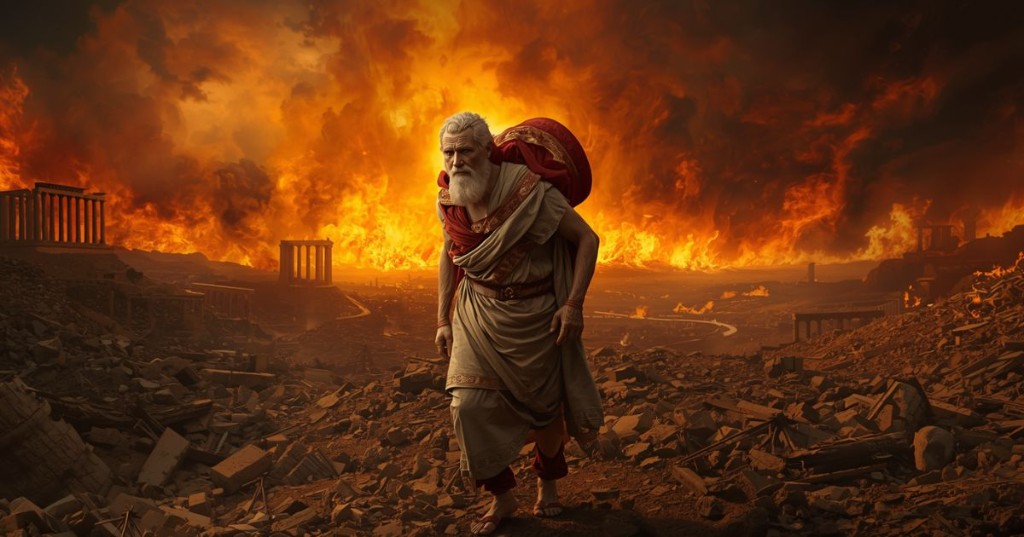
Book 2 is Aeneas's painful answer to Dido's question. Before the court he warns that retelling Troy will reopen wounds even Greeks wept to hear, then narrates the final night of a ten-year siege. The Greeks feign retreat, hide soldiers inside a wooden horse, and leave Sinon behind to complete the lie. Laocoon urges the city to trust no gift from enemies, hurls a spear into the hollow flank, and is destroyed with his sons by sea serpents the crowd reads as divine punishment for striking the offering. Sinon plays victim, swears by altars, and claims Minerva demands the horse be brought inside Troy's walls. Cassandra prophesies doom; the crowd celebrates anyway. At night the fleet returns from Tenedos, Sinon opens the belly, and Greeks pour into a city asleep with wine.
Aeneas moves from witness to combatant. Hector's ghost orders him to flee and carry Troy's household gods; later Venus unveils the gods themselves tearing down walls and commands escape a second time. He rallies companions, disguises them in captured Greek armor, and briefly turns confusion into slaughter until Trojans mistake them for enemies and crush the party at Pallas's shrine. He sees Cassandra dragged away, Pyrrhus murder Priam on the altar, and Helen hiding in Vesta's porch. Rage nearly drives him to kill Helen, but Venus shows him the futility of punishing a woman when heaven has decreed Troy's end. The lesson is brutal: individual vengeance cannot reverse collective fate.
Anchises at first refuses exile, preferring death among ruins to dishonorable flight. Aeneas argues, threatens suicide, and is stopped only when omens crown Ascanius with harmless flame and a shooting star points toward Ida. The old man relents, and pietas becomes physical labor. Aeneas carries Anchises on his shoulders, leads Iulus by the hand, and tells Creusa to follow through dark streets filled with fire and mistaken armies. She vanishes in the crush. He searches the burning city, calls her name through Greek-occupied temples, and finds only her ghost. She forbids further grief, promises him Italy, a royal bride, and Ascanius's future, then slips from his arms like wind.
By dawn he leads a growing band of exiles from the hill, loaded with treasure and gods. The book moves from collective catastrophe to personal sacrifice: a city dies, a marriage ends, and leadership becomes saving remnants for a future none can yet see. Virgil analyzes how deception exploits exhaustion, how timed omens can silence accurate dissent, and how duty to the living overrides the romance of dying with the walls. Sinon's performance matters because Troy wants the war to be over. Laocoon matters because he names the trap before theology is weaponized against him. Creusa's ghost matters because it redirects private mourning into public mission.
Aeneas wanted heroic death; heaven demands refugee life. That conversion defines the hero Rome will claim as ancestor. Dido listens as witness and host, unaware that the story she demands will deepen the attachment Jupiter's plan will later force Aeneas to betray. Virgil lingers on details that make Troy's fall intelligible as human failure rather than mere fate. The horse is debated in council; voices of caution exist before theology turns them into rebels. Once battle begins, the poem refuses a single heroic lane: Aeneas charges, mourns, argues with parents, nearly murders Helen, and finally obeys ghosts. Each episode asks what should be saved when a state dies.
Priam's slaughter shows royalty stripped to flesh; Cassandra's capture shows truth ignored; Coroebus's death shows improvised courage wasted by confusion. The book's emotional arc moves from collective delusion to family triage. By the time Creusa speaks, readers understand that Aeneas's mission is not revenge but transmission: carry gods, father, son, and name toward a shore he has never seen, even when every visible landmark is flame. For Dido's court the tale functions as entertainment and intimacy; for Aeneas it is testimony that reopens trauma. Virgil thus prepares Book 4 emotionally: the same voice that persuades a queen to pity will later be accused of coldness when duty calls. The fall of Troy is not only history here.
It is courtship, identity, and the price of surviving when one's city becomes a story told in someone else's hall. Sinon deserves emphasis as a social engineer. He understands that credibility grows from wounded pride, named enemies, and religious language mortals fear to contradict. Laocoon deserves emphasis as the ignored risk officer of Troy. His spear strike is technically correct and politically fatal because the city wants the war to be over. Aeneas's night fighting shows how courage without coordination becomes suicide with better lighting. The chapter's final image, exiles climbing Ida with gods and gold, turns defeat into mobile statehood. Troy ends as geography but survives as obligation carried on one man's back and one boy's uncertain steps.
The Trojans weren't idiots - they were worn down by a decade of war and desperate for it to end. This reveals something crucial about human psychology that predators understand perfectly: exhaustion makes us vulnerable to believing beautiful lies. The wooden horse worked because it gave the Trojans exactly what they wanted to hear - the war is over, the gods approve, you can finally rest. Modern scammers use the identical playbook. They target people who are emotionally or financially drained, then offer solutions that sound too good to be true but come with elaborate explanations for every concern. The romance scammer targets the lonely widow with the perfect love story that just happens to require money transfers. The MLM recruiter finds the struggling single mom and shows her exactly how she'll make six figures working part-time. The predatory lender approaches the family facing foreclosure with the loan that will save everything. In each case, there's always a Laocoon - the friend, family member, or gut instinct throwing spears at the beautiful solution. But we ignore them because the lie feels better than facing reality. The pattern isn't about intelligence; it's about recognizing when our desperation makes us vulnerable and learning to trust the warnings over our wishes.
Explore this chapter with AI to uncover deeper meaning and practical takeaways.
AI Discussion