
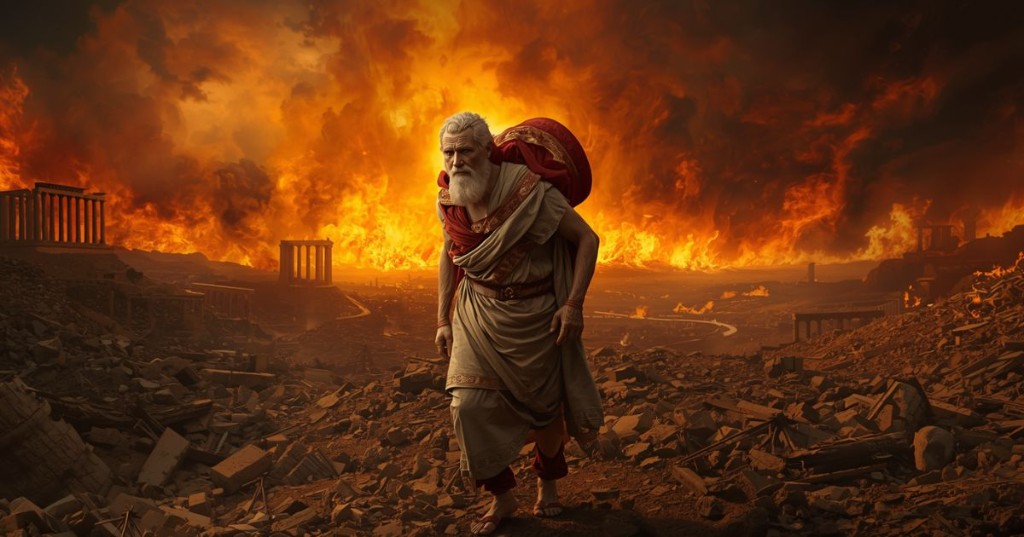
Book 1 opens with Virgil's famous declaration: arms and the man, forced by fate and Juno's hatred, bearing long labors before Rome can rise. The Muse is invoked to explain why heaven persecuted a man famed for justice. Carthage appears immediately as Juno's favored city and Rome's future rival, so the reader understands that present shipwreck sits inside a centuries-long quarrel of powers. After seven years at sea, the Trojan fleet nears Italy when Juno, still burning from Paris's judgment and fearing prophecy, bribes Aeolus to unleash a storm that scatters and sinks ships. Winds tear sails, Orontes drowns before Aeneas's eyes, and the hero wishes he had died with comrades under Troy's walls rather than endure exile without end.
Neptune restores order, not from love of Troy but from offended sovereignty over the sea. He rebukes the winds, calms the waters, and guides the battered fleet into a hidden Libyan harbor where seven ships survive. On shore Aeneas hunts stags to feed his men, shares Acestes' wine, and speaks encouragement he does not fully feel. His public steadiness conceals private despair, establishing leadership as performed resilience under catastrophe. Meanwhile Venus climbs Olympus and accuses Jupiter of allowing her son to be barred from every coast while lesser Trojans like Antenor found kingdoms. Jupiter answers with the epic's master plan: Aeneas will reach Italy, tame nations, and found Rome; Ascanius will reign; even Juno's rage will eventually serve empire. He sends Mercury to secure Trojan welcome in Carthage.
On earth Venus meets her son disguised as a huntress. She tells him where he has landed, narrates Dido's flight from murderous Pygmalion and the bull-hide founding of Carthage, and reveals that his scattered ships have already arrived safely. She wraps him in mist so he can enter the busy city unseen. What he sees astonishes him: Tyrians raising walls, drafting laws, building theaters, and working with bee-like discipline. Against that rising order he murmurs envy and grief, a homeless prince watching strangers possess the stability he lacks. In Juno's temple he finds murals of the Trojan War, stops before painted Hector and Priam, and weeps at foreign eyes witnessing his nation's humiliation.
Dido enters like Diana leading nymphs, administers justice from a throne, and receives Ilioneus's embassy before Aeneas reveals himself. The envoys plead for refuge, describe their lost leader, and ask only to repair ships for Italy. Dido offers land, alliance, and even wishes the storm had driven Aeneas himself to her shore. When the mist clears, Venus's son appears in radiant beauty. He thanks the queen, praises her mercy, and embraces reunited captains while Dido studies his face with growing wonder. She recognizes a fellow exile who built authority from ruin, invites him to feast, and sends rich supplies to the ships.
Venus, fearing Juno's city, plots a softer invasion. She sends Cupid disguised as Ascanius to the banquet while the real boy sleeps under myrtle in Idalium. Gifts from Troy dazzle the court, but Dido cannot take her eyes from the false child. Cupid sits in her lap, breathes poison into her heart, and replaces old grief with new fixation on Aeneas. Wine, music, and Iopas's science songs fill the hall; Dido questions the guest about Priam, Hector, and every detail of the war until she finally demands the full tale of Troy's fall and the seven years of wandering since. Hospitality has become narrative intimacy and the prelude to passion. The book establishes the poem's central tensions: pious leadership under divine politics, exile's humiliation before another people's rising walls, and the dangerous bond that forms when refugees meet a queen whose mercy is also loneliness. Aeneas has found harbor, but Dido's request means memory will steer the voyage as forcefully as wind or fate. Readers leave Book 1 with Carthage prospering, Troy remembered on foreign walls, and a queen already bound to a guest who cannot stay.
Throughout, Virgil balances spectacle with policy. Juno's storm displays cosmic enmity; Neptune's trident restores hierarchy among elements; Mercury prepares diplomatic reception before Aeneas ever speaks to Dido. The hero's piety appears in small acts, rescuing household gods, feeding comrades, honouring envoys, and praising a queen's mercy even while envy stings him before rising masonry. Roman readers were meant to see in Carthage both wonder and warning: civilization can bloom quickly on African shore, yet this hospitality will collide with Italy's calling. Survival here is not only reaching land but reading the host, accepting help without surrendering the mission, and letting a story told at night bind hearts as firmly as any oath at the altar. Even the simile of bees links civic virtue to collective labor, hinting that Rome too must be built stroke by stroke. Aeneas is not yet that founder; he is a guest learning what he lacks. That humility makes his later betrayals more complicated, because Carthage genuinely saves lives before love complicates duty.
Virgil understood something we've forgotten in our bootstrap culture: survival often requires calculated vulnerability. Aeneas doesn't just stumble into Dido's court begging, he observes first, reads the room, then reveals himself strategically. This ancient wisdom directly challenges our modern myth that asking for help equals weakness. In working-class communities, this tension runs deep. Pride keeps families from accessing food assistance even when children go hungry. Workers suffer through dangerous conditions rather than report safety violations that might cost jobs. Single parents burn out completely rather than admit they're drowning. Yet the most successful people in these same communities, the ones who build lasting stability, master strategic vulnerability. They know which neighbors will help during emergencies, which bosses respond to honest communication about struggles, which family members can be trusted with real problems. The key isn't avoiding vulnerability but timing it right. Aeneas teaches us to develop what we might call 'vulnerability radar', the ability to read how someone handles others' struggles before exposing our own. Watch how your supervisor treats employees who admit mistakes. Notice how potential friends respond when others share problems. This isn't cynical calculation; it's survival intelligence. In a world where one wrong revelation can cost jobs, relationships, or safety, knowing when and how to ask for help becomes a crucial life skill.
Explore this chapter with AI to uncover deeper meaning and practical takeaways.
AI Discussion