
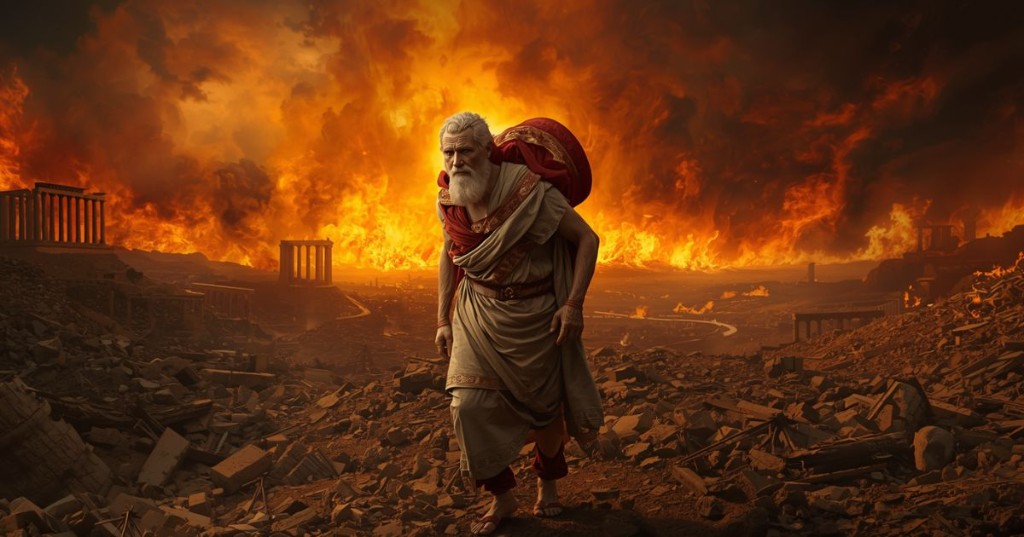
Book 3 continues the banquet narrative with years of wandering after Troy's fall. Near Ida the Trojans cut sacred timber, build a fleet, and sail with household gods while spring still young. Thrace promises friendship until Aeneas uproots myrtle that bleeds black blood and hears Polydorus accuse the king who murdered him for gold. Funeral rites follow, then Delos, where Apollo commands them to seek the ancient mother of their race. Anchises interprets Crete from Trojan genealogy; they found Pergamus there, legislate, and marry until plague and withered fields expose the error. In dream the penates appear in light, name Hesperia, and order Italy. Anchises recalls Cassandra's ignored prophecy and accepts correction.
Further trials refine the lesson. Harpies foul every meal on the Strophades until Celaeno prophesies famine requiring plates to be eaten. At Buthrotum, Helenus and Andromache have built a miniature Troy beside a fabricated Xanthus; her fainting reunion with Aeneas shows how war's survivors carry names like open wounds. Helenus gives elaborate navigation advice, warns against Italian shortcuts, and urges reverence for Juno. Gifts and crews enlarge the fleet before departure. Achaemenides, left by Ulysses, begs rescue from Polyphemus; the Cyclops roars from shore as oars flee volcanic Sicily. They pass Charybdis, glimpse Italy, perform rites at Cumae's approaches, then reach Drepanum where Anchises dies.
Aeneas closes by telling Dido that prophets named famine and war but concealed this private loss, the greatest of his labors. From Sicily's grief the storm of Book 1 will drive him to her harbor. The book is therefore a study in misread signs, sunk-cost settlements, and the discipline of turning back when gods, plague, and bleeding earth contradict a chosen shore. Leadership means burying the dead honestly, performing rites, and sailing again before pride turns a mistaken harbor into a graveyard. The episodic structure mirrors refugee experience: brief safety, sudden horror, partial guidance, renewed departure. Polydorus warns against trusting wealth to tyrants; the Delian oracle warns against literalism; Helenus warns against geographic shortcuts and neglected ritual. Even success at Buthrotum is bittersweet, a copied Troy that comforts Andromache while reminding Aeneas that imitation is not arrival. Palinurus, Aetna, and Polyphemus add mortal terror to divine obscurity. When Anchises dies, the wanderers lose their living memory of homeland. Aeneas buries him, resumes command, and sails toward the storm that opens the poem. Book 3 proves that destiny can be true while directions remain unclear, and that the cruelest losses are sometimes the ones no prophet bothers to mention. Dido hears this book as the middle of a confession whose end will implicate her harbor. That narrative frame matters: Aeneas is not omniscient, only persistent. His authority comes from endured error, not flawless navigation.
Aeneas's father Anchises hears 'seek your mother earth' and immediately thinks Crete because that's where their family tree points. He's not stupid, he's human. We all filter new information through existing frameworks, especially when we're desperate for direction. In Virgil's time, displaced people clung to ancestral connections for identity and legitimacy. Today, we do the same thing with career advice, relationship guidance, even medical instructions. When your boss says 'take more initiative,' you hear it through your experience of previous jobs. When your doctor says 'reduce stress,' you interpret it based on what you think stress means. The problem isn't that we make assumptions, it's that we don't test them. Anchises was the respected elder, so nobody questioned his interpretation until plague forced a reckoning. In our world, expertise and confidence often shut down the clarifying questions that could prevent costly mistakes. The Trojans lost years building in the wrong place. How many of us have lost time, money, or opportunities because we were too embarrassed to say 'Wait, can you be more specific?' The ancient pattern persists: we'd rather act on uncertain understanding than admit we need clarification.
Explore this chapter with AI to uncover deeper meaning and practical takeaways.
AI Discussion