
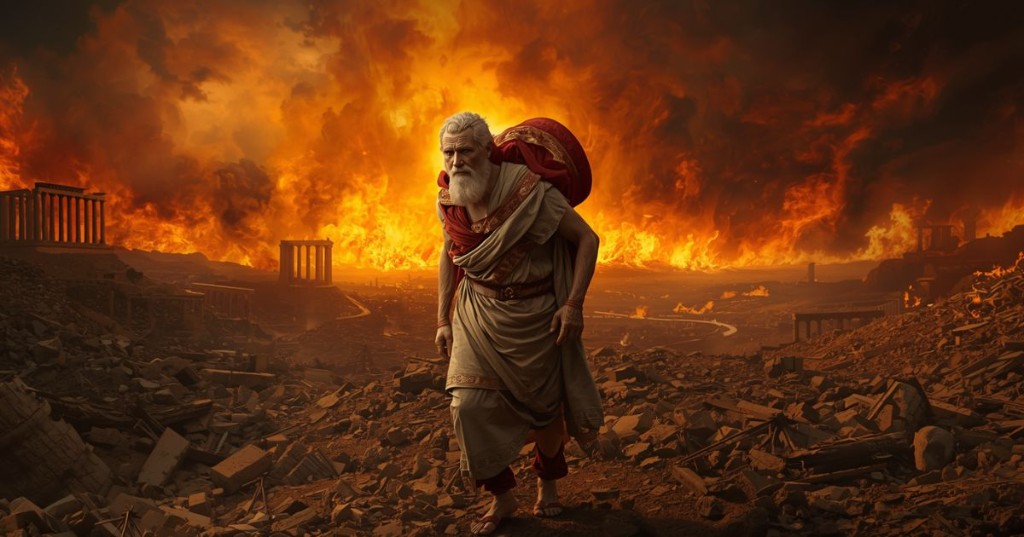
Morning after the slaughter, Aeneas erects a trophy from Mezentius's armor on an oak trunk and tells his men that one enemy is gone while Turnus remains. He then turns from triumph to grief, preparing a funeral procession for Pallas that is as elaborate as a prince's death demands. Evander's son is carried toward Arcadia with captured prisoners, spoils, horses, and weeping attendants while Aeneas restrains his tears because the war still requires command. Latin envoys arrive under olive branches asking for a truce to bury the dead. Aeneas grants it generously, blaming the war on Turnus and offering peace if the rival will fight him alone.
He reminds them that he did not seek this war and that Latinus broke the first offer of alliance when he promised Lavinia to Turnus instead of the stranger fate had sent. For twelve days both sides gather wood, burn pyres, and mourn in parallel along the Tiber. The fields smell of smoke and sacrifice. Prisoners destined for Pallas's pyre walk in the procession, and captured arms clatter on the bier while Acoetes, the old attendant, beats his breast and cannot keep pace with grief. Evander receives his son's body in Pallanteum and collapses in silent grief before cursing the war and demanding Turnus's head as the only payment left. Inside Laurentum, Latinus convenes the council because Diomedes has refused aid and the gods clearly favor the Trojans.
He offers land, alliance, and even the bride if the war can end. Venulus repeats Diomedes's warning that war with Aeneas brought the Greeks only misery and that Latin peace is wiser than Latin pride. Drances, who hates Turnus, attacks the prince publicly, blaming him for Latin losses and daring him to face Aeneas in single combat. Turnus answers with fury, listing his deeds and refusing to be lectured by a man who fights with words alone. He accepts the duel in principle, then learns that Aeneas is already advancing on the city.
The council dissolves into alarm. Turnus deploys cavalry under Camilla, the Volscian warrior raised in the wild and devoted to Diana. She asks to meet the Trojan horse herself while Turnus prepares an ambush in a wooded pass. Diana, knowing Camilla is doomed, sends her nymph Opis with a bow to avenge any killer. Diana recounts how Metabus saved the infant Camilla across the Amasene with a spear and cork bark, raising her in the wild until she became the Volscians' terror. The cavalry battle swings back and forth until Camilla dominates the field.
She kills enemy after enemy with spear, axe, and bow, inspiring terror and admiration at once. Tarchon shames his Tuscans back into the fight by snatching an enemy rider from his horse in full view of both armies, a raw display of leadership by example. Her brilliance becomes blindness when she sees the priest Chloreus in glittering Phrygian armor and chases him for spoils, ignoring the larger fight. Before that fatal chase she humiliates Tuscans, outrides male warriors, and mocks Aunus until his trickery lures her off her horse and into the open where Aruns waits.
Aruns stalks her from hiding and drives a javelin into her breast. Opis immediately kills Aruns from the air, fulfilling Diana's command that Camilla's killer would not escape. Camilla dies with a message for Turnus on her lips, asking Acca to tell him the city needs him. Her Volscians break. The Latins flee toward the walls in chaos. Turnus abandons his ambush and rushes back as Trojan and Tuscan forces pour through the pass he meant to seal. Acca delivers Camilla's last message, and the Latin lines buckle as women on the walls watch their cavalry scatter toward gates too narrow for panic.
Night ends the day's fighting with both armies encamped and the city still unbroken, but the psychological balance has shifted. Aeneas has honoured the dead without losing momentum. Latin politics are fractured. Camilla's valor is spent. Turnus is running out of room, allies, and time. The chapter shows war's double ledger: funeral rites and council debates on one side, cavalry charges and fatal fixation on the other. Grief, truce, and rhetoric cannot pause violence for long when leaders still chase trophies, whether on the battlefield or in the senate.
Amata and Lavinia appear on the walls with prayers to Pallas's temple while the city trembles between peace talks and another charge of hooves. The book ends at dusk with armies facing each other across a narrow space, every soldier knowing that the next sunrise may not bring another chance to bury the dead before fighting again. Book 11 proves that truce can still honour the dead without ending the war, and that one warrior woman's fixation on gold can collapse an army faster than any lost debate in council.
Camilla's story reveals something unsettling: the very qualities that make us successful can destroy us if we're not careful. She wasn't killed by a superior warrior, she was killed by her own excellence turned toxic. Her legendary focus, the trait that made her unbeatable in battle, became tunnel vision that made her vulnerable to a coward's ambush. This isn't just ancient history. We see this pattern everywhere in working-class life. The nurse whose dedication to her patients makes her ignore her own health until she burns out. The mechanic whose perfectionism helps him do excellent work but also makes him miss deadlines and lose customers. The single parent whose fierce protectiveness keeps their teenager safe but also prevents them from developing independence. The construction worker whose pride in craftsmanship makes him the go-to guy for quality work but also makes him unable to delegate, limiting his ability to grow his business. Virgil understood something we often miss: our strengths aren't fixed assets, they're tools that can be used well or poorly. The question isn't whether to be focused, dedicated, protective, or proud of our work. The question is whether we can maintain enough self-awareness to know when these good qualities are starting to work against us. How do we stay excellent at what we do while avoiding the trap of excellence becoming obsession?
Explore this chapter with AI to uncover deeper meaning and practical takeaways.
AI Discussion